
How Cold Is Too Cold to Run? A Policy for High School Teams
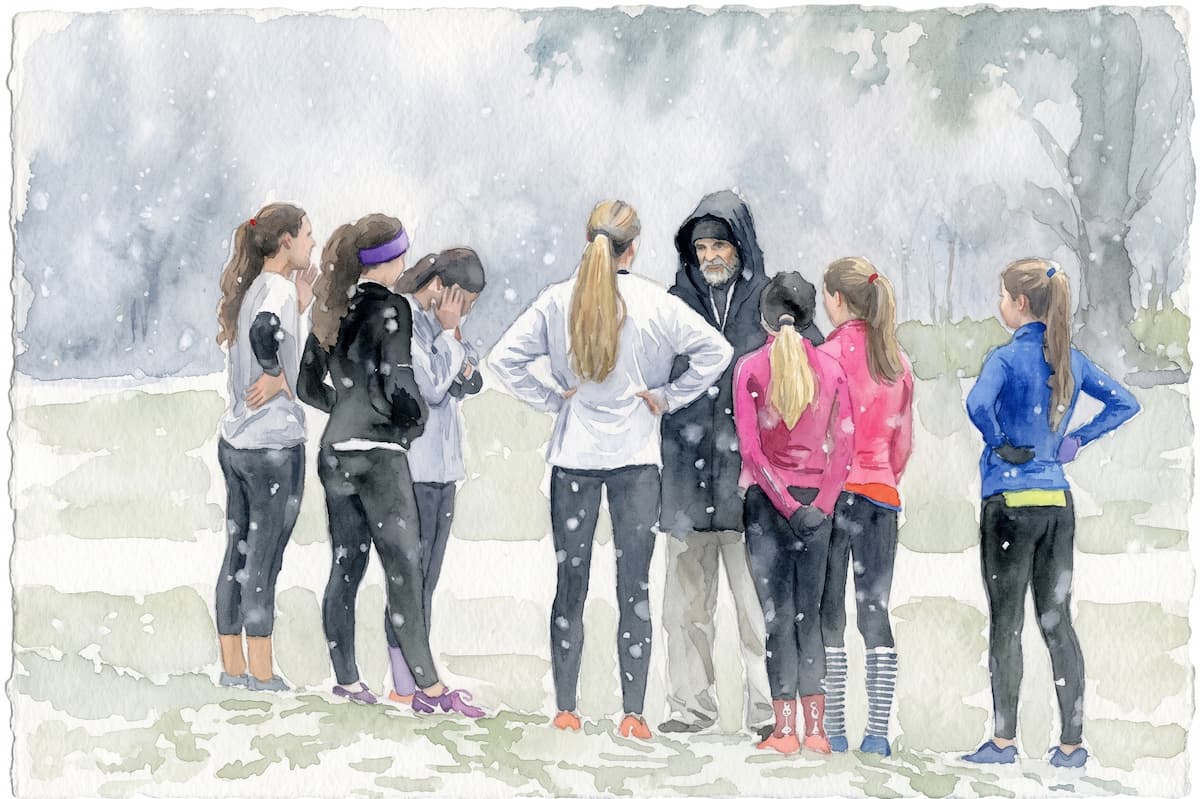
It is 6:15 on a January morning, the phone says the wind chill is 4 degrees, and thirty athletes are waiting to find out whether practice is outside. You have about ninety seconds to decide, and whatever you decide, somebody’s parent will disagree with it.
That is the wrong moment to be forming an opinion about cold weather.
The short version. Practice outdoors above 20°F wind chill. Between 20°F and 0°F, shorten the session, cover all exposed skin, move the warm-up indoors and cut the long intervals. Below 0°F, go inside. Any ice on the running surface means inside regardless of temperature. Write those numbers down in November and send them to your athletic director before December.
The thresholds matter less than the fact that they exist in writing. What follows is the policy I use, the reasoning behind each line, and one thing about wind chill that changes how you should read the number on your phone.
The policy, in one table
| Wind chill | What we do |
|---|---|
| Above 20°F | Practice outdoors as normal. |
| 20°F to 0°F | Shorten the session. Cover all exposed skin. No long intervals. Warm-up starts indoors. |
| 0°F to −10°F | Indoors. |
| Ice on the surface | Indoors regardless of temperature. |
These are more conservative than a general population cold weather chart, and the next section explains why they should be.
The Winter Training Block
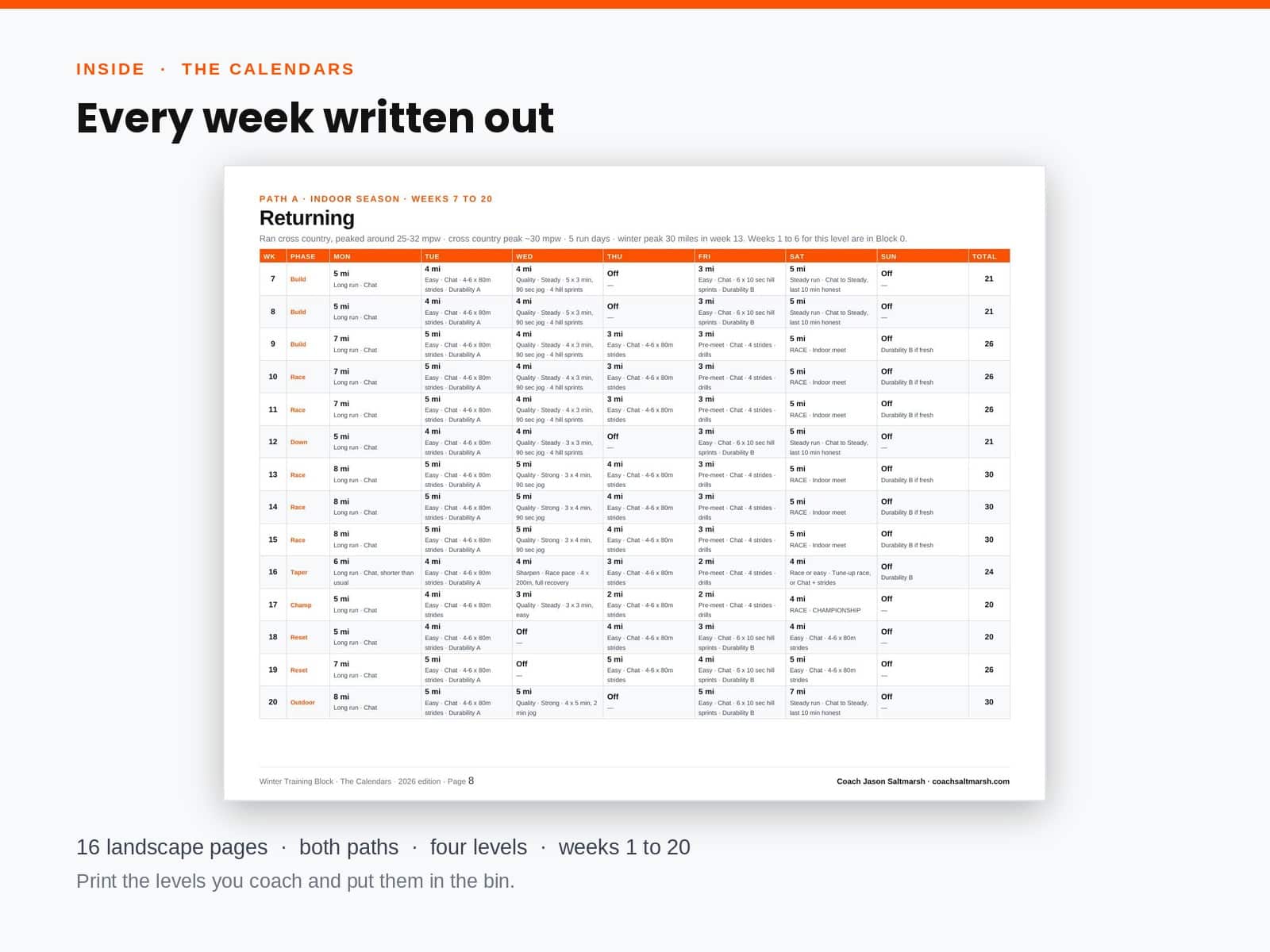
Two paths depending on whether your program races indoors, four levels set by cross country peak week, and every session written out. Sixteen landscape pages of calendars, plus the Coach’s Guide, the Winter Kit and the Event Guide.
Get the Winter Training Block — $59Instant download · 30-day guarantee
Why it has to be written down
The NFHS makes this point better than I can. Predetermined school policies bring neutrality to the decision and help everyone anticipate it.
Read that again with a specific parent in mind. A threshold you wrote in November is a rule that applies to everybody. A threshold you invent at 6:15 on a Tuesday is an opinion, and an opinion is something a parent can argue with, escalate, or compare unfavourably to what the soccer coach did last week.
The written policy is not really about the weather. It is about removing you from the position of making a contested judgement call in front of an audience, twice a week, all winter.
The thing the wind chill number does not tell you
This is the part almost nobody publishes, and it is the reason my thresholds sit where they do.
What the index actually measures
The wind chill temperature index you see on your phone is the 2001 model developed jointly by the National Weather Service and Environment Canada. It came out of human trials in Toronto, where twelve volunteers walked on treadmills in a refrigerated wind tunnel with thermal transducers on their cheeks, foreheads, noses and chins while researchers measured how fast their faces lost heat.
Three details from that description matter to you.
It models a person walking at about 3 miles an hour. It measures heat loss from exposed facial skin, and nothing else. And it assumes no sunshine, which is the one assumption that works in your favour on a bright afternoon.
What that means for a runner
Your athletes are not walking at 3 miles an hour. An athlete running 6:30 pace is moving at about 9 miles an hour, and when they turn into a headwind, their own speed adds to it. The air hitting their face is moving considerably faster than the wind the forecast measured.
Here is roughly what that does, using the same formula with running speed added to a 5 mph ambient wind.
| Air temp | Posted wind chill | Roughly what a runner meets |
|---|---|---|
| 30°F | 25°F | 19°F |
| 20°F | 13°F | 7°F |
| 10°F | 1°F | −6°F |
| 0°F | −11°F | −19°F |
Posted column is the official NWS wind chill at 5 mph wind. Right column applies the same 2001 formula with a 6:30 per mile pace added to the ambient wind. Treat it as directional rather than official. The index was not designed to be used this way, and no governing body publishes a runner-adjusted figure.
Six to eight degrees is not a rounding error. It is the difference between the top band of a policy and the middle one. It is also why an athlete comes back from a January tempo run colder than the forecast said they should be, and why the coach who checked the app feels like the kid is exaggerating.
The gap is widest on calm days, where the runner is generating almost all of their own wind. On an already windy day the difference narrows, because the underlying formula flattens out at higher wind speeds.
And it says nothing at all about fingers and toes
The index predicts frostbite risk for exposed facial skin. That is what the Toronto trials measured. It does not model the extremities.
Which is unfortunate, because in fifteen winters of high school coaching I have never once dealt with a frostbitten cheek. I have dealt with fingers that would not work, toes that stayed numb through fourth period, and ears that hurt for two days after a kid forgot a hat. The number on your phone is silent on all three.
Practical translation. Read the posted wind chill as the best case. Assume your athletes are five to eight degrees colder than it says, assume the number tells you nothing about their hands, and set your thresholds accordingly. That is the whole justification for the table at the top of this page.
Making the call
Three things turn a threshold into a working policy.
A time. The call is made by a fixed hour, every day, whether or not the weather is marginal. I use 1:00 p.m. because it gives families time to plan and it is before the buses matter. A policy with no decision time produces a coach checking an app at 5:50.
One channel, always the same. Team chat first, then email to families. The same two, in the same order, every time. Athletes who learn where to look stop texting you individually, which is the actual time saving.
One person. Name them. It should be you, or it should be the athletic director, and it should not be whoever happens to be in the building.
What changes when it is cold
Practising outdoors at 15°F is not the same session as practising at 45°F, even if the workout on paper is identical.
Double the warm-up. Cold muscle strains more easily. Start the routine indoors if you have a hallway. Never send anyone from a warm building straight into a workout, which is the single most common way January produces a hamstring.
They are dehydrated and they do not know it. Thirst perception drops substantially in the cold, and dry air increases water loss with every breath. Stress fluid at practice in January the way you do in August. Nobody does this, and it is free.
Cold air and airways. Exercise-induced bronchoconstriction is common in winter athletes and cold dry air is a trigger. An athlete with a prescribed rescue inhaler uses it 20 to 30 minutes beforehand. A buff or gaiter over the mouth genuinely helps by warming and humidifying the air. Symptoms usually settle within about 20 minutes indoors. If they do not, that athlete needs to see a doctor.
No long intervals below 20°F. Not because of the cold itself but because of what happens between reps. An athlete standing still in a sweat-soaked layer for three minutes of recovery gets cold in a way that running does not.
Do not put a stopwatch on anything. Prescribe by effort. A frozen 400 split tells you what the wind was doing, not what the athlete was doing.
Ice is a different decision
Cold is a judgement call. Ice is not.
Ice on the running surface means indoors, at any temperature, with no discussion. A cancelled session in January costs nothing in May. One stride on black ice ends a season, and it ends it in the least recoverable way, because a fall on ice injures ankles and wrists rather than producing the gradual overuse problems you are trained to spot.
This includes the descent on hill sessions, which is where the risk concentrates and where coaches most often decide it looks fine.
The thresholds above, the call time, the communication plan and the winter checklist on a single page you can put your own numbers into and send to your athletic director.
Comes as a PDF to print and post, and an editable version so you can change the numbers to match your school.
Get the cold policy templateSending it to your athletic director
Send it in November, before the first cold morning, with three sentences and nothing else.
Tell them these are the thresholds you intend to use, that they are more conservative than a general population chart because runners generate their own wind, and ask whether the school has an existing policy you should align to instead. That last question is the one that matters. Some districts already have something, and finding out in November is considerably better than finding out in January after you have sent families a different number.
Copy the school nurse or athletic trainer if you have one. They will not mind, and their name on the thread is useful the first time somebody questions a cancellation.
Common questions
How cold is too cold to run?
For a high school team, practise outdoors above 20°F wind chill, shorten and cover up between 20°F and 0°F, and go indoors below 0°F. Any ice on the surface means indoors regardless of temperature. Individual adults tolerate colder conditions, but a team policy has to protect the least prepared athlete on the roster.
Is the wind chill on my phone accurate for runners?
It is accurate for what it measures, which is heat loss from the face of a person walking at about 3 mph. A runner moving at 9 mph into the same wind meets meaningfully colder air, roughly five to eight degrees on a calm day. Read the posted figure as the best case.
What about frostbite on hands and feet?
The wind chill index does not predict it. The frostbite times published with the chart apply to exposed facial skin only. Gloves, a hat that covers the ears, and dry socks matter more than the number does.
Should athletes wear a mask or buff in cold air?
A buff or gaiter over the mouth warms and humidifies inhaled air and helps athletes prone to exercise-induced bronchoconstriction. It is worth having a few spare ones in the bin.
Can we still do a workout in the cold?
Yes, with two changes. Warm up longer and start indoors if you can, and avoid long intervals with standing recovery, because the standing is what gets them cold. Continuous efforts work better than broken ones below 20°F.
What if the school has no cold weather policy?
Write one, send it to your athletic director, and ask whether it should be adopted more widely. Most districts have nothing specific to running, and a coach arriving with a drafted policy is usually met with relief rather than resistance.
The rest of the winter
The cold policy is one page of a twenty-week block that runs from the last cross country race to the first outdoor meet. Two paths depending on whether your program races indoors, four levels, and a calendar for each.
Read the winter training guideKeep reading
- Winter training for high school distance runners. The full twenty weeks, both paths, four levels.
- How long should runners take off after cross country. What happens in the ten days before winter training starts.
- High school cross country training. The five gears, and the season this winter block feeds.
Sources
- NFHS, Guidelines for Competition in the Cold.
- National Weather Service and Environment Canada, Wind Chill Temperature Index, 2001. Human trials conducted at the Defence and Civil Institute of Environmental Medicine, Toronto.
- Office of the Federal Coordinator for Meteorological Services, Joint Action Group for Temperature Indices, wind chill chart and frostbite times for exposed facial skin.
- Exercise-induced bronchoconstriction in winter athletes: prevalence, triggers and management. American Academy of Allergy, Asthma and Immunology guidance.
This article is general coaching education, not medical advice. Cold weather policy should be confirmed with your athletic director, school nursing staff and any applicable state association rules. An athlete with respiratory symptoms that do not settle after 20 minutes indoors, or with signs of frostbite or hypothermia, needs medical attention rather than a coaching decision.