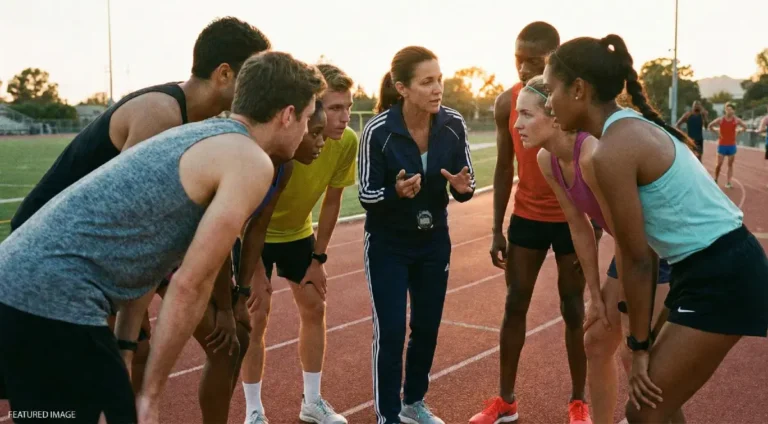

Diljeet Taylor’s System: How BYU Builds Distance Champions

Jane Hedengren arrived at BYU having done something no female high school distance runner in American history had done: broken 15 minutes for the 5,000 meters. She had set nine national high school records. She was, by any measurable standard, the best female high school distance runner of her era.
Diljeet Taylor’s first coaching decision was to run her less.
Not slightly less. Measurably less than Hedengren was running as a high school senior. Fewer miles. Lower volume. More productive training. And then she waited.
The result was an NCAA 5K record of 14:44.79, a ranking of second on the U.S. all-time indoor list, and back-to-back national championships for the BYU women’s program.
If you coach female distance runners at any level, Diljeet Taylor’s approach is the most important thing in distance coaching right now. Here is what she actually does and why it works.
Why This Matters Beyond the Headlines
The conventional coaching response to talent like Hedengren’s is to add training. More miles. More intensity. More competitions. The logic is straightforward: if this athlete is this good on this training, imagine what she will do with more.
Taylor’s response was the opposite: this athlete has been doing too much. Let us be intentional.
This is not a novel idea in coaching theory. Coaches have known for decades that more is not always better, that elite young athletes often arrive overtrained, and that reducing load frequently produces better performance than increasing it. The theory is well-established.
The practice is rare. The pressure to add training to talented athletes is relentless, from athletes who want to improve, from parents who see potential, from programs that need results. Taylor resisted all of it.
As a high school coach, you will face this pressure with every talented athlete you develop. The Taylor model gives you both the principle and the evidence to push back.
Diljeet Taylor: Who She Is
Taylor is the women’s cross country and distance track coach at Brigham Young University in Provo, Utah. Her record:
- Two NCAA national championships
- Two Big 12 Conference titles
- Two-time national coach of the year
- Two-time Big 12 coach of the year
Before the Hedengren era, Taylor had already built one of the premier women’s distance programs in the country. Hedengren did not create the system. She arrived into a system that was already designed to develop elite female distance runners intentionally and sustainably.
The team culture that defines the program: “Believe in HER.” Not a motto. A daily operational standard. Taylor describes it as the guiding mindset through training and competition: every athlete is capable of greatness when she trusts her potential and when her teammates share that belief.
Jane Hedengren: What She Brought and What Changed
Hedengren’s high school record is one of the most decorated in the sport’s history:
- First female high school athlete to break 15:00 for 5,000 meters
- Nine national high school records
- Gatorade National Girls Track and Field Player of the Year
She also arrived, by her own assessment, having trained excessively. Her senior year of high school involved a training load that she has described as “a bit excessive.”
Taylor’s evaluation confirmed this. The response was a structured reduction in volume accompanied by an increase in training quality and intentionality. The exact mileage Hedengren runs at BYU is in the 50s per week, less than her high school senior year. The intensity within that volume is slightly higher.
Hedengren’s summary of the shift: “We’ve brought down the training and have made it far more productive.”
The outcome of that productive training: an NCAA 5K record, the second-fastest indoor 5K in American women’s history, and consistent performances that exceeded what she was producing on higher volume in high school.
The Training System Breakdown
Volume: The Intentional Reduction
Hedengren runs in the 50s per week at BYU. This is less than she ran as a high school senior.
Taylor on the athlete’s natural instinct: “As an athlete, you always think to be better, you have to do more.” The coaching intervention is redirecting that instinct. The shift is from quantity to quality. From more to better.
The reduction was not a conservative choice driven by injury risk management alone. It was the result of Taylor looking at what Hedengren actually needed to develop further and finding that more volume was not the answer. The answer was better, more calculated training inside a reduced volume envelope.
Intensity: Productive Rather Than Maximal
Intensity at BYU is slightly higher than Hedengren experienced in high school despite lower overall volume. The distinction Taylor draws is between productive intensity and exhaustive intensity.
Athletes in the BYU program push each other within workouts. The team environment is the training stimulus. When ten athletes are in a workout together, the competitive pressure drives quality naturally. The coach does not need to prescribe excessive intensity. The group creates it.
This is an important structural point. The intensity is not produced by harder prescribed sessions. It is produced by a team culture in which athletes elevate each other. The training stimulus is social and competitive as much as it is physiological.
Intentionality as a Training Principle
The word Taylor returns to most consistently is intentional. Every element of training has a defined purpose. Nothing is run for its own sake.
This has two practical effects. First, athletes understand why they are doing what they are doing. An athlete who understands the purpose of a session approaches it differently than an athlete following instructions. Second, the coach is forced to defend every training decision on its merits. If you cannot explain why a session serves the development goal, the session should probably not be in the plan.
Taylor: “We really want her to have a great senior year in college and a great pro career, and we are going to build those blocks a little slower.”
A coach who is thinking about a senior year and a professional career in the first month of freshman cross country season is building a four-year plan, not a four-week training block. Every daily decision becomes an expression of that longer planning horizon.
Nutrition as a Training Variable
One of the most significant development breakthroughs Hedengren has described was nutritional, not physical. Working with a sports dietitian, she substantially increased her carbohydrate and caloric intake specifically for athletic performance.
Her assessment: “It’s allowed me to recover, allowed me to be a happier person.”
Better recovery from better fueling allowed the training to land. An athlete who is under-fueled is not actually completing the training sessions she shows up for. She is completing partial sessions and absorbing partial adaptations. The training prescription matters. What goes into the body to support that training matters equally.
Taylor addresses nutrition as a component of training design, not a separate lifestyle concern. Coaches who treat nutrition as the athlete’s personal responsibility and training as the coach’s professional domain are operating with an incomplete model.
Mental Architecture: Being Where Your Feet Are
“We just want to be where our feet are.” This is Taylor’s competition mindset philosophy. The practical application: do not race against expectations. Do not race against records. Race against the course, the competitors, and your own best effort on that day.
Hedengren’s version: “The best way for me to approach races is to not be focused on what people expect, but instead be focused on why I love to compete.”
For a high school coach, this is directly applicable. Your athletes who perform below their training in competition are almost always managing expectations rather than racing. The coaching work is building the mental habit of presence before building any more physical fitness.
The Philosophy Behind the Numbers
Taylor has described her fundamental purpose in coaching: “My purpose is to help great runners become great women and help great women become great runners.”
That statement works in both directions deliberately. You do not build one without building the other. An athlete whose personal development is suppressed in service of performance will eventually perform to the level of her personal development, which is low. An athlete whose personal development is supported will bring the full force of her character to her training, which makes the training more effective.
The Newbury Park model (culture plus training) and the FM model (psychology plus training) make the same argument. Brosnan, Aris, and Taylor are saying the same thing from three different programs: the training only works when the person doing it is growing in the right direction.
Taylor also coined the phrase “Janerational talent” to describe what makes Hedengren special: a combination of maturity, work ethic, natural ability, humility, and desire to improve. Notice what that list contains. Natural ability is one of five components. The other four are character qualities. The talent that is sustainable is not just physical. It is the specific combination of qualities that makes a person coachable.
What Most Coaches Get Wrong
Most coaches, when they have a talented athlete, train the talent. They build on what is already there. The athlete who is fast gets faster workouts. The athlete who handles high mileage gets more mileage. The coach’s instinct is to push the existing strength further.
Taylor’s approach trains the gaps. She identified that Hedengren’s volume was excessive and addressed it. She identified that Hedengren’s fueling was inadequate and addressed it. She identified that Hedengren’s competition mindset needed development and addressed it.
None of those interventions were about running more or harder. All of them were about running better, recovering better, and competing better. The result was an athlete who produced performances beyond what she was capable of on higher volume.
The coaching error I see most often with talented female athletes specifically is the failure to protect them from their own willingness to do more. Talented female distance runners will run as much as you let them. Many of them will not tell you when they are tired, because they fear looking weak or ungrateful. The coach’s job is to observe, to ask, to insist on rest, and to be the person in the athlete’s corner who says “enough for today” when the athlete would keep going.
Taylor built a system where that restraint is the norm, not the exception. The result is athletes who stay healthy, develop continuously, and produce records.
How to Apply This to Your Program
1. Evaluate whether your best athletes are actually training the right volume or just the most volume.
For each athlete who shows genuine elite potential, ask: is there any evidence this athlete needs more training, or do they need better training? The answer is almost always better. Prescribe specifically and watch the response. Adjust based on evidence, not ambition.
2. Build the team environment that creates internal competition.
The BYU system uses team dynamics as a training stimulus. Your athletes push each other in workouts, and that competitive pressure is more sustainable than externally prescribed hard sessions. Build a culture where athletes genuinely try to help each other run better in practice. Workouts done in competitive groups produce different adaptations than workouts done alone.
3. Address nutrition explicitly.
Do not assume your athletes are fueling correctly. At the high school level, many athletes are significantly underfueled relative to their training demands, either from intentional restriction, limited food access, or simply not eating enough around training. A conversation about pre- and post-workout nutrition is coaching. It belongs in your program.
4. Teach presence as a competition skill.
In practice, drill the habit of focusing on execution rather than outcome. An athlete who runs tempo workouts focused on form and effort rather than pace learns to compete from execution. An athlete who runs tempo workouts focused only on hitting a pace number learns to compete from anxiety. The competition experience is built in practice, not just on race day.
5. Think in four-year arcs.
If you coach freshmen, the decisions you make this month should be filtered through the question: what does this athlete need in order to peak as a senior? Often the answer is less than you are tempted to give them. Protect them from overtraining now so they can train fully in two and three years.
The Bottom Line
Diljeet Taylor built a national championship program by consistently choosing patient, intentional development over the immediate push for results. When she got the best high school distance runner in American history, she ran her less and waited. The records came.
For high school coaches, the application is direct. Your most talented athletes do not need more training. They need better training, appropriate nutrition, a competitive team environment, and a coach who is thinking four years ahead rather than four weeks ahead.
Taylor’s word is intentional. Put that word in your training plans, your practice conversations, and your development philosophy. Every session has a purpose. Every athlete has a trajectory. Every coaching decision either serves the four-year arc or it does not.
If you are building the training system that supports this kind of athlete development, the High School Cross Country Training: The Championship Blueprint gives you the complete season structure from June through November, week by week. The philosophy is nothing without the architecture.