

The Sprinter Who Became the World’s Most Complete Distance Runner: The Hellen Obiri Story
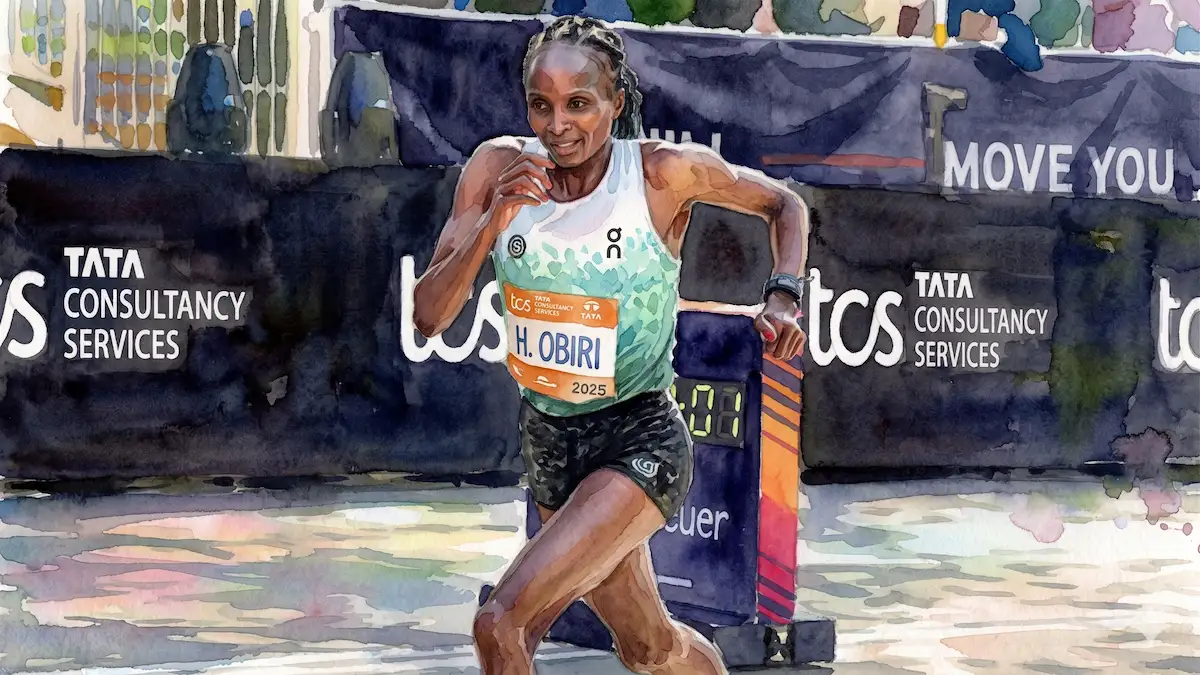
At age 14, Hellen Obiri was recruited as a sprinter. She ran the 200 meters and 400 meters. Coaches identified her not as a distance talent, but as a speed athlete, someone with the fast-twitch machinery required for short events.
By 17, she had quit the sport entirely. She spent two full years away from competition to focus on her education.
At 19, she returned through an institutional program. She enrolled in the Kenya Defence Forces (KDF) training program in Eldoret, re-entered athletics via the military sports network, and began her true development as a distance runner.
Hellen Obiri did not start competing in longer events until she was over 20 years old. She did not run a marathon until she was 32.
At 36 years old, she has won two World Athletics Championships over 5000 meters, three Olympic medals, multiple World Cross Country titles, the Boston Marathon twice, and the New York City Marathon. In late 2025, she claimed the New York City Marathon course record in 2:19:51. More recently, she finished second at the 2026 London Marathon in a race that required a women’s-only world record performance to beat her.
The arc of Hellen Obiri’s career offers one of the most instructive case studies in the history of women’s distance running. She succeeds not because she is a classic prodigy, but because she is the exact opposite. She arrived late to every distance, rebuilt her training from scratch multiple times, and continued to improve well into her 30s.
The Sprinter Nobody Was Watching
A critical detail about Hellen Obiri’s career is often overlooked: she did not start as a middle-distance runner who occasionally moved up or down in distance. She was recruited specifically for the 200m and 400m at Riruta Central Secondary School in Nairobi.
That recruitment reveals a permanent physiological truth. At 14, her physical profile matched that of a sprinter. She possessed the neuromuscular patterns and fast-twitch muscle fibers that sprint coaches seek. That physical foundation remains even when an athlete switches disciplines. Speed converts into a massive asset for long-distance events.
After her two-year hiatus from the sport, the Kenya Defence Forces provided the structure she needed to return. The KDF has produced world-class runners for decades by offering elite coaching, consistent resources, and high-level competition to athletes who might otherwise leave the sport.
In 2009, around age 19, Hellen Obiri graduated from KDF training and resumed competitive racing. She began with the 800m and 1500m, then moved up to the 5000m, cross country, and eventually the marathon. At each transition, her previous speed foundation served as her primary competitive advantage.
The 5000m Years: Building a World-Class Track Career
Throughout her 20s, Obiri developed into one of the most dominant 5000m runners in history. Her track career was defined by steady, deliberate building rather than immediate success.
Key Track and Cross Country Achievements:
- National Records: Kenyan records in the 5000m (14:18.37) and the mile (4:16.15).
- World Championships: Back-to-back gold medals in the 5000m in 2017 (London) and 2019 (Doha).
- Cross Country Titles: Multiple World Athletics Cross Country Championships, including the 2019 title in Aarhus, Denmark, a race run on one of the toughest courses in history.
- Olympic Games: Two silver medals in the 5000m at the 2016 Rio de Janeiro Games and the 2020 Tokyo Games.
On the track, Obiri was a master tactician. Her sprinting background gave her a closing gear that her competitors simply could not match. She could initiate a hard surge with 1000 meters to go or sit back and wait for the final 200 meters. Her elite speed remained fully intact, it was just deployed at the end of a grueling 14-minute race.
Her cross country success also deserves recognition. Cross country requires exceptional aerobic depth and the ability to adapt to uneven terrain. Her dominance in this discipline highlights her physical durability, which later made her transition to the roads seamless.
The Marathon Decision: Why Now, Why Boulder?
In 2022, at age 32, Obiri made the calculated decision to move up to the marathon. She accepted an invitation to join the On Athletics Club (OAC) based in Boulder, Colorado, training under coach Dathan Ritzenhein, and relocated her family from Kenya to the United States.
This was a deliberate, disruptive choice. To optimize her marathon potential, she uprooted her training environment to work with a specific coach in a high-altitude setting.
Why Dathan Ritzenhein?
The OAC is built around individual physiological evaluation, high-volume aerobic training, and twice-daily sessions. Ritzenhein has guided high-profile track athletes to American records and global podiums. His background as an elite runner from the 1500m up to the marathon makes him uniquely qualified to guide track athletes transitioning to the roads.
Why Boulder?
The OAC trains year-round at 5,100 feet above sea level. This continuous altitude exposure creates permanent physiological adaptations, whereas temporary altitude camps only offer short-term benefits.
Why the Marathon?
Obiri noted that the marathon was her next logical challenge. At 32, she faced diminishing returns in defending her 5000m titles against younger athletes. The marathon offered a new competitive arena, and ultimately, a second career peak.
Mastering the 26.2-Mile Distance
Hellen Obiri’s marathon debut came at the 2022 New York City Marathon, where she finished sixth in 2:25:49. For a track runner attempting a technical course like New York (the bridges are killers), a sixth-place finish is an excellent introduction. Most elite track runners require several attempts to master marathon fueling, pacing, and mechanics.
By her second marathon, she had solved the distance.
At the 2023 Boston Marathon, Obiri broke away late in the race to win in 2:21:38. To win a major marathon on a hilly, point-to-point course in just your second attempt defies conventional coaching expectations. Later that year, she won the 2023 New York City Marathon in 2:27:23, becoming the first woman in 34 years (Ingrid Kristiansen did it in 1989) to win both Boston and New York in the same calendar year.
In 2024, she successfully defended her title at the Boston Marathon, winning in 2:22:37, and later earned a bronze medal in the marathon at the Paris Olympics. By late 2025, she returned to the New York City Marathon to set a course record of 2:19:51 at 35 years old.
The OAC Training Architecture
What does it take to prepare an athlete for this level of performance? The training structure developed by Ritzenhein for Obiri focuses on four primary pillars:
| Training Variable | Implementation Details |
| Weekly Volume | 180 to 200 kilometers (112 to 124 miles) per week. At Boulder’s altitude, this generates a massive stimulus. |
| Structure | Twice-daily training sessions. Splitting the volume allows for higher totals while managing immediate physical fatigue. |
| Altitude Strategy | Permanent base in Boulder at 5,100 feet, combined with training blocks in Kenya at higher altitudes (above 7,000 feet) to escape the winter weather. |
| Recovery Strategy | Up to 14 hours of sleep per day, including a scheduled six-hour nap between morning and afternoon sessions. |
At 36 years old and handling up to 200 kilometers a week, recovery is just as critical as the workouts themselves. Obiri approaches sleep as a non-negotiable performance decision.
Why Early Speed Matters in the Marathon
Obiri’s career offers an important lesson for endurance coaches: the sprint mechanics she developed as a teenager are directly responsible for her marathon success.
Elite marathoners with deep track backgrounds close out races differently than athletes who spent their entire careers on the roads. The neuromuscular recruitment patterns built during her 200m and 400m days allow her to recruit fresh muscle fibers late in a race.
When Obiri broke the New York City Marathon course record, her final miles were run at a pace that only track athletes can sustain. She did not merely maintain her speed under fatigue; she accelerated. That finishing gear is a direct transfer of the speed she built decades earlier.
Coaching Takeaways from Hellen Obiri’s Journey
1. Re-evaluate Talent Identification Timelines
Obiri’s career challenges the idea of early specialization. She was a sprinter at 14, quit at 16, joined the military at 19, moved to the track at 22, and transitioned to the marathon at 32.
Coaches should avoid writing off late developers. Athletes who enter the sport late or switch from other disciplines may simply be at the beginning of a long, productive development curve.
2. Speed is a Permanent Asset
The sprint training Obiri completed as a teenager remains visible in her 26.2-mile performances today. When you integrate high-velocity work into a distance runner’s training through short hill sprints, strides, and neuromuscular drills, you are building a permanent asset.
3. Treat Recovery as a Training Metric
While most athletes cannot sleep 14 hours a day, the underlying principle holds true. Recovery capacity directly limits training adaptation. Coaches who intentionally monitor and protect their athletes’ recovery windows will always see better results from the training they prescribe.
The Four-Stage Arc
Sprinter. Mid Distance champion. Cross country champion. Distance Champion. Marathon Champion.
Hellen Obiri’s career demonstrates what is possible when an athlete remains adaptable, commits to a long-term development process, and works with coaches who respect the physical foundation she spent a lifetime building. At 36, having just run a spectacular race at the London Marathon, she shows no signs of slowing down.