
Alicia Monson: The Training Behind the American 5K & 10K Records
What Alicia Monson’s Career Teaches Every Coach About Patient Development, Adversity, and Building an Aerobic Engine
Amery, Wisconsin has a population of roughly 2,900 people. It sits in northwestern Wisconsin near the Minnesota border where cross country is part of the fall fabric because that’s what schools in that part of the state do. There are no altitude training centers in Amery. There is no history of producing professional distance runners.
Alicia Monson is from Amery.
She started running in sixth grade not because she had identified distance running as her calling, but because it was the only school sport available to sixth graders and she wanted to be in something. She had older siblings who competed, and she wanted to compete too.
By the time she finished her first competitive year, it was clear she was not just a participant. She was something different.
The path from that sixth-grade start to North American records in the 5,000m, 10,000m, and two-mile and to the podium at multiple global championships runs through a torn ACL, a coach she had to trust before he had a track record, and a training environment built entirely from scratch in Boulder, Colorado.
What it teaches every coach who works with female distance runners is worth examining carefully.
Amery: The Origin and the First Adversity
Monson competed for Amery High School under coaches Paul Enslin and Kelsey Faschingbauer. She was a genuine talent, a Wisconsin state champion in cross country and the 3,200m as a senior, and a state runner-up in the 1,600m. But the journey to those championships was not easy.
In her senior year, while playing basketball, she tore her ACL.
That injury is often treated as background noise in Monson’s story when it is actually a formative event. A torn ACL in your senior year of high school, before you have signed with a college, is a genuine threat to a running career. Many athletes have walked away from sports at that point. The recovery is long, and the uncertainty sits in your head. Will I ever return to the same level again? Can I trust my body?
Monson came back. Five months after surgery, she won the Wisconsin state 3,200m championship.
That comeback is illustrative. It is the first evidence of the characteristic that makes her a great competitor. She does not quit when the path gets difficult. She adjusts and moves forward.
Wisconsin: Developing Under Jill Miller
Monson enrolled at the University of Wisconsin in 2016 and competed for the Badgers under coach Jill Miller. Her development was steady and patient. She improved reliably, year after year, building toward something that revealed itself in her senior year.
The volume progression across her collegiate career tells you exactly what kind of program Wisconsin ran. As a junior, she was training 25–30 miles per week. By her senior year, she had pushed that to roughly 50. That doubling of volume took place over multiple years, not a single offseason. Wisconsin was not forcing adaptation. They were letting the athlete grow into it.
In 2019, Monson won the NCAA Indoor 5,000m championship and followed it with a runner-up finish at the NCAA Cross Country Championships. By the end of her collegiate career, she had proven she could compete with the best in the country.
When COVID disrupted the 2020 season and the University of Wisconsin announced it would not grant athletes an extra year of eligibility, Monson faced a decision: return for a senior season under uncertain conditions, or turn professional. She turned professional.
What she did next revealed the same quality that had returned her to the state meet five months after an ACL surgery. She chose risk.
The On Athletics Club Decision: Betting on Dathan Ritzenhein
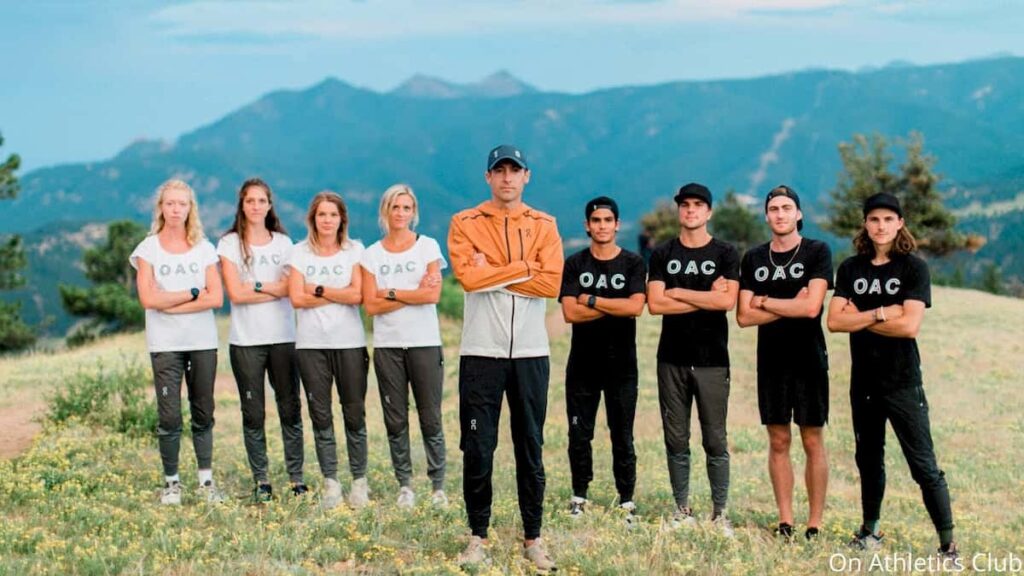
The On Athletics Club did not exist in 2019. It was founded by Dathan Ritzenhein in 2020, sponsored by the Swiss running shoe company On, and based in Boulder, Colorado.
Ritzenhein is a three-time Olympian, a former American record holder in the 5,000m and the marathon, and one of the most complete distance runners the United States has produced in the modern era. He retired in 2019 and almost immediately began building the program he wished had existed for him during his own career.
Alicia Monson was one of his first recruits.
There was no track record to evaluate. No alumni performances to research. No testimonials from athletes who had come through OAC and succeeded. There was one man with a clear vision and a specific philosophy, and Monson had to decide whether she believed in him.
She said yes. Her reason was partly practical, COVID’s uncertainty made the professional path more attractive than another ambiguous year of school, but it was also about chemistry. “Being Midwesterners, Dathan and I understand each other,” she said. Ritzenhein grew up in Rockford, Michigan. Monson grew up in Amery, Wisconsin. There was a shared cultural language, an orientation toward hard work and practicality that made the relationship feel right from the start.
That cultural fit is not trivial. The athletes who perform best under a coach are almost always the athletes who trust the coach completely, who believe that the work being asked of them has a reason, even when they cannot see it. Monson trusted Ritzenhein. That trust, over the next four years, was fully earned.
Building the Aerobic Engine: The OAC Training System
Volume Progression From College to World-Class
The mileage arc of Monson’s career is as instructive as any workout she has ever run.
She arrived at Wisconsin at 25–30 miles per week. She left at roughly 50. She arrived at OAC and, in her own telling, inadvertently jumped to 80-mile weeks during an altitude training camp at 10,000 feet. The result was a calf and metatarsal stress reaction that required a full cross-training block: bike intervals, elliptical, and pool running before she could resume normal training.
That setback in year one was not a program failure. It was information. It told Ritzenhein exactly where the ceiling was and established the baseline from which to build systematically. A hard lesson.
Year two: 85–90 miles per week. Years three and four: 90–95 miles per week. All of it at 5,100 feet in Boulder. Nearly all of it as doubles. A morning run and an evening run, most days of the week.
Ritzenhein’s rationale for doubles training is grounded in physiology: a 12-mile morning run and a 6-mile evening run at altitude accomplish more aerobic work than an 18-mile single run at the same effort at sea level. The training load is distributed, recovery is built into the structure, and the accumulation is continuous without requiring any individual session to be extreme.
The altitude matters in a way worth stating plainly. At 5,100 feet, the reduced oxygen pressure forces the body to produce more red blood cells, elevate hemoglobin concentration, and become more efficient at oxygen delivery. These adaptations translate directly into performance when racing at sea level. They take weeks to develop and are most powerful when built continuously over years. Monson has been in Boulder since 2020. The cumulative altitude adaptation she has built across that period is a meaningful and compounding competitive advantage.
The Workout Structure
Ritzenhein’s training philosophy has a unifying principle: “There’s no magic other than you have to be consistent.”
That principle shapes everything about how OAC structures training blocks. Seasons run four to six months with scheduled downtime between them. Nothing is built to a sharp peak and discarded. Consistency across years is the mechanism by which an aerobic engine grows large enough to set continental records.
Within that framework, the weekly training structure builds on several types of sessions:
The OAC Ladder Fartlek. Ritzenhein returns to this workout every three to four weeks as a team session. The structure: 1 minute hard / 1 minute easy; 2 minutes hard / 2 minutes easy; 3 minutes hard / 3 minutes easy. Then, reverse back down the ladder. The entire group runs together regardless of individual fitness level. The goal is not a fixed pace target. The goal is consistent effort calibration: learning to find the right level of hard and hold it precisely, a skill that translates directly to championship racing.
Threshold and tempo work. Mile repeats and tempo runs year-round, at what Ritzenhein considers aerobic strength pace. Not glamorous. Present in every training block, every season.
The benchmark mile workout. Reported by Outside Online, this session captures what peak fitness looks like for Monson: 4 × 1 mile at 5:05 per mile pace with 400m recoveries. Monson has described it as one of the most demanding sessions she runs. The recovery is not easy. The effort required to sustain 5:05 on the fourth rep, after three miles at that pace and three active recoveries, requires the kind of mental engagement she describes as putting herself in race scenarios to find the competitive mindset that allows her to finish rather than shut it down.
Speed work. 200m repeats and hill accelerations, present year-round but never dominant. Kept in the program to maintain neuromuscular sharpness without overemphasizing a quality that Monson does not rely on to win races.
The long run. Up to 17 miles, at a pace Monson describes as genuinely fast rather than easy aerobic work. The ability to “hang on” to pace through the final miles of a long run is a strength quality as much as an aerobic one. It is one she credits directly to her work with strength coach Jason Ross, whose programming has built the structural resilience to sustain pace when fatigue accumulates.
Strength Training as a Non-Negotiable
The strength work is not incidental to the OAC model. Distance women who lift seriously have meaningfully better injury profiles over long careers than those who do not. Monson’s commitment to the full training package, not just the running, is part of what has kept her competing at the highest level and part of why Ross’s role in her development is worth naming explicitly.
For high school coaches: this is the piece most often omitted from training plans. If your athletes are doing serious mileage without a parallel strength program, the structural durability their bodies need to absorb that mileage is not being built.
Racing Philosophy: Making the Race Brutal Before the Final 200
Monson’s competitive philosophy is a direct product of her training.
Her self-described approach: use big moves from far out, running at VO2 max effort for long stretches before the final lap. She developed this style specifically because her finishing kick was not her sharpest weapon early in her professional career. Rather than trying to win a sprint she was not yet equipped to win, she learned to win by making the race so aerobically brutal in the middle miles that no one has a sprint left.
That is a coaching insight as much as a competitive one. Identify the athlete’s actual strengths. Build a racing strategy around them. Teach the athlete to deploy that strategy with conviction rather than defaulting to a tactical approach that suits someone else’s strengths.
The 4 × 1 mile workout at 5:05 is not just a fitness benchmark. It is direct preparation for this racing style. An athlete who has trained to sustain VO2 max effort for extended stretches in practice has a different relationship with that effort in a race. The competitive reference point exists. She has done this before.
Ritzenhein frames the mental dimension of this work directly: the last one percent, he says, is where special performances are made. The physical preparation gets an athlete to the point where one percent is the difference. The mental preparation determines which athletes actually find it.
Breaking the North American Records
Monson’s record-breaking career is evidence of a training system that was willing to develop an athlete past her collegiate ceiling and patient enough to wait for that development to arrive.
The 10,000m is the most striking example. She had virtually no 10,000m experience when she joined OAC. In December 2020, in her first serious attempt at the distance, she ran 31:10.84, good enough to put herself in contention for the Olympic team. She had gone from having never truly raced 10K to legitimate Olympic qualifier in a matter of months of structured training under Ritzenhein.
That is not an accident. Ritzenhein correctly assessed what his athlete’s aerobic engine could produce at a distance she had never been asked to run and built a training block specifically designed to unlock that capacity.
By 2022, Monson had broken the American record in the 10,000m by 9.35 seconds. Not a marginal improvement. A statement.
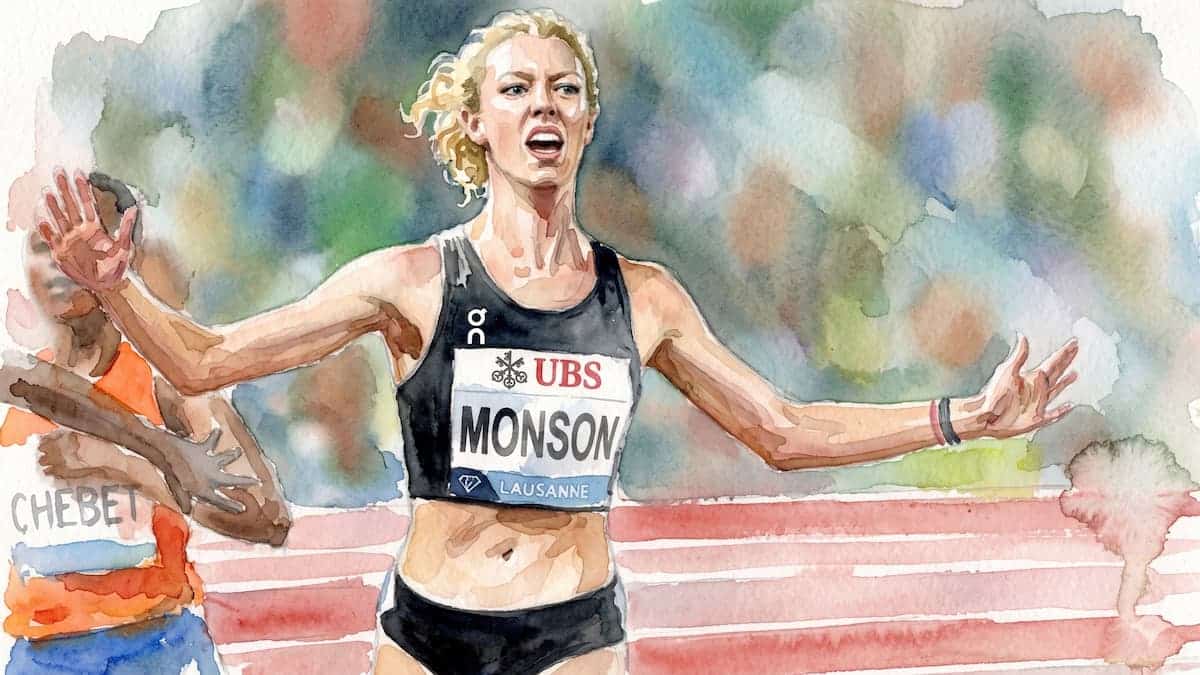
In July 2023, at the London Diamond League, she ran 14:19.45 in the 5,000m, breaking what had been the American record. The London Diamond League is one of the highest-quality distance races in the world. Monson ran the record in a field of world-class Africans, in a meet set up for fast running, and delivered.
She also holds the North American record in the two-mile at 9:09.70, set at the Millrose Games, making her the North American record holder at three distances simultaneously.
Ritzenhein’s comment after one of those record weekends captures his coaching philosophy precisely: he said he felt like they were doing things he thought they would be doing four years from now. That is a coach who had a long-term vision for his athlete’s development and watched her arrive at it ahead of schedule.
Paris 2024: The Year She Wasn’t There
In April 2024, Monson had surgery on her knee meniscus and missed the entire season.
She missed the Olympic Trials. She missed Paris. She missed the opportunity to run the 10,000m or 5,000m at the most important competition in the world, in the year that her training had been building toward.
Every distance coach has had athletes who worked harder and longer than the results reflected, who put in seasons of preparation that disappeared behind an injury. That frustration is a specific kind of grief in this sport. Monson’s situation in 2024 is the highest-stakes version of that experience.
But it is not the final chapter. The North American records stand. The infrastructure for her return is intact.
To protect her knee while preserving the aerobic engine that set those records, Ritzenhein and the OAC shifted a significant portion of her training to the underwater treadmill. A methodology that maintains cardiovascular stimulus while eliminating ground-impact stress. The training block has adapted. The philosophy has not.
The ACL in high school. The COVID disruption in college. The knee surgery in 2024. Three significant interruptions, and the career continues. The pattern is consistent across fifteen years of competitive running: Monson responds to adversity with exactly the same quality she demonstrated as a high school senior, winning a state title five months after surgery.
The Redemption Roadmap
Monson has stated clearly that the 2027 World Championships in Beijing are the target. The goals are direct: reclaim a spot on the global podium and lower her own continental marks in the 5,000m and 10,000m.
Her return to racing is expected in late spring or early summer 2026. The mental character that produced a state title five months after an ACL tear has not changed. The coaching relationship is stable. The training environment that produced her best performances has adapted to protect her while preserving what made her great.
For Coaches: What the Monson Model Teaches
The small-town athlete with limited infrastructure is not at a disadvantage.
Monson grew up in Amery, Wisconsin, without access to altitude training, without professional coaching resources, without any of the structural advantages that attract top recruits to high-profile programs. She was developed through patient, progressive, well-executed coaching at the high school and collegiate levels. What she had was coaches who did not rush the development and an athlete who responded to adversity rather than being defined by it.
Volume builds over years, not seasons.
Monson ran 25–30 miles per week as a college junior and 50 as a senior. She then inadvertently overcorrected in her first professional training camp, paid for it with a stress reaction, and learned exactly where her ceiling was. Years two through four as a professional were spent systematically closing in on 90–95 miles per week at altitude. The North American records she set in 2022 and 2023 were built on six years of carefully managed mileage increases, not a single great training cycle.
Teach your athletes to race to their actual strengths.
Monson’s front-running, aerobic punch in the face style, was not random. It was a deliberate response to an honest assessment of where she and her coach identified her competitive edge. If your athletes are racing the wrong way for their fitness profile, they will never find their ceiling. The conversation about how to race is as important as the conversation about how to train.
New programs with great coaches are worth the risk.
Monson joined OAC when Ritzenhein had coached professionally for about thirty seconds. He is now arguably the most successful American distance coach of the current era. An established program with a good coach is safer. A new program with a great coach is better.
Mental preparation is a training variable.
Ritzenhein is explicit that the last one percent is where special performances are made. The 4 × 1 mile workout that requires Monson to visualize race scenarios to complete the final rep is not just physiological preparation, it is deliberate practice at accessing that one percent under controlled conditions. Build sessions into your plan that require something beyond fitness to finish. Your athletes need the competitive reference point.
Athletic resilience is shaped by the coaching relationship.
The ACL recovery, the COVID disruption, and the knee surgery are all events where the athlete’s response was shaped by the environment around her. Athletes who have coaches they trust deeply, who understand the long-term vision for their development, respond to adversity differently than athletes who feel like each missed season is a permanent loss. That trust is built in practice, in honest conversations, in the pattern of a coach doing what they say they will do over years.
The Bottom Line
Alicia Monson holds the North American records in the 5,000m, 10,000m, and the two-mile. She built them from a sixth-grade start in a town of 2,900 people, through a torn ACL before she signed with a college, through two years of patient collegiate development, through an inadvertent 80-mile week that ended in a stress reaction, and through a year of progressive altitude training before she broke the first record.
The system that produced those records was not complicated. It was consistent, progressive, honest about where the athlete’s strengths actually were, and built on a coaching relationship stable enough to survive everything that disrupted it.
For the coaches reading this: you are more likely to be Brian Diglio or Jill Miller in this story than Dathan Ritzenhein. You are working with athletes years before anyone knows what they might become. The patient, progressive, honest work you do now is the foundation every subsequent coach builds on.
Monson ran 25 miles a week as a college junior. Someone coached her that year. That work mattered.