

How to Coach Middle School Cross Country
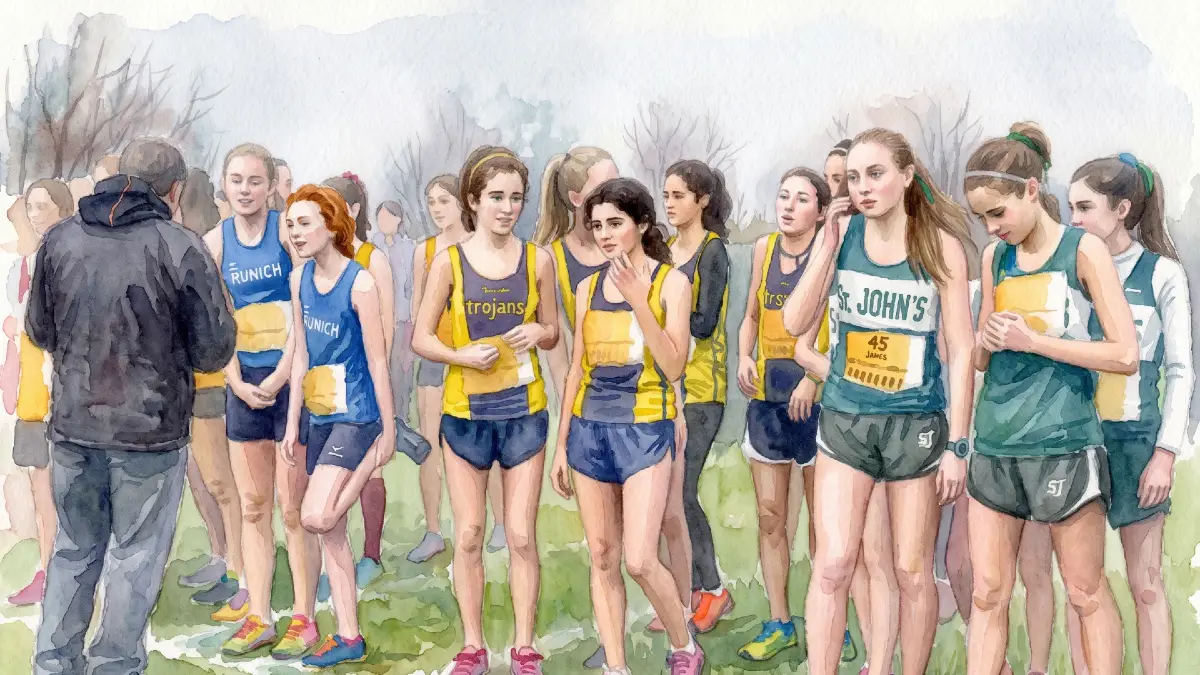
Somebody handed you a middle school team. Maybe you asked for it. More likely you coach the high school program and the feeder squad came attached, or your kid is on the team and nobody else raised a hand.
The short version. Coach middle school cross country by assigning volume in minutes rather than miles, keeping about ninety percent of running at conversation pace, and allowing one hard effort per week delivered as a game so eleven-year-olds cannot turn it into a race. Run a twelve-week season. Spend the first seventeen minutes of every practice on movement skills and sprinting. Judge the season on whether they come back.
Twenty-five years in, here is what I wish someone had told me at the start: middle school cross country is not high school cross country with the mileage halved. It is a different job with a different goal, and doing it well means wanting something other than fast times this fall.
This guide covers what to do at practice on Monday, and why. The why matters, because it is what stops you from writing a workout that ruins an eleven-year-old’s September.
If your season starts in the next two weeks and you have never done this before, read your first week coaching middle school cross country first. It is the day-by-day version: what to do before day one, what the first five practices look like, and the questions parents will ask you in the parking lot. Then come back here for the rest of the season.
What is in this guide
The three jobs
Everything below serves one of three jobs. If a decision does not serve one of them, it does not belong in your season.
They come back. The best predictor of a fast senior is a happy seventh grader. Retention is a training variable, and it is the one that compounds. An athlete who quits in eighth grade has a ceiling of zero, no matter how fast they ran in October.
Build the athlete, not the runner. Ages ten through fourteen are the best window you will ever get for coordination, sprint mechanics, and tissue preparation. Mileage can be added later. Movement quality is much harder to add later.
Teach the language. A thirteen-year-old arrives at high school knowing what easy means, what a stride is, and how to run the first four hundred meters of a race. They are a year ahead of a faster kid who knows none of it.
Notice what is missing. Winning the league. Peak mileage. Personal records. Those are consequences. They take care of themselves when the three jobs are done.
The statistic everyone repeats, and what is actually true
You have read that seventy percent of kids quit organized sports by age thirteen. It gets quoted in every youth sports article, including by people I respect.
The number does not hold up. In June 2026 a columnist went looking for its origin and found repetition rather than evidence. Researchers who traced it back describe a figure that got built and accepted until it stopped having to prove itself. An advocate at the Aspen Institute hunted for the same source, came up empty, and then reframed the question in a way I find far more useful: maybe kids do not quit sports by thirteen. Maybe they quit most sports by thirteen, and pick one.
That matters for you. Middle school is not a cliff, it is a sorting year. Kids are deciding what they are. Your job is to keep running on the short list.
The real numbers are still worth knowing. The American Academy of Pediatrics published a clinical report on overuse injury, overtraining, and burnout in young athletes in Pediatrics in February 2024. It found that injury and burnout are among the leading reasons kids leave sport, that roughly one in ten young athletes experiences burnout, and that as many as thirty-five percent show signs of overtraining. The report names the professionalization of youth sport as the driver: high training volumes and pressure to specialize early.
That is the part you control. You cannot decide whether a twelve-year-old prefers basketball. You can decide whether cross country is the sport that hurt them.
What the evidence supports
Middle school running attracts a lot of confident opinion and not much sourcing. Here is what the governing bodies and the research say. Links are at the bottom so you can check my work.
The season should be short. USATF Foundation guidance draws on Training for Young Distance Runners by Larry Greene and Russ Pate. It says children around ages eight to twelve do well in an organized running program with a systematic training environment, lasting two to three months. Not year-round. Two to three months, then out.
Start low and build. The same guidance says to begin a young runner with low volume, low intensity, and a limited number of days per week, then increase the workload across the program. The Road Runners Club of America says the same thing in its FUNdamentals of Youth Running.
Volume can rise later, not now. Both sources note that around age twelve for girls and fourteen for boys, developmental changes allow training distance and duration to increase. Before that, you are not building an engine. You are protecting one.
Limit systematic training before puberty. The RRCA is blunt about this. Children before puberty are growing fast, and heavy systematic training can interfere with normal growth and cause injury.
One program does not fit the group. Both organizations warn against a one-size-fits-all approach and tell you to accommodate the range of ability in front of you, because kids mature physically and emotionally at wildly different rates. On any middle school team you will have a four-minute-per-mile spread and a two-year spread in biological age. Those are not the same athletes.
Make it fun, and never use running as punishment. That is not a soft sentiment. Both organizations put it in writing.
One place the popular science is wrong
You have probably heard that there are “windows of opportunity” for speed and coordination that slam shut at puberty. That idea came from older long-term athlete development models, and it is too neat.
Rhodri Lloyd and Jon Oliver published the Youth Physical Development model in the Strength and Conditioning Journal in 2012, and it is now the standard reference. It argues that every fitness quality is trainable at every stage. What changes is how the body adapts, not whether it can.
So why do I still spend seventeen minutes of every practice on skips, bounds, and sprinting? Because coordination is cheap to buy now and expensive later. A twelve-year-old learns a B-skip in two sessions. A seventeen-year-old takes a month.
How far should middle schoolers run?
Stop counting miles. Count minutes.
This is the single most useful change you can make, and almost nobody does it. Here is why it works.
Your slowest athlete runs a ten-minute mile. Your fastest runs a six-thirty. Assign three miles and the slow kid is out there for thirty minutes while the fast kid is done in twenty. You have given your least-developed athlete fifty percent more training stress than your most-developed one, which is exactly backward.
Assign twenty-five minutes and everyone gets twenty-five minutes. The dose is equal. Nobody finishes last in front of the team. And a slower kid never has to hear a number that makes them feel slow.
Here is where I set the ceilings. These are for a twelve-week fall season, and they are ceilings rather than targets. An athlete who thrives at the low end stays at the low end.
| Level | Who | Weekly cap | Run days | Long run cap |
|---|---|---|---|---|
| First season | Grades 5–6, or any first-year runner | ~145 min (about 15 miles) | 4–5 | 45 min or 4 miles |
| Second season | Grades 6–7, one healthy season done | ~190 min (about 20 miles) | 5 | 50 min or 5 miles |
| Third season | Grades 7–8, two or more seasons | ~225 min (about 25 miles) | 5–6 | 60 min or 5.5 miles |
Three things about that table.
Assign the level by training age, not grade or talent. A fast fifth grader is a first-year runner. So is a slow one. So is an eighth grader who has never trained. Talent is not durability, and the athlete most likely to get hurt in your program is the gifted seventh grader whose ambition outruns their tendons.
The long run has two ceilings. Minutes and miles, whichever comes first. At sixty minutes a fast eighth grader covers close to seven miles of ground contact and a slow one covers four and a half. That is a different load on a growing tibia even though the clock says the same thing. Minutes protect the slower athlete. Miles protect the faster one.
Ninety percent of it is easy. My high school plans run seventy-five to eighty percent easy. Middle school runs ninety. Conversation pace, all season, almost all the time.
If you just want the schedule, it is published free: the complete 12-week middle school cross country training plan, day by day. Twelve weeks of the Builder level, every session, foundation through championship, with the weekly totals and the down weeks already built in. It is also available as a printable PDF. This guide is the reasoning behind it.
When a parent asks you to justify those numbers, and one will, send them how many miles should a 12-year-old run. It is the parent-facing version, with what the AAP, NATA, and the RRCA actually publish, and what the research does and does not support.
What a middle school practice looks like
Every practice, all season, follows one shape. The sameness is the point. A kid who runs this shape for three years walks into a high school practice and recognizes the whole thing.
If you only have sixty minutes, cut the running, not the Athlete Base. A twenty-minute easy run with a full movement warm-up beats a forty-minute run with five minutes of jogging and a hamstring stretch. Every time, at this age.
The Athlete Base
Seventeen minutes, on grass, no equipment. This is the block that makes the rest of it work, and it is the block most coaches skip because it does not look like running.
Prepare, five minutes. Easy jogging, then a movement series over about twenty meters: side shuffle both ways, carioca both ways, walking leg cradle, walking toe touch, walking lunge with a torso turn, inchworm to plank.
Skills, seven minutes. Pick two a day and rotate. A-skip. B-skip. Straight-leg bounding. Pogo hops. Bounding for distance. Backward running. Single-leg hop and stick. Bear crawl and crab walk. Fast feet into an acceleration.
Speed, five minutes, three days a week. Middle schoolers should sprint. Real sprinting: ten to forty meters, full recovery, three times a week. Four to six strides of fifteen to twenty seconds on grass, walking back between each. It develops the nervous system, it protects hamstrings, and it makes distance running feel easy by comparison.
USATF built a whole national program on this premise. RunJumpThrow, run with Hershey, teaches children ages seven to twelve the fundamentals of running, jumping, and throwing, free and without competition. It passed a million participants in early 2026. Skills first, competition later. If the governing body of the sport thinks a twelve-year-old should be jumping and throwing, your distance runners can spare five minutes to sprint.
One day a week, replace the skills block with actual play. Ultimate, capture the flag, sharks and minnows on a cone grid. Change of direction, acceleration, deceleration, and a lot of laughing. It is real athletic development and it is the block they will describe at dinner.
Strength
Bodyweight only, twice a week, fifteen to twenty minutes, after the run. No weight room, no barbells, regardless of how strong an eighth grader looks.
Three things matter most at this age. Calf raises, both straight-knee and bent-knee, because growing kids get heel pain and loaded calves are the answer. Single-leg balance and hopping, because a growth spurt scrambles coordination and this is the fix. Trunk bracing, not for abs but for not leaking force in the last two hundred meters of a race.
Coaching middle school and high school on one field
This is the part nobody writes about, and it is the situation half of you are actually in: two teams, one field, one whistle, and possibly one coach.
Check your state association first
Rules on this vary by state and some prohibit it outright. Ohio’s bylaws, for example, bar student-athletes in grades seven and eight from practicing or competing with high school athletes during the season of play, in all sports.
Ask your athletic director to confirm in writing before you build a schedule around a combined practice. If the answer is no, everything below still works. It just runs as its own practice at its own time. More on the governing rules in how to start a middle school cross country program.
Where it is allowed, it is solvable, and three things do the work.
One loop. Measure a single loop, ideally 800 to 1200 meters, with a spot in the middle where you can see all of it. Every group runs the same loop. Volume is laps, not routes. A fifth grader runs six while a senior runs fourteen. Nobody is out of sight, nobody gets lost, and your fastest and slowest athletes pass each other four times a session. That passing is your team culture, and it costs nothing.
One clock. Every session starts and ends at the same minute. Time is the constant and distance is the variable. This is the whole reason to write middle school training in minutes. It makes a joint practice arithmetically possible, and nobody stands around waiting.
One session type, different doses. On a Wednesday, every athlete in the building does a threshold-family session. A first-year middle schooler does four one-minute efforts. A varsity senior does five six-minute efforts. Same loop, same whistle, wildly different amounts. The twelve-year-old can see what the work turns into, which is worth more than any speech you will give.
Two structural details make it hold together.
The whole squad warms up together and finishes together. Only the running block splits. Kids remember who they warmed up next to a lot longer than they remember Wednesday’s rep count.
Pair every high school athlete with one middle schooler. Their job is small: partner in the strength circuit, check that the log got written, find them at meets. That is all. It improves your effective coaching ratio without hiring anyone, it develops your sophomores, and it addresses the number one reason a middle schooler goes out for high school cross country, which is not the coach. It is that they already know somebody on the team.
Three things that never happen in a combined practice. A middle schooler never runs the high school long run, especially not the one who can hang. A fast seventh grader never trains with the varsity group, because level is training age and not talent. And you never give the whole field the same number of reps because it is simpler. If you catch yourself doing that, you have stopped running two programs and started running one badly.
How to run a hard workout without running a race
Here is the trap. You want your athletes to work. You know that intensity, applied carefully, is part of development. So you write a workout, and eleven-year-olds do what eleven-year-olds do: they race it. Every rep becomes a competition, the session lands two gears higher than you planned, and you have accidentally run a time trial on a Wednesday in September.
Wrap the dose in a game. One rule makes it work: set the dose before the athletes see the game.
Decide the session is four one-minute efforts at controlled hard. Then pick the wrapper. Never let the wrapper generate the dose, because it always generates too much.
Three games that carry a real workout:
Traffic Light. Write your calls on an index card before practice. Stand where everyone passes you. Call green, yellow, or red. Green is conversation pace, yellow is comfortably fast, red is controlled hard. Athletes shout the gear back as they pass. The card is the dose. Count your reds against it, and when the card runs out, the session is over. Improvised calls always add volume.
Stacked Deck. Athletes draw a playing card at the end of each lap. Red means easy, black means steady, a face card means a hard effort of a set length. You build the deck the night before with exactly as many face cards as you want efforts. The draw is random. The deck is not. The dose is physically in your hand, which makes this the session to hand to a volunteer.
Predator and Prey. Rank the group by recent race pace, slowest starts first, staggered so the field converges near the end. Everybody runs the same duration. The dose is time, so your slowest athlete runs exactly as long as your fastest, and only the geography differs. Blow the whistle at the time cap and everyone stops, caught or not. This is the best game in existence for a squad with a wide range of ability.
Two more rules. Handicap everything, because any game the fastest athlete wins by default teaches the eighth-slowest athlete to quit. And stop while they still want another round. That is the hardest thing on this page to actually do.
Those three are the ones I use most. There are nine more, and the full set is written up in twelve middle school cross country workouts disguised as games, with the setup, the dose, and the specific way each one falls apart.
Racing: how far, how often
Race distances at this age are a mess, because leagues do whatever they have always done. USATF has a clear answer, and it is worth knowing because it is the number to quote when a parent tells you the race is too long or too short.
USATF sets Junior Olympic championship distances by two-year age division. Division is set by your athlete’s age on December 31.
| Age division | Championship distance |
|---|---|
| 8 and under | 2K |
| 9–10 | 3K |
| 11–12 | 3K |
| 13–14 | 4K |
| 15–18 | 5K |
Grades five through eight land in the 9–10, 11–12, and 13–14 divisions. So the national governing body of the sport races your athletes at 3K, moving to 4K for the oldest of them. If your league runs a mile and a half or two miles, run what your league runs. It is close enough and it is fine.
The 5K can wait. USATF Foundation guidance and the RRCA both put a 5K in range from around age twelve, and the RRCA advises holding 10K and beyond until after puberty. Permission is not a recommendation. One 5K in an eighth-grade season is a graduation race. Two is a program that has confused middle school with high school.
How often. Six or seven race opportunities across a twelve-week season, and no individual should run more than six. Sit your eighth graders out of one and tell them why, which is that you are pointing them at November. First-year runners should race four or five times. Those races are the only high-intensity work in a well-built middle school season, and four doses is plenty.
What to teach. Three things, in this order.
The first two hundred meters. Every middle school race goes out too fast, without exception. Practice the start as its own drill: sprint fifty meters for position, then deliberately shift down and hold.
The middle. Give them one job: pass one person. Not five. One. It is achievable for every athlete in your program including the last finisher, and it turns the middle of a race from suffering into a task.
The last two hundred. Everything left. Practice it at the end of easy runs all season so the finish is a reflex instead of a decision.
And do not give a first-year runner a goal time before their third race. Give them a goal behavior. Go out controlled, pass one person, finish hard.
Meet day
Everything above is training. This is the part that actually goes wrong, and it goes wrong in logistics rather than in physiology. A middle school meet is forty kids, one bus, a course nobody has seen, and a parent asking you where the bathrooms are while you are trying to count heads.
The night before
Submit entries the moment the window opens, not the day of. Middle school meet directors are volunteers and late entries get lost. Send one parent email with four things and nothing else: departure time, return time, what to bring, and where to stand to watch. Four items. Any more and none of them get read.
Pack a bin and keep it packed all season. Safety pins, a printed roster, a stopwatch, athletic tape, a marker for writing hip numbers, ice, a spare pair of shoes in the two most common sizes on your roster, and a garbage bag for whichever kid ends up soaked. Somebody forgets their uniform every single meet. Plan for it instead of being annoyed by it.
Know how the scoring works before a parent asks
Cross country scores the top five finishers on each team. Places are added, low score wins, and runners six and seven displace opposing scorers without scoring themselves. At the middle school level many leagues run everyone together and score differently, or do not score at all. Find out which before the first meet, because you will be asked at the finish line and “I am not sure” is a worse answer than any actual rule.
Whatever the scoring is, do not seed the race by it. Middle school lineups built around a top five teach a twenty-third runner that they are not part of the team.
The warm-up clock
Work backward from the gun, not forward from arrival. Forty-five minutes out, walk the course as a group, all levels together, and name the two places that matter: where the field narrows and where the last turn is. Twenty-five minutes out, ten to twelve minutes of easy running. Fifteen minutes out, the movement series from the Athlete Base, shortened. Eight minutes out, four strides. Then get to the line early and stand there, because a middle schooler who is late to the line races the first four hundred in a panic.
If the bus is late, and it will be, cut the easy running and keep the strides and the drills. The drills are what stops a cold twelve-year-old from tearing something in the first hundred meters. The easy jog is the part you can afford to lose.
The finish line
Stand past the finish, not at it. Your job in the ten seconds after a kid crosses is to get them upright, walking, and away from the chute, and to say one specific true thing about how they ran. Specific and true. Not “great job.” Something they actually did, like held their position on the hill, or moved up in the last four hundred.
Times come later, and at this age they come quietly. Post them if the league does, but do not read a place list aloud to the team. The kid who finished last already knows.
Then run a cool down. Ten to fifteen minutes, everyone, no exceptions, including the athlete who won. It is the clearest signal you can send about what the race was for.
The injuries you will actually see
The middle school injury list is not the high school list. Growth plates are open, coordination is unstable, and the athletes are much worse at telling you something hurts. Learn these four.
Heel pain, worse at the start of a run. This is Sever’s disease, or calcaneal apophysitis, and it is the most common cause of heel pain in children and adolescents. It shows up between roughly eight and fifteen, while the heel growth plate is still open. The Achilles pulls on that growth plate, usually because the calf muscle has not kept pace with a bone that just grew. Squeezing the back of the heel hurts. Cut volume, add cushioning and a heel lift, keep loading the calves in your strength work, and refer them if it does not settle in two to three weeks. It resolves as the growth plate closes, usually by fifteen or sixteen.
Pain and a bump below the kneecap. Osgood-Schlatter. Same category, same story, also self-limiting. Reduce hills and jumping, keep running at reduced volume if it is tolerable, and refer for confirmation.
Pinpoint tenderness on the shin that sharpens during a run. Possible bone stress. Rare at these volumes, serious when it happens. Stop that athlete today and refer to a physician. Bone pain is never run through, at any age.
A coordinated kid who suddenly trips over everything. That is a growth spurt. Proprioception lags limb length by months. It is normal and it passes. Add balance and single-leg work, cut technical terrain and downhills, do not increase volume during it, and expect a performance plateau. Say that out loud to the athlete so they do not panic, because they will assume they are getting worse.
One more, and it has no physical sign. The kid who used to laugh at practice and stopped. That is the most important thing in this section. Talk to them, alone, that day, and not about running. That is the athlete you lose over the winter if you miss it.
The handoff to high school
Everything above serves one moment: a fourteen-year-old walking into a high school practice in August.
Here is what a well-coached eighth grader should arrive with. A working sense of easy, and the honesty to run it. Two or three years of bodyweight strength work, which means feet, calves, hips, and a trunk that have been loaded on purpose. Sprint mechanics. A long run habit. Around twenty-five miles a week of tolerance. A training log habit. And two teammates who already know their name.
Then their volume will drop, and you should explain why before it happens. A high school program adds a real weekly threshold session, a much longer long run, and eventually intervals. Volume resets so the new stimulus has room. Nothing has been taken away. The training got harder in a different direction.
One last thing, aimed at the high school coaches reading this. When you inherit a middle school class, ask for three things per athlete: their training level, their peak weekly minutes, and any injury or growth flags. Nothing else. Not times, not a ranking. A coach who inherits a ranked list starts the season with a top seven already in their head, and that is exactly the wrong way to meet a freshman class.
The twelve weeks, already written
Everything above is the reasoning. The free 12-week schedule is the execution, published in full: the middle level, every day, foundation through championship. Print it and run your season off it.
If you are coaching a real roster you have first-year runners and third-season eighth graders on the same field. The Middle School XC Coach’s Kit adds the other two levels, 36 print-and-post schedule pages, a manual covering twelve games with the exact dose for each, and the full practice structure for coaching grades 5 through 12 on one field.
Built to hand athletes off to the 22-Week Season Blueprint already speaking the same language.
Get the free 12-week schedule See the full kit — $49.99Ten rules to coach by
- Play is training, not a reward for finishing training.
- Set the dose before they see the game.
- Ninety percent of the running is easy.
- Count minutes, not miles.
- One hard effort per week. On race weeks, the race is it.
- Never add volume and intensity in the same week.
- Take a down week every fourth week and do not skip it because they feel good. They feel good because of it.
- Assign levels by training age, not grade or talent.
- Caps are ceilings, not targets.
- Every practice ends with them wanting more.
Frequently asked questions
How many miles a week should a middle school cross country runner run?
Between about 15 and 25 miles a week depending on training age. Better still, count it as 145 to 225 minutes. A first-year runner tops out near 15 miles. An eighth grader in a third season can handle 25. Both numbers are ceilings, reached gradually across a season, not starting points.
How long should a middle school cross country race be?
USATF races the 9–10 and 11–12 divisions at 3K and the 13–14 division at 4K. Many school leagues run a mile and a half or two miles, which is close enough. Save the 5K for an eighth grader as a season-ending race, at most once.
Should middle schoolers do speed work?
They should sprint, and they should not do VO2max intervals. Short sprints and strides with full recovery build coordination and protect hamstrings. Long, hard intervals with short rest deliver a stress these athletes do not need, and racing supplies all the high-end work a middle schooler requires.
How many days a week should middle school runners train?
Four to six, depending on training age, with a full day off every week. A first-year runner does well on four running days. Take at least one day completely off, which is also what the American Academy of Pediatrics recommends for young athletes generally.
How long should a middle school warm-up be before a race?
About forty-five minutes from arrival to the gun. Walk the course as a group, then ten to twelve minutes of easy running starting twenty-five minutes out, a shortened movement series at fifteen minutes, and four strides at eight minutes. If the bus is late, cut the easy running and keep the drills and strides.
Should middle school runners play other sports?
Yes, and say so at your parent meeting, because parents are waiting for a coach’s permission. The AAP recommends young athletes take two to three months off from each sport per year and avoid playing more than one sport in a day. Early specialization does not produce faster high schoolers. It produces injured and bored ones.
How do I coach middle school and high school athletes at the same practice?
First check that your state association permits it, because some do not. Where it is allowed, use one measured loop, run everything on one clock, and give every group the same session type at a different dose. Keep the warm-up and the strength block joint and split only the running. That structure lets one coach supervise grades five through twelve at once.
Keep reading
- Your first week coaching middle school cross country — the day-by-day plan for a coach whose season starts in ten days. What to do before day one, the first five practices, and the five questions parents will ask you.
- 12 middle school cross country workouts disguised as games — every game with its setup, its dose, and the specific way it falls apart. Including the nine not covered above.
- How many miles should a 12-year-old run? — written for parents. What the AAP, NATA, and RRCA publish, why nobody gives a mileage number, and what the research actually shows about youth running and injury.
- How to start a middle school cross country program — for anyone building one from zero. Approvals, state rules, budget, finding a coach, building a course, and where a first roster actually comes from.
- Salty Talks: Your Freshman Class Is Already Decided — the bonus episode on why the middle school season sets the ceiling for a high school program. Show notes and full transcript.
Sources
- Brenner JS, Watson A, AAP Council on Sports Medicine and Fitness. Overuse Injuries, Overtraining, and Burnout in Young Athletes. Pediatrics. 2024;153(2):e2023065129.
- USATF Foundation youth coaching guidance, drawn from Greene L, Pate R, Training for Young Distance Runners.
- RRCA FUNdamentals of Youth Running.
- Lloyd RS, Oliver JL. The Youth Physical Development Model: A New Approach to Long-Term Athletic Development. Strength and Conditioning Journal. 2012;34(3):61–72.
- Achar S, Yamanaka J. Sever Disease (Calcaneal Apophysitis). StatPearls, 2024.
- Ohio High School Athletic Association, Cross Country Coaches Manual, on middle school participation with high school athletes.
- USATF National Junior Olympic Cross Country Championships, race distances by age division.
- Context on the youth dropout figure: tucson.com, June 2026.
This article is general education, not medical advice. Clear any existing injury with a qualified professional.