
Seven Runners, One Jersey: Are Elite Meets and Club Coaching Breaking High School Cross Country?
Elite meets and paid club coaching are pulling the best runners off the school calendar. Here is what that does to the sport, the coach, and the kids who stay.
Picture a Tuesday practice in late October. The league meet is over. The championship season is ahead. The varsity group gathers for the warm-up, but the top runner is not there. There is an elite meet this weekend, a separate workout from a private coach, and a separate set of priorities.
A freshman looks around. This kid has shown up every day since August and has never come close to the varsity seven. The question is simple: “Is everyone still going to the meet on Saturday?”
The honest answer is getting harder to give.
I have coached high school cross country for decades. I love this sport because it is the purest team sport in American athletics. Your fifth runner counts exactly as much as your first. A kid running 22 minutes can decide a championship by passing one person in the final 400 meters. No other sport makes the case for the ordinary teammate so clearly.
That is why I am worried. Two trends are turning a team sport into an individual one with a school logo on the singlet. The first is a growing industry of paid private and club coaching. The second is a parallel calendar of elite meets that pulls top athletes away from the school schedule. Nobody set out to do this. Good intentions do not change outcomes.
I am not the only one saying it
Mike Smith raised this question in his recent NHXCTF column, “Are Elite Meets Killing HS Cross Country?” He tracked five years of Division III championship fields. They have shrunk by an average of nine athletes and three teams, even though at least three teams were added to the division. More teams are hiding fewer runners.
His central point stayed with me. When a school’s best athlete can travel to separate meets as an individual, part of the sport’s “teamness” leaves with them.
Smith was careful not to blame anyone. I will be just as careful. I do not resent families who chase these opportunities. The exposure is real. So are the recruiting benefits. But Smith also named the part we rarely say out loud. These events run on athletes who want elite opportunities and are willing to pay for them. They are businesses.
The numbers do not show a collapse
High school sports are not dying. The NFHS counted a record 8,260,891 high school athletes in 2024-25. In cross country, boys’ participation rose by about 2,000 while girls’ dropped by about 1,000.
So my concern is not that kids are leaving. It is that the meaning of a school team is changing, and national totals can hide local erosion exactly the way Smith described in his division.
Two calendars, one kid
National races are not new. The Foot Locker race, now the Brooks championship, dates back to 1979. What is new is the volume. Today the fall has Brooks, Nike Cross Nationals, and RunningLane, each marketed as the championship, stacked on top of a growing tier of regional elite meets. Top athletes now live on two calendars. One belongs to the team. The other belongs to them.
New Jersey offers a preview. Cherokee’s Jack Tindall, a state champion and one of the state’s top young distance runners, is not running for his high school team this fall. He said the school season means a lot of racing, and running on his own lets him focus on specific races. That is a reasonable choice for one athlete.
What struck me was his coach’s response. He called it a loss, then pointed to a strong group of returners led by a terrific senior class. That is a team moving forward without its best runner. It is admirable. It is also a warning.
Responsibility without authority
Coaches feel this next part deeply and rarely say it in public, because it can sound like we just want power. When an athlete’s training, racing, and schedule are directed from outside the program, the school coach keeps all of the responsibility and loses most of the authority.
I am still the coach of record. If that athlete gets hurt, overtrains, or shows signs of under-fueling, I am the adult expected to notice and respond. But I may not know their weekly mileage, what the private coach assigned yesterday, or which race they are peaking for. That is not a question of pride. It is a question of safety.
I should be clear about my own position. I coach athletes outside the school setting too, through training plans and consultations. I am not against outside coaching. I am against outside coaching that replaces the team instead of supporting it, where the school program becomes a bus service and a jersey supplier.
The word “control” needs care. Steve Magness has spent years taking apart the old command-and-control model of coaching, and he is right to. In Do Hard Things (2022), he argues that the drill-sergeant idea of toughness gets it wrong. Real toughness grows from support, awareness, and connection. I agree with every word. Coaches are not asking for the right to dictate. We are asking for a center: one plan everyone can see, one set of expectations, and one adult who knows the whole picture.
Two sets of rules
The deeper damage is quieter. One athlete skips the Saturday invitational. One athlete runs a different workout. One athlete leaves after the regular season while everyone else is expected to show up. The team learns a lesson nobody meant to teach: expectations depend on talent.
The fifth runner notices. The freshman notices.
Once standards become negotiable for some, they become negotiable for everyone.
The coach is left in an impossible spot. Hold the line and you risk losing the athlete, frustrating the family, and looking like the person holding a talented kid back. Bend and you tell the rest of the roster that their commitment counts for less.
The price tag problem
Behind much of this sits a quiet belief. If it costs money, it must be better.
Price shapes perception in powerful ways. In a 2008 study in JAMA, people told that a placebo painkiller cost $2.50 instead of 10 cents were far more likely to report relief: 85.4 percent versus 61 percent. A later trial with Parkinson’s patients found the same pattern. The same saline injection worked better when patients were told it cost $1,500 a dose instead of $100.
Youth sports has absorbed that lesson. The Aspen Institute found the average sports family spent $1,016 on a child’s primary sport in 2024, up 46 percent since 2019 and twice the rate of inflation. Team fees, travel, camps, and private instruction drive the increase. Hope drives the spending. About two in ten youth sports parents believe their child could play Division I. One in ten think their child could go pro or reach the Olympics.
Against that backdrop, the school coach can look like the budget option. Free, local, familiar. But price measures what the market will bear. It does not measure the quality of the coaching or the value of the experience. Some things a school team offers cannot be bought: the bus ride home after a bad race, a teammate waiting at the finish, a coach who has watched you grow up for four years.
There is an equity cost too. Kids from households earning $100,000 or more are twice as likely to play travel sports as kids from homes earning under $50,000. School sports were supposed to be the one place where a family’s bank account did not decide who got to participate.
The pandemic hangover
I believe, as a coach and not a scientist, that the teams we have coached since COVID are different. Many of today’s high schoolers spent formative years isolated, learning through screens, training alone, and chasing their own numbers. For some, that built independence. For others, it built a habit of treating sport as a personal project instead of a shared one.
The research is more complicated than a coach’s hunch. Researchers found that pandemic isolation disrupted in-person social life and put adolescents at risk for poorer social development, and that loneliness was tied to higher anxiety and depression.
So my conclusion is not that kids have become selfish. It is that belonging has become harder to find and easier to skip. That is exactly why a real team matters more now than it did before. A cross country team is one of the few places left where a teenager is asked, every day, to show up and work hard for others.
It is not just cross country
Soccer is further down this road. In 2012, U.S. Soccer’s Development Academy barred its players from high school teams, and high school coaches across the country pushed back. That academy has since folded, but the model survived. Today, MLS NEXT Homegrown players cannot play Homegrown competition and high school soccer at the same time.
Soccer also shows another way. The ECNL built its schedule around the high school season on purpose, so players can compete at the elite club level and still play for their school. Elite development and school sports can coexist. It only happens when the adults design for it.
What performance science tells us
Magness offers the clearest framework I know. In Win the Inside Game (2025), he builds lasting performance on three ideas: Be, Do, and Belong. Be is clarity on who you are. Do is clarity in your pursuits. Belong is clarity on where you fit. When we tie our worth to achievement and chase outside validation, he argues, it backfires and pushes us into survival mode.
Now picture a teenager on two calendars. Racing for rankings. Trained by someone they see on a screen. Drifting from the teammates they started with. The Do is growing. The Belong is shrinking.
Magness and Brad Stulberg made a related point in The Passion Paradox (2019). Harmonious passion comes from loving the activity itself. Obsessive passion is tied to outcomes and validation. David Epstein’s Range makes the case that broad, varied experience serves young athletes better than early, narrow specialization. None of these writers are against excellence. They argue that excellence lasts longer when it is rooted in something bigger than the self. For a lot of teenagers, that something bigger is a team.
What high school cross country loses
We lose something as a sport. Cross country’s genius is that it values the whole team. When the best runners race on a separate schedule, the sport starts rewarding what other sports already reward: the individual star.
We lose something as coaches. The hardest part of this job used to be building a culture. Now it is keeping that culture whole while the calendar, the money, and the incentives pull it apart.
We lose something in morale. The number six and seven runners are watching. They will most likely never race at Nationals. However, some of them will run for the rest of their lives because a team gave them a place to belong. After 25 years, what I remember is not the times on the scoreboard. It is the teams.
Two Octobers, ten years out
Trends are easy to argue about in the abstract. So picture the same public high school ten years from now. Same town. Same course. Two different futures.
October 2036: the team as an afterthought
The fastest runner in the school has not worn the school singlet since sophomore year. A private coach writes the training. A national ranking sets the race schedule. An NIL deal with a local business covers the travel.
The team still exists. Nine kids. The coach is a teacher who took the stipend because nobody else would. The previous coach left for a club that paid three times as much.
The state meet is lackluster. The fastest kids in the state are resting for a national race the following weekend. The local paper stopped sending a reporter years ago. The professional timing companies have long since left to make their money elsewhere.
The athletic budget comes up at a school board meeting. Someone asks a fair question: why does the district fund a sport its best athletes skip? Nobody in the room has a good answer.
The kids whose families can pay get elite coaching. Everyone else gets what is left, or nothing at all. Nobody decided this. It happened one reasonable family decision at a time.
October 2036: the team as the center
The fastest runner in the school races two national meets this fall. Both were on the team calendar in August, because the elite meet organizers built their schedules around state championships instead of on top of them.
The private coach and the school coach share a year-long training log. Mileage, workouts, race plans. One athlete, one picture, two adults who talk every week. One adult with the final say each season.
That runner races the league meet, the regionals, and the state meet, with the team. In December the rest of the roster crowds into the team room to watch the Nationals livestream and scream at a laptop.
The district treats coaching as professional work and pays for it. Some of the best club coaches in the region return to coach their school teams, because the job is worth having.
The number seven runner started as a freshman who could not run a mile without stopping. This fall that kid runs varsity at states. Nobody on that team wonders whether the team matters.
Neither October is guaranteed. Pieces of both are already happening somewhere. The difference between them is not the athletes. It is the choices adults make over the next few years about calendars, communication, and what we are willing to pay for.
A way forward
- Align the calendars. Elite meet organizers and state associations can do what the ECNL did in soccer. Build around the high school season, not across it.
- Put it in writing. At the start of the season, athletes, families, private coaches, and school coaches agree on who writes the training, how mileage and race plans get shared, and which team commitments apply to everyone.
- Offer a both/and path. School programs can make room for top athletes to chase elite races without leaving the team, as long as the expectations are clear and apply to everyone.
- Ask what college coaches actually want. They want athletes who are coachable, durable, and good teammates. Four years of showing up for a team is a résumé builder too.
Back to that Tuesday
That freshman is not asking about Saturday’s race. The real question is whether this team is something real, whether showing up matters, and whether there is a place here for everyone.
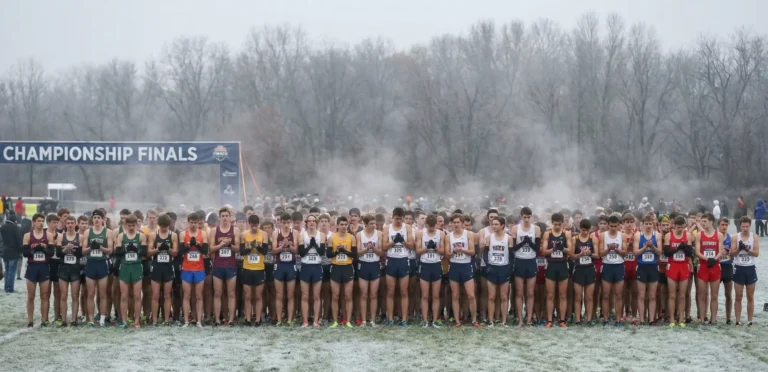
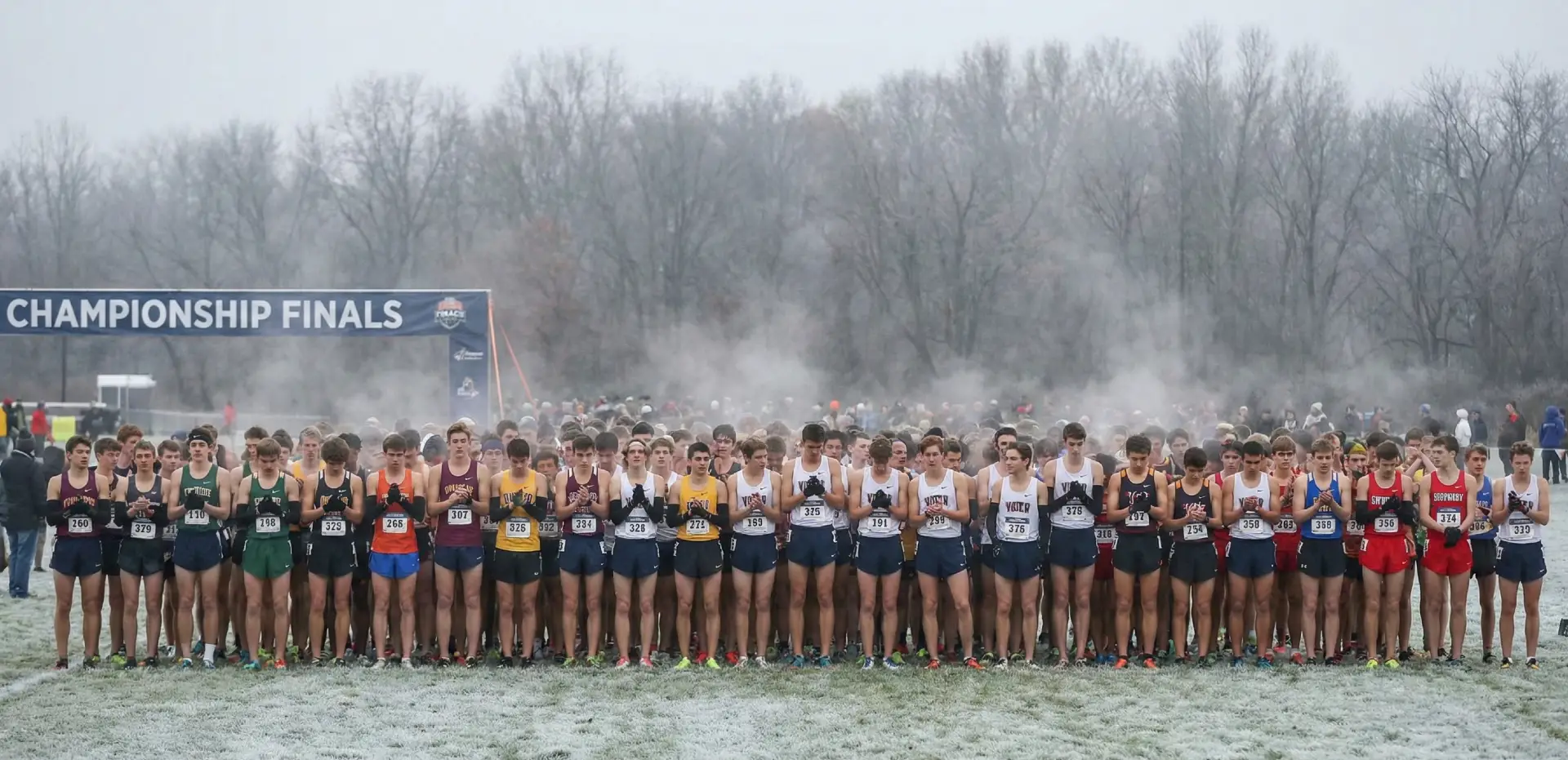
I want to answer yes for as long as I coach. That does not mean holding talented kids back. It means building a sport where the fastest runner and the slowest runner stand on the same starting line, in the same jersey, on a cold Saturday morning, and go out together.
That is what a team is. And it’s worth protecting.
Jason Saltmarsh is a USATF Level 2 Endurance Coach with 25 years of high school cross country and track coaching in New Hampshire, including 31 state champions and the 2018 NH Cross Country Coach of the Year award.
Sources
- Mike Smith, “Short Strides and Odd Thoughts: Are Elite Meets Killing HS Cross Country?” NHXCTF, September 14, 2026.
- MileSplit NJ, “Jack Tindall Won’t Be Running For Cherokee This XC Season,” August 2026.
- NFHS, 2024-25 High School Athletics Participation Survey and track and cross country trends.
- Aspen Institute Project Play, family spending survey, State of Play 2025 trends, and participation trends.
- Waber, Shiv, Carmon, and Ariely, “Commercial Features of Placebo and Therapeutic Efficacy,” JAMA, 2008, summarized in The BMJ. Espay et al., placebo pricing in Parkinson’s disease, Neurology, 2015.
- “Impacts of COVID-19 quarantine and isolation on adolescent social functioning,” Current Opinion in Psychology, 2023.
- Michigan High School Athletic Association, “U.S. Soccer Gets a Red Card,” 2012. MLS NEXT Homegrown and Academy rules, 2026-27.
- Steve Magness, Do Hard Things (HarperOne, 2022) and Win the Inside Game (HarperOne, 2025). Brad Stulberg and Steve Magness, The Passion Paradox (Rodale, 2019). David Epstein, Range (Riverhead, 2019).