

Japanese vs. American High School Distance Running
Japanese vs. American High School Distance Running
Five hundred sub-15:00 boys, a nationally televised relay, and the one training change you can make for free right now
I have coached high school cross country and track for 25 years. Thirty-one state champions have come out of my program. I have watched kids walk in as freshmen who could barely finish a two-mile time trial and leave as seniors running under 16:00.
And every few years, some coach at a clinic pulls up the Japanese high school ekiden results on his phone and slides it across the table like it is a bar bet. I’m not gonna lie. It stings a little.
So let’s actually look at it. Not as a novelty. Not as a “wow, aren’t they tough” moment. Let us look at it the way coaches look at things, with the physiology on the table, and the ethics too, and figure out what is transferable, what is not, and what we would be foolish to copy from these elite Japanese high school teams.
Here is my thesis: We do not run less hard, we run less easy. The Japanese system is not beating us with a secret workout. It is beating us with a structure.
The short version, if you only read one box
- The gap is real and enormous. Japan produced 575 high school boys under 15:00 for 5K in a single year, from a population one third the size of ours.
- It is not a talent gap. It is a training-age gap. Japanese runners arrive in high school with three-plus years of competitive junior high running behind them.
- They are not out-training us with harder hard days. A top Tokyo program runs 81 miles a week on two workouts and a full day off about 60 percent of their volume is recovery pace.
- The event structure drives everything. The ekiden rewards aerobic depth. Our high school distance caps out at 5K. Most American coaches rationally decline to build a base the system doesn’t prioritize.
- Their athletes pick their own pace group based on how they feel during the warm-up run. Autoregulation.
- And there is a real cost, mostly paid by girls. Twenty-six years of national championship data show rising rates of excessive thinness among female Japanese runners. Do not copy that part.
Quantifying the Performance Gap in Youth Distance Running
The performance gap between Japanese and American high school distance running is massive. Statistically, Japan produces over 500 high school boys under 15:00 for the 5,000-meter run annually out of a population one-third the size of the United States. Conversely, most individual US states produce fewer than five sub-15:00 high school runners per year.
Let us establish the scoreboard first, because if you do not feel the size of the gap you will not take the rest of this seriously.
The 5,000-Meter and 3,000-Meter Statistical Realities
The most-cited figures in the English-language literature come from the All-Japan High School Ekiden Championship data, and I want to be upfront about their vintage, because most articles that quote them are not.
These numbers are from 2008. They are the ones everybody uses because they were compiled and published in English, and no equally clean dataset has replaced them. Take them as a snapshot of a system, not as this year’s rankings.
In 2008 in Japan, at the 5000 meter distance, 575 high school boys were under 15:00, with the fastest at 13:33.24. For the high school girls that same year, at 3000 meters, 485 were under 10:00, the fastest being 8:58.77.
Read those slowly.
Five hundred and seventy-five boys under 15:00 for 5,000 meters. In one year. In a country with roughly 127 million people, about a third of the population of the United States.
Four hundred and eighty-five girls under 10:00 for 3,000 meters. That is 5:22 per mile, sustained. In one year.
Now think about your state. How many boys broke 15:00 last spring? In most states the honest answer is somewhere between zero and five.
And if you are tempted to write 2008 off as a high-water mark that Japan has since fallen from, it has not. Japan Running News reported a record-breaking 22 Japanese high school boys under 14:00 for 5,000 meters in a single season. Twenty-two. Under fourteen minutes! Still in high school! The system did not decay. It got faster.
The Nike Cross Nationals (NXN) Dual-Meet Simulation
The guy behind the Running Otaku YouTube channel ran a comparison I have not been able to shake.
He took the top seven finishers at Nike Cross Nationals, our national high school cross country championship, our best of the best, and scored them in imaginary dual meets against the top seven from five different Japanese high school ekiden teams, using those Japanese athletes’ track 5,000 PRs from the same year.
The NXN all-star team got swept by all five Japanese high school teams.
He knew that was not fair, since cross country is slower than a track. So he gave the Americans a 10-second-per-mile handicap. They still lost four of five.
Then he gave them 15 seconds per mile, 45 seconds off every American 5K, and they still lost to the Japanese team that had finished twentieth at the national ekiden. Not first. Twentieth.
At that same handicap, the slowest of the seven runners on the winning Japanese team would have been around 14:12, roughly the same as the fastest American. How can that be?
Long-Term Aerobic Development and Elite Marathon Depths
The obvious rebuttal: they burn out. All that mileage as teenagers, and they are cooked by 22.
The data says no.
At the professional level it stops being a comparison and becomes a rout. In February 2021 at the Lake Biwa Mainichi Marathon, 42 men, all but two of them Japanese, broke 2:10 in a single race. Across Japan’s late-winter elite marathon circuit this year, 50 Japanese men ran under 2:10. According to the World Athletics database, only 47 American men have ever run sub-2:10.
Fifty Japanese men across a single late-winter circuit. Forty-seven Americans in the recorded history of the country.
Fair caveat, and it matters: that American total spans decades, most of them pre-supershoe. Strip the carbon plates out of the Japanese number and the gap narrows. It does not close. Not remotely.
Nobody seriously claims the Japanese gene pool differs meaningfully from the American one for endurance running. This is not a talent gap. It is a pipeline gap. And pipelines are built by coaches, at the high school level.
Training Age: The Core Factor in Tissue Resilience
Before we look at a single workout, we need to fix the comparison itself, because the way it’s usually presented is disingenuous if not dishonest.
We are not comparing 17-year-olds to 17-year-olds. We are comparing a runner with 3 or 4 years of training age to one with 6 or 7.
The Japanese athlete arrived in high school having already run competitively through junior high. Japan runs a full national junior high ekiden championship, boys covering 18 kilometers in six 3K legs, girls covering 12 kilometers in five legs, with a national qualifying structure feeding into it. In 2008, the winning junior high boys’ team averaged 5:01.9 per mile.
Sit with that. Seventh, eighth, and ninth graders. National championship. Averaging five-minute miles.
By the time that kid is a high school sophomore, he has three to four years of accumulated aerobic training in his tissue, his tendons, his capillary beds, and his mitochondria.
The American kid shows up as a freshman in August. He played soccer. He has never run more than three miles at once. Maybe he did a summer program, maybe he did not.
Some people may look at the Japanese sophomore’s 5K time and conclude something about toughness.
It is not toughness. It is training age, and it is the single most underrated variable in this entire discussion. Training age is what determines how much load a tissue can absorb without breaking. It is what determines whether a 60-mile week is a stimulus or an injury.
This reframes everything, and it sharpens the prescription enormously:
You cannot fix this in high school. By the time a kid walks into your program as a freshman, the most important developmental years are behind him (in terms of high school career performance, not long-term development). The real levers are the middle school program you build or influence, and the summer, every summer, without exception.
Deconstructing Japanese High School Mileage and Structure
Top Japanese high school distance running programs like Kokugakuin Kugayama average 80 to 87 miles (130 to 140 kilometers) per week for elite athletes. However, this volume is heavily polarized: approximately 60% of the weekly volume is executed at a slow recovery pace, supported by only two high-intensity workouts and one mandatory full rest day per week.
Most articles on this topic say “they run more miles” and stop. They do run more miles. But how they run those miles is the entire ballgame, and if you copy the volume without copying the structure you will destroy your team.
Inside the Kokugakuin Kugayama Training Methodology
In the Sweat Elite documentary series covering Kokugakuin Kugayama High School (a dominant Tokyo distance program featuring over ten sub-15:00 5K athletes), the head coach detailed their weekly microcycle structure. This is not secondhand. This is the coach, in his own words.
“For the high-mileage runners, they do about 130 to 140 kilometers a week. Even the low-mileage runners do around 80 kilometers.”
That is 80 to 87 miles a week for the top group. And the bottom of that program, the kids not making the ekiden squad, is running 50 miles a week.
The team captain, Shinta Inai, confirms his own number independently later in the same video: “Distance-wise, I run about 130 to 140 kilometers a week. I drop it significantly right before a race, but during normal training periods, it’s about 130 to 140km.”
He has run 14:02 for 5,000 meters, the fastest in Tokyo, which is one prefecture out of forty-seven. Nationally, that would not crack the top tier. The All-Japan high school record is 13:22.
Meanwhile, the typical American male high school distance runner is probably running around 40 miles a week, and many are running fewer.
| Training Metric | Kokugakuin Kugayama (Tokyo) | Typical US High School Program |
|---|---|---|
| Average Weekly Volume | 80 – 87 Miles (130–140 km) | 35 – 45 Miles (56–72 km) |
| High-Intensity Quality | ~20 Miles (2 Workouts) | ~18 Miles (2-3 Workouts) |
| Moderate Steady-State | ~10 Miles (1 Group Jog) | ~0 – 5 Miles |
| Genuinely Easy Recovery | ~50 Miles (3 Restorative Jogs) | ~15 – 22 Miles |
| Weekly Rest Windows | 1 Full Day Off Non-Negotiable | Variable (Often 0–1 Days) |
| Recovery Volume % | ~60% of total volume | <30% of total volume |
The Myth of the Seven-Day Training Week
I have read a dozen articles claiming Japanese high schoolers train seven days a week, year-round, no days off. That’s the hardcore approach of a Joe Vigil.
But, the Kugayama coach says otherwise:
“On weekdays and usually Saturdays they train, and then either Sunday or Monday is a day off. They take one day off a week. They do workout sessions twice a week. Another day is a group jog, which is a slightly higher intensity jog. The remaining three days are just recovery jogs to shake out fatigue.”
Count that up. Out of seven days:
- One day off. Every week.
- Two workout sessions. Two.
- One moderate group jog.
- Three recovery jogs, and he uses the phrase “to shake out fatigue,” which tells you exactly how hard they are meant to be.
Two hard days a week. That is it.
Now do the arithmetic, because almost nobody does and it is the most important number in this article.
Call it 81 miles for a 130km week. Two workouts, with warmup and cooldown, run maybe 10 miles apiece. That is 20. The moderate group jog, call it another 10. That is 30 miles accounted for.
Which leaves roughly 50 miles a week of recovery jogging.
About 60 percent of their weekly volume is run at recovery pace.
Now ask yourself the uncomfortable question. What percentage of your team’s weekly volume is genuinely recovery pace?
For most American programs, the honest answer is under thirty percent, because we run 40 miles a week with 2-3 quality days buried in them and call it working hard.
Here is the thesis of this entire article in seven words:
We do not run less hard. We run less easy.
On morning runs, the coach is even more relaxed than most American coaches would be:
“Regarding morning practice, I really just leave it up to them. They use that time to individually work on whatever areas they feel they are lacking. Some runners have actually gotten much stronger just by focusing on that afternoon session. They are commuters, so they have to travel by train to get to school. For athletes who live incredibly far away, forcing them to do morning practice might actually be inefficient and counterproductive. So, in that regard, I have them consult with their own bodies and manage it individually.”
Consult with their own bodies. From the coach of one of the strongest distance programs in Tokyo.Sit with that for a second, and then think about the last time you heard an American coach say something that athlete-centered about doubles.
How Japanese Runners Pick Their Own Workout Paces
Here is the Kugayama workout the camera crew filmed, and it is the single most transferable thing in this entire article.
The session was 6 to 8 x 400m at 5K race pace, tuning up for a 5,000 time trial. Straightforward enough. But listen to how the coach assigns it:
“As for the pace, the fastest boy is running at 66 seconds. He is aiming for a 13-minute time. The next group is at 68 seconds; those guys are aiming for a single-digit 14-minute time. After that, it goes to 70 seconds, 72 seconds, split roughly into 2-second increments.”
So far this is just pace grouping. Any competent American coach does this. Then the interviewer asks whether the athletes choose their group.
“Yes, that’s right. There isn’t a strict rule dictated to them about exactly how many seconds they must run; they basically join the group they want to train with.”
And then the detail that stopped me cold. The team’s track is five kilometers from the school. They run there as a warm-up. And that run over is not just a warm-up:
“They kind of treat the run over as a trial period to check how they feel, see if they can keep up today, and then they decide which group to enter based on that.”
Read that again.
The athletes run three miles to the track, and during those three miles they are assessing themselves. How do the legs feel today? Did I sleep? Am I fighting something? By the time they arrive, they have made a decision about which pace group they belong in today not which group they belong in on paper, not which group matches their PR, which group matches their body this afternoon.
Then they run that group’s pace. And the coach backs them.
That is autoregulation. It is what every sports science paper for the last fifteen years has been telling us to do, and this Tokyo high school coach is doing it, and it costs him nothing.
Compare it to how most of us assign a workout. We hand a sophomore a target pace on Sunday based on a race he ran three weeks ago, and on Tuesday we hold him to it whether he slept four hours or nine, whether he is growing an inch this month or not, whether he is coming down with something or not. And when he blows up in rep six we call it a bad day. Okay, maybe you don’t do that, but you probabaly know someone who does.
A high schooler who has learned to read his own body is worth more to you than a high schooler who has learned to hit your splits. The first one is still running at twenty-six. The second one may be battling an overuse injury later in the season.
You can install this tomorrow! Post three or four pace groups. Let the warm-up be the assessment. Back their choice.
If you actually try this, introduce it in stages, because self-selection is a skill and it has to be taught.
This works at Kugayama because those athletes have six years of training age and know what their own bodies feel like. A freshman does not. Hand a freshman four pace groups and he will pick the one his friend picked, or the one that flatters his ego, or the one that matches the PR he ran in September before he grew two inches.
A graduated approach to going “full-Kugayama:”
- Freshmen: you assign the group. But you ask them how they feel first, and you say your reasoning out loud. “You look flat today and you told me you slept five hours. You’re in the 82 group, not the 78. Here’s why.” You are teaching them the vocabulary.
- Sophomores and juniors: you offer two adjacent groups and let them choose between them. Bounded autonomy. They cannot pick something reckless, but the choice is real.
- Seniors and experienced athletes: full self-selection. The Kugayama model. They have earned it and they have the training age to use it.
The Gifu Prefecture 3:00/km Pace Architecture
For the pace structure underneath all this, we have a second source: a retired Gifu prefecture coach whose training paperwork anchors the Running Otaku analysis.
A note on evidence, because the two sources are not equal. The Kugayama material is primary, a named coach, on camera, describing his current program. The Gifu material is secondhand: a retired coach’s documents, filtered through an analyst. Where they conflict, trust Kugayama. That is precisely why I corrected the rest-day claim above. But on pace architecture the two agree, and the Gifu documents lay out the structure in more detail than any interview could.
He built his entire system around one number: 3:00 per kilometer. That is 4:50 per mile.
Everything cascades from that single anchor:
The coach organized his athletes’ paces into five bands: strides faster than 10K pace, roughly 4:30/mile; speed intervals of 1K to 3K just faster than 10K race pace, 4:30 to 4:50/mile; speed-endurance work at 10K race pace; fast endurance, essentially lactate threshold, over 8K to 16K; and endurance and recovery running at 4:40 to 5:00 per kilometer, which is 7:30 to 8:00 per mile.
Look at that last line again.
A boy capable of 30:00 for 10K, 4:50 per mile, does his recovery runs at 7:30 to 8:00 per mile.
Nearly three minutes per mile slower than race pace.
How many of your athletes do that? How many run their easy days at 7:00 flat because their teammate is running 7:00 and nobody wants to be the guy off the back?
I will say this as plainly as I know how: the Japanese are not out-training us with harder hard days. They are out-training us with easier easy days, which is the thing that permits the faster race days.
Two workouts a week. Three recovery jogs to shake out fatigue. A day off. Eighty-seven miles.
That is not a brutality story. That is a patience story, and we have been telling it wrong for twenty years.
This is the same principle the Norwegians formalized decades later with double-threshold work and lactate control. The same principle Arthur Lydiard preached to New Zealanders in 1960. The same principle in Jack Daniels‘ Running Formula when he tells you E pace exists for a reason and running it faster does not make you fitter.
Polarization is not a Norwegian invention. It is a physiological law. The Japanese found it early and had the discipline to obey it.
The weekly structure
The Gifu coach ran a nine-day rotation rather than a seven-day one. Two easy days, then a couple of hard days, an easy day, then hard again.
Inside a representative block:
- Tuesday: speed endurance, including a 4K tempo and a 2K tempo
- Wednesday: 16K (10 miles) continuous at 3:20–3:32/km, about 10 percent slower than 10K race pace, a genuine steady state
- Friday: 12K (about 8 miles) at 3:15–3:22/km, only five to seven percent slower than 10K race pace, a hard aerobic grind, finishing with a hard 1K up a hill
- Saturday: a hilly 16K progression on dirt trails
That last detail deserves its own paragraph.
The myth is that Japanese runners pile all their mileage onto pavement. Not so. The Saturday run is a cross-country build-up on trails, and one reason the coach programs it is so the entire team can run the first 5 to 10K together, which lets the slower and younger athletes run alongside the elite guys on the team.
That is not sentimentality. That is a coaching decision serving a physiological purpose and a retention purpose in the same session. We will come back to it, and I will show you the mechanism.
The Physiology of Aerobic Volume in Adolescent Athletes
Here is the mechanism, and it matters.
Endurance performance rests on three pillars: how much oxygen you can deliver (VO2max), what fraction of that ceiling you can hold for a long time (lactate threshold, practically speaking), and how much energy you burn to move at a given speed (running economy).
For a 15-year-old, VO2max is the least trainable of the three. The youth trainability research indicates that central factors, cardiac output, stroke volume, rather than peripheral oxygen usage determine training-induced aerobic gains in children, and that the magnitude of cardiac adaptation in children is somewhat lower than in adults, contributing to reduced aerobic trainability in that age group.
Translation: hammering VO2max intervals at a 14-year-old buys you less than you think it does.
But threshold and economy? Highly trainable, and they respond to years of accumulated aerobic volume, not to weeks of interval punishment.
The systematic review evidence on mitochondrial and capillary adaptation is clear that while all training modalities raise VO2max similarly, endurance training produces the largest increases in capillary density, and training load, volume multiplied by intensity, is a suitable predictor of change in mitochondrial content. Capillarization specifically favors endurance work, with endurance training producing capillary density increases 5 to 10 percent higher than high-intensity or sprint protocols.
Capillary density and mitochondrial volume are the two things that move a threshold. They are volume-driven. They accumulate slowly. They are the physiological equivalent of compound interest.
The Japanese system starts compounding in junior high and never stops. Our system starts compounding in August, stops in November, restarts in March, stops in June, and then a lot of kids do nothing until August.
We keep opening and closing the account. That, more than any single workout, is the gap.
The Ekiden Competitive Structure as a Training Stimulus
You cannot understand Japanese high school running without understanding the ekiden, and Americans consistently underrate it because we hear “relay” and picture a 4×800.
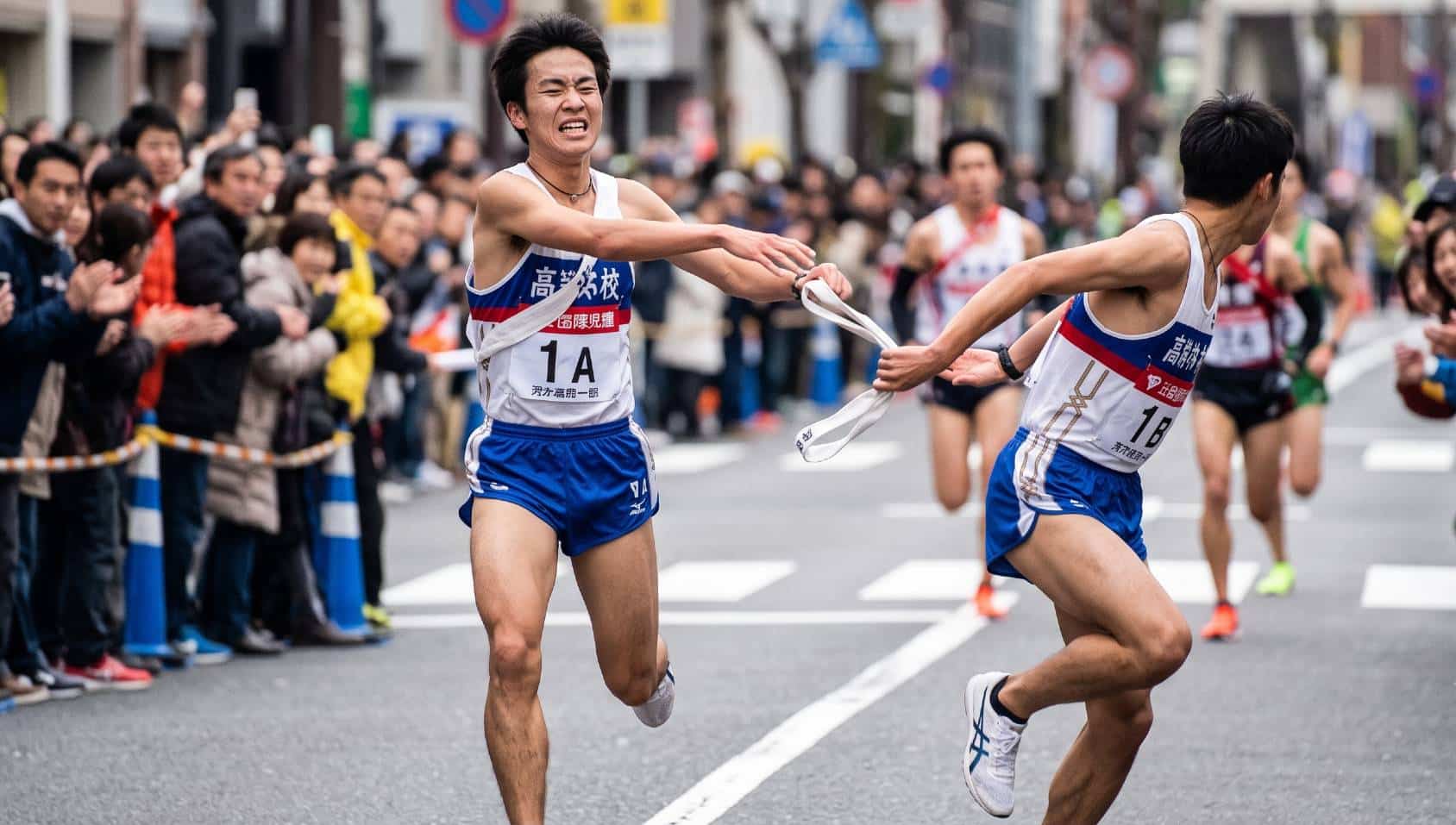
An ekiden is a long-distance road relay. Runners hand off a sash called a tasuki instead of a baton.
The high school national championship
Each of Japan’s 47 prefectures sends one boys’ team and one girls’ team to Kyoto for the national championship in late December. Competition is school-based, not club-based. There are no regional all-star teams.
That is critical. When you see those times, you are looking at one high school. Not a select squad.
The boys’ race covers exactly a marathon, 42 kilometers, split into seven legs ranging from 3K to 10K. The 10K runners come through in about 29 minutes. The 8K runners run about 23 minutes.
The girls run five legs covering a half marathon. In the 2008 field, of the 47 qualifying schools, 36 high schools listed at least five girls with 3,000-meter times under 10:00.
Thirty-six schools. Five girls each. All under 10:00 for 3K. Yowza!
Why the race format is itself a training driver
Here is the structural genius, and I want American coaches to think about this.
Because the legs range from 3K to 10K, the team must train for a range of distances simultaneously. Some athletes need 10K strength. Some need 3K speed. They all build it from the same aerobic base, in the same group, on the same trails.
The team is training for distances that in many instances are far longer than the 5K American kids are training for in high school.
Meanwhile our track season is built around the 1600 and 3200. Our cross country course is a 5K. Our entire developmental incentive structure caps out at three miles.
If the longest race your track and field athlete will run all year is 3,200 meters, why on earth would you build a 60-mile aerobic base? The system does not reward it. So most coaches do not do it, and they are being rational.
Event structure determines training. Training determines the athlete. Japan built a competitive calendar that demands aerobic depth, and got aerobic depth.
Hakone: the engine behind the engine
Then there is the university race that makes the whole thing go.
The Hakone Ekiden runs 108 kilometers from Tokyo to the resort town of Hakone on January 2, then 110 kilometers back on January 3. Twenty-three universities, ten runners each. It has been broadcast live since 1987, roughly 11 hours of uninterrupted coverage.
Brett Larner, editor of Japan Running News and a 25-year resident of Japan, puts the viewership at up to 35 percent, with 65 million people watching at some point, attention comparable to a Super Bowl or a Champions League final. Larner credits the television production: road race broadcasts outside Japan mostly show the leader, while ekiden coverage follows the race from multiple perspectives, who started where, who is overtaking, who is dropping, who is still to come.
Larner is careful about not reducing this to a tidy cultural stereotype, and I want to honor that carefulness.
“It’s easy to say that the aspect of each individual contributing their best for the benefit of the group as a whole fits conceptions of what Japanese culture is, but I try to avoid thinking in those terms,” he says. “Ekidens are popular because, like popular team sports anywhere, they’re fun to do and exciting to watch.”
American kids play basketball and football because they see those sports on TV and want to do that. Distance running in Japan works the same way. It is already popular, and that popularity drives more popularity.
Visibility creates participation. Participation creates depth. Depth creates performance.
We have 238,685 boys and roughly 191,733 girls running high school cross country in the United States, per the NFHS 2024-25 participation survey. That is a large pool. It is not a deep one, because almost none of those kids has ever seen distance running presented as something a nation stops to watch.
The Health Consequences of Excessive Volume: RED-S and Thinness
Now I am going to change tone, and I am not going to soften it.
If you take everything above and go tell your sophomore girls they are running 80 miles a week starting Monday, you will hurt them. Possibly permanently. And you will be repeating a mistake the Japanese themselves are now openly reckoning with.
Thinness has trended the wrong way for a quarter century
A 2014 peer-reviewed study published in the Asian Journal of Sports Medicine analyzed 26 years of data (1989–2014) from the All-Japan High School Ekiden Championship and revealed critical health trends:
- Systemic Female Thinness: Rates of mild, moderate, and severe thinness consistently increased among elite adolescent female runners across a quarter-century.
- Gender Asymmetry: Severe thinness was concentrated almost exclusively in female athletes; only 0.13% of the 12,768 male runners met the criteria for severe thinness.
- Clinical Pathologies: The data correlates heightened competitive pressure with an increased prevalence of Relative Energy Deficiency in Sport (RED-S), bone density degradation, and eating disorders.\
Read that asymmetry again. The boys are fine. The girls are not. Over twenty-six years it got worse, not better.
It goes further than thinness
Japan Running News has documented practices at the elite high school level that should stop any American coach cold.
In reporting on iron injection abuse, one woman who graduated from a high school in East Japan described her coach taking her to a local hospital up to three times a month. A week before a big race, all five members of the ekiden team would receive injections. The coach told them it had vitamins mixed in, so it was fine. A doctor confirmed all five girls received iron injections and iron drips, and that the coach brought them in every week starting around September, often without any blood testing beforehand.
The JAAF has since had to crack down and mandate blood testing.
On the weight side, Professor Yamauchi, quoted in the same outlet’s coverage of a former national-team marathoner who developed an eating disorder, names the mechanism directly:
As the level of high school ekiden competition has increased, measures to suppress athletes’ weight in order to improve performance have led to many adverse outcomes, including weaker bones, higher injury rates, athletes quitting the sport as a result, and increased prevalence of eating disorders.
Weaker bones. Higher injury rates. Athletes leaving the sport. Eating disorders.
Those are outputs of the same system that produces the 9:20 3K girls. Both things are true at once. Any coach who shows you the times without showing you this is selling you something.
I have written elsewhere about RED-S and the adolescent female runner, and every word of it applies double here.
The number with the hidden denominator
And here is the part that almost never gets said.
Those 575 sub-15:00 boys are a numerator. Nobody publishes the denominator.
They are the ones who remained. We have no idea, because it is not tracked in any English-language source I can find, how many started, got hurt, got pushed out, or quit.
A system with an enormous pipeline can absorb enormous attrition and still produce staggering top-end numbers. It may be a substantial part of the explanation for them.
We do not have that pipeline here in America. We cannot afford that attrition. And frankly, we should not want it even if we could afford it. Every runner deserves to be protected from harm and cared for by their coach.
The mileage literature is genuinely unsettled, and I am not going to pretend otherwise
On one hand: research indicates 28 to 38 percent of high school runners sustain at least one running-related injury during a season, and injury risk is related to running more miles per week. Identified extrinsic risk factors in high school cross country runners include low step rate, higher weekly mileage, and infrequently alternating short and long training mileage. Female high school cross country runners classified as high sport specializers carried a two-fold greater risk of musculoskeletal injury than low specializers.
On the other hand: a systematic review of youth distance running and lower extremity injury found no correlation between running mileage and sustaining an injury, and concluded that available literature suggests youth can participate in distance running with minimal adverse effects, with one exception, an increased vulnerability to growth plate injury. The main finding was a paucity of research, and mileage recommendations cannot be made for runners under age 15.
That review is explicit: we do not have the evidence to back recommendations for youth distance running, including what distances are safe.
So where does that leave a coach?
Where coaches actually live: making decisions under uncertainty about other people’s children. And when you are operating under uncertainty about other people’s children, the correct default is conservatism, individualization, and a bias toward the athlete’s twenty-year health over your November result.
The specialization finding is the one I would carve into the wall. Two-fold injury risk for high-specializing girls. That one is not ambiguous, and it points straight at the thing our system does badly, pushing kids to run year-round with no off-ramp, no second sport, no genuine break.
Japan’s Blind Spot: Why They Own the Marathon and Lose the 1500
Japan is dominant in the marathon and largely absent from the 1500 and 5000. The observation from inside the sport is consistent: lots of miles and threshold work, less volume and frequency of 5K pace and faster sessions, which is also why they are mediocre in middle distance events.
The depth reflects it. Japan is incredibly thin at 800 and 1500, because most middle-distance-capable athletes are trained to run 20-kilometer ekiden legs in college.
Larner frames it structurally: people start road running in ekidens in junior high or earlier, and it stays the focus, with track and cross country mostly supplemental. The system is really geared toward the half marathon, and when you develop a large pool of runners with solid half marathon experience, it is not a big jump for a subset of them to succeed as marathoners.
This is the physiological receipt for everything above. A system built on enormous aerobic volume and threshold work at the expense of top-end speed produces exactly the athlete you would predict: a devastating tempo runner with no kick.
It also demolishes the lazy “the Japanese are just tougher” story. They are not producing a superior runner. They are producing a superior marathoner, on purpose.
And notably, Larner pushes back on even the mileage stereotype:
Stereotypical Japanese training is based on loads of mileage, but that isn’t really an accurate picture. There’s a wealth of approaches and ideas, especially among younger coaches.” He cites Yuta Shitara, who set a 2:06:11 national record, saying on television with his coach that mileage is an old-fashioned way of doing things, that he never runs over 30 kilometers, that he does a lot of quality, and that he always does a 25 to 30 kilometer tempo run three days before a marathon.
So even in Japan, good coaches there are arguing about the same things we are arguing about.
The kid inside the system who sees it clearly
But the most damning critique of Japanese distance running I have encountered did not come from an American analyst or a sports scientist. It came from a Japanese high school student, on camera, in the Kugayama video.
Koki Terada is a third-year at Kugayama. He runs 1:49 for 800 meters and 3:46 for 1500. In a program where, in the coach’s own words, “most of the kids who enroll at Kugayama do so because they want to run the National High School Ekiden in Kyoto,” Terada is the outlier who came for the track.
The interviewer asks him about Hakone, the race every Japanese schoolboy supposedly dreams of.
“Well, I think the Hakone Ekiden itself is a very interesting event. But if you ask me if I actually want to run it myself… my feeling that it is ‘fun to watch’ is much stronger than any desire to run it. I don’t really want to run it myself.”
Asked why, he gives an answer sharper than anything in the coaching literature:
“If you look at those who run the Japanese Ekidens on the roads and then look for athletes who go on to truly compete at the world’s top level after graduating university, there are almost none. I feel like there are a lot of athletes who get injured doing that and become unable to reach the top level, so I’d rather avoid it.”
A seventeen-year-old just diagnosed his own country’s development system.
To be precise about what that quote is and is not: Terada is describing a perception, not citing a study. He has not run the numbers. But his perception maps exactly onto the structural argument the data supports, and that is the point. He is not guessing. He is watching it happen to the kids around him and drawing the correct conclusion.
He is describing exactly what I laid out above: a pipeline optimized to produce ekiden and marathon runners, which grinds up the middle-distance talent that might otherwise have become world-class. He can see it happening to the kids around him. And he has decided not to volunteer for it.
Ask him who he watches, and he does not name a single Japanese runner:
“The number one athlete is Jakob Ingebrigtsen from Norway. Also, from the US, athletes around my generation like Simeon Birnbaum or the Young brothers. Because our ages are so close, instead of looking at someone like Jakob, they make me think, ‘If I work harder, I can actually compete with them.'”
Meanwhile Shinta Inai, the team captain and the fastest high schooler in Tokyo at 14:02, gets asked the same question and says: “I don’t really have an athlete I admire or look up to at all.”
Two athletes, same team, same track, same afternoon. One is aiming at the Olympic marathon by way of Hakone. The other is watching our juniors and thinking he can beat them.
Terada’s final word on whether a Japanese athlete can reach the world level at 1500 without leaving:
“I think if you just follow the traditional Japanese mindset and stay in Japan, there is a limit… But right now, the reality is that there aren’t really any athletes who train exclusively in Japan and are successfully battling at the world level. So, I want to go abroad.”
Their best middle-distance kid wants to come here. He is looking at Simeon Birnbaum and the Young brothers and thinking those are my peers. Whatever we are doing badly, we are doing something at 1500 meters that a Japanese phenom is willing to cross an ocean for.
The coach who let him
One more thing from that transcript, and it is a coaching lesson, not a cultural one.
The Kugayama coach could have crushed Terada. Every incentive pushed that way, the program is built around the ekiden, the school’s identity is the ekiden, and here is a kid with an engine saying he does not care about it.
Instead:
“He came to our school explicitly stating he wanted to do track, specifically the 800m and 1500m. At first, he had absolutely no interest in the Ekiden. He was like, ‘I don’t really care about competing in it.’ For athletes like him, I let them compete primarily on the track at first. But when they see the team aspect of the sport, they start thinking, ‘I want to run this too.’ So, since last year when he was a 2nd-year, even though he still does track, he has started running the Ekiden during the Ekiden season.”
He let the kid be who the kid was. And the kid came around on his own, partway, in his own time, because he wanted to and not because he was told to. Patience is a virtue.
Actionable Training Modifications for American Coaches
Here is my honest list. Not “copy Japan.” Copy the mechanisms that are portable, ethical, and free.
Steal this: easy-day discipline
Number one, and it is not close. It is the highest-leverage change available to almost every American high school program.
The principle: an easy day should be conversational. If your athlete cannot speak in full sentences, it is not an easy day. It is a mediocre workout that costs recovery and buys nothing.
And I am going to be braver about the number than I was in the first draft of this piece, because the evidence demands it.
Both Japanese sources point the same direction, and it is a direction that will make most American coaches uncomfortable. The Gifu chart has a 30:00 10K runner, a 4:50-per-mile athlete, jogging his recovery days at 7:30 to 8:00 per mile. That is two and a half to three minutes per mile slower than race pace. And Kugayama runs sixty percent of its enormous weekly volume at that kind of effort.
The best programs in the world run their easy days dramatically slower than most American coaches think is acceptable. If your athlete’s easy pace feels too slow to you, it is probably close to right.
Anchor it to breathing and conversation, not to a GPS. Individualize it. A kid coming off a growth spurt, a kid short on sleep, a kid in a hard exam week, their easy pace today is not their easy pace last month.
Every mile of easy running done too fast is a mile that costs you recovery and buys you nothing. It is worse than a day off. I have moved a team’s threshold more by slowing easy days than by adding any interval session.
Steal this: aerobic volume, built across years, not weeks
Not 80 miles. Please, not 80 miles.
But the principle that threshold and economy are built by accumulated aerobic volume, and that accumulation is a multi-year project, is the physiology, and it is real.
The lever is not “run more this week.” The lever is run consistently for four years. See my piece on safe mileage progression.
Progressive. Individualized. Year over year. That is the transferable version, and it is bounded by training age, not by what the Japanese kid down the street is doing.

Steal this: run the team together, and here is the mechanism
Remember the Gifu coach’s Saturday trail run?
The mechanism is specific: the varsity athletes run the first 5 to 10K of the session with the entire team, then continue on to finish their own longer, harder work after the group peels off.
Nobody gets bagged. Your top kid still gets his session, he just gets the first half of it as a shakeout with the freshmen instead of alone. And your fifteenth kid spends 30 minutes a week running shoulder-to-shoulder with the best runner in the program, which is worth more to his retention than anything you will say to him in a team meeting.
Because here is the thing: the biggest constraint on American high school distance depth is not that our best kids are slow. It is that we lose the seventh through twentieth kid on the roster to attrition, boredom, and the quiet sense that they are not really on the team.
Run together. Build it into the structure of a hard day, not as a nice gesture on an easy one. It is free and it works.
Steal this: give the calendar something worth building toward
You cannot rewrite your state association’s meet schedule tomorrow. But you can build a program culture where the 5K is treated as the real event, where summer base is not optional, and where a kid who wants to be good understands the work happens in July.
And if you have any influence at the state or association level, push for more. A 5,000 on the track. A distance medley. A road relay. Structure creates behavior. Japan proved that at national scale.
Do NOT steal this: weight as a performance lever on teenagers
I am going to be as clear as I know how to be.
Twenty-six years of national championship data show the girls in that system getting thinner and thinner and thinner. Yamauchi’s list, weaker bones, higher injury rates, kids quitting, eating disorders, is the bill that came due.
You do not talk to a fifteen-year-old about her weight. Not once. Not as a joke. Not “as a nutrition conversation.” The cost is a stress fracture, a career that ends at twenty, and bone density she never gets back.
If you take one thing from this entire article, take that one.
Do NOT steal this: the volume, without the architecture underneath it
The danger is not that Japanese kids train seven days a week. They do not. The Kugayama coach gives his athletes a day off every week, runs two workouts, leaves morning runs to the athlete’s own judgment, and tells them to consult their own bodies.
The danger is that an American coach reads “80-plus miles a week” and implements the number without installing any of the four things that make the number survivable:
- Six years of training age underneath it. Their kids started in junior high.
- Two hard days a week. Two. Not four. Not “every day is quality.”
- Recovery runs actually run at recovery pace three of them, explicitly described as shaking out fatigue.
- A day off, every week. Non-negotiable, from the coach’s own mouth.
Strip those four pillars out, run them for 80 miles a week, and you won’t have a team to coach.
And the specialization data is unambiguous on who pays first: high-specializing female cross country runners carry a two-fold greater musculoskeletal injury risk than low specializers.
So give them a day off. Give them a real off-season. Let them play another sport. Let a kid who wants to be a miler be a miler, the Kugayama coach did exactly that with Terada and got a 1:49 800 out of it and, eventually, an ekiden runner too.
The athlete still running at twenty-six is worth more to this sport than the one who ran 15:40 as a junior and never ran again and never recommended the sport to anyone else lest they end up hurt and miserable too.
The Question That Should End Every Version of This Article
The Running Otaku video closes on a note that has stuck with me longer than any of the split times.
He asks: which would you rather have, a really great, fun high school experience, or something that was not much fun but where you got the most out of yourself? For each of us the answer will be different. But for a lot of Japanese runners, they are willing to forego that kind of happiness in exchange for personal growth and being part of a great team.
I have chewed on that framing for a long time, and I think it is false and oversimplified. And, I think American coaches are actually well positioned to prove it.
The kids on my teams who ran fastest were not the ones who suffered most. They were the ones who stayed healthy four straight years. Who loved being on the team enough to show up all summer long. Who ran their easy days easy because they trusted me when I explained why. Who were still hungry to race as seniors because we had not spent them by sophomore year and they found the podium off 35-40 miles per week.
Consistency beats intensity. Longevity beats heroics. That is not a soft position, that is the physiology. Capillary density and mitochondrial volume do not care how much it hurt. They care how many months in a row you fed them.
The Japanese system is not winning because their kids suffer more. It is winning because their kids run easy on easy days, run together, start compounding at twelve instead of fifteen, and grow up in a country where the biggest race of the year is on television and everybody watches.
Three of those four you can build in your program starting Monday. For free. The fourth one is on all of us.
Frequently Asked Questions
How many miles do Japanese high school runners run per week?
At Kugayama, a top Tokyo program, the head coach states on camera that his high-mileage runners cover 130 to 140 kilometers per week, roughly 80 to 87 miles, while even the low-mileage runners cover about 80 kilometers, or 50 miles. The typical American high school distance runner runs closer to 40 miles per week. But the volume is not the real story. That same coach schedules only two hard workouts per week, three recovery jogs explicitly meant to shake out fatigue, and one full day off every week. Japanese high schoolers do not train seven days a week, contrary to the common claim. They run a large volume at genuinely easy intensity, on top of three-plus years of junior high training age.
Why are Japanese high school runners so much faster than American high school runners?
Four structural reasons, in rough order of importance: a much longer training age (competitive running starts in junior high, with a national junior high ekiden championship), genuinely easy easy days that permit genuinely hard hard days, an event structure, the ekiden, that rewards aerobic depth rather than capping at two miles, and a national culture where the Hakone Ekiden draws Super Bowl-level viewership and makes distance running visibly aspirational.
What is an ekiden?
An ekiden is a Japanese long-distance road relay in which runners hand off a cloth sash called a tasuki instead of a baton. The high school national championship covers a full marathon across seven legs of 3K to 10K for boys, and a half marathon across five legs for girls. Each of Japan’s 47 prefectures sends one school team, not an all-star squad.
How fast should a high school runner’s easy days be?
Conversational. If the athlete cannot speak in full sentences, it is not an easy day. For most high school runners that falls roughly 90 seconds to two minutes per mile slower than current 5K race pace, but this is a range to check against effort, not a number to enforce with a GPS. Individualize by athlete and by day.
Do Japanese high school runners burn out?
Not in the way Americans usually assume, Japan’s depth at the university and professional level is enormous, which argues against widespread physiological burnout among the athletes who continue. But the published data documents serious harm, particularly to girls: 26 years of national championship data show steadily rising rates of excessive thinness in female runners, alongside documented iron injection abuse and elevated eating disorder prevalence.
Why is Japan dominant in the marathon but weak in the 1500 and 5000?
Because the training makes that trade on purpose. Enormous aerobic volume and threshold work at the expense of top-end speed produces a devastating tempo runner with little finishing kick. Most middle-distance-capable Japanese athletes get funneled into training for 20-kilometer ekiden legs in college rather than developing as milers.
Sources and Further Reading
- “High School Cross Country Running Japan vs. America” Running Otaku, YouTube. Watch here.
- “EKIDEN E5, Kugayama High School, With Over 10 Sub-15:00 5K Runners” Sweat Elite / Tempo Japan. Watch here. The most valuable source in this article.
- Japan Running News Brett Larner. japanrunningnews.blogspot.com.
- Brett Larner interview CITIUS Mag. Read here.
- “The hunt. The hunted down. The ekiden, a psychological game” Maurten. Read here.
- “Secular Trend in Thinness Prevalence for 26 Years (1989–2014) among High School Runners in Japan” Asian Journal of Sports Medicine. PubMed Central.
- “Iron Injections Remain an Issue in Japanese High School Girls’ Distance Running” Japan Running News. Read here.
- “Youth Distance Running and Lower Extremity Injury: A Systematic Review” IJERPH. PubMed Central.
- “Adolescent Running Biomechanics: Implications for Injury Prevention and Rehabilitation” Frontiers in Sports and Active Living. Read here.
- “Effects of Exercise Training on Mitochondrial and Capillary Growth in Human Skeletal Muscle” Sports Medicine. Read here.
- “Trainability of Young Athletes and Overtraining” Journal of Sports Science & Medicine. PubMed Central.
- NFHS High School Athletics Participation Survey, 2024-25. Read here.
- All-Japan High School Ekiden Championship format and history.
- “Ekiden: A closer look at the Japanese way” ESPN. Read here.