
Running in Wildfire Smoke: A Cross Country Training Guide
By Dr. Jason Saltmarsh, USATF Level 2 Coach
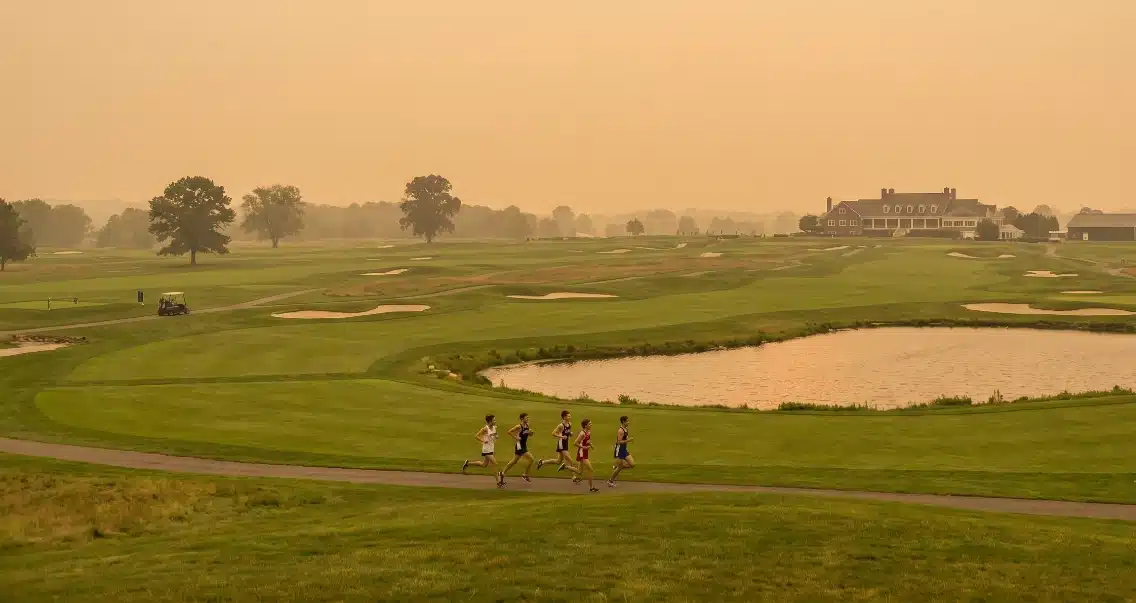
The sky turns the color of a dirty penny. The sun sits low and orange at ten in the morning. You walk out to the track and the air smells like a campfire that nobody lit. If you coach cross country anywhere in the northern half of the country, you already know this feeling. Unfortunately, running in wildfire smoke has become part of the preseason.
As I write this, smoke from Canadian wildfires is pouring across the border again. On July 15, 2026, air quality alerts covered a swath of the Midwest and Northeast, with forecasters warning that roughly 100 million people could see degraded air into the end of the week. Here on the New Hampshire seacoast we caught the edge of it. Boston went milky and hazy. This is not a freak event anymore. In Canada this summer, nearly 3,500 fires have burned more than 4.8 million acres, and the door stays open for more plumes to drift south for months.
So the question is not whether your team will train under smoke this season. The question is what you do when it happens. This article is a coach-to-coach guide built from the current science, the guidance from athletic and public health authorities, and a couple of decades of watching kids run in every kind of weather. I want you to walk away with a plan, not a problem.
Why Wildfire Smoke (PM2.5) is Dangerous for Runners
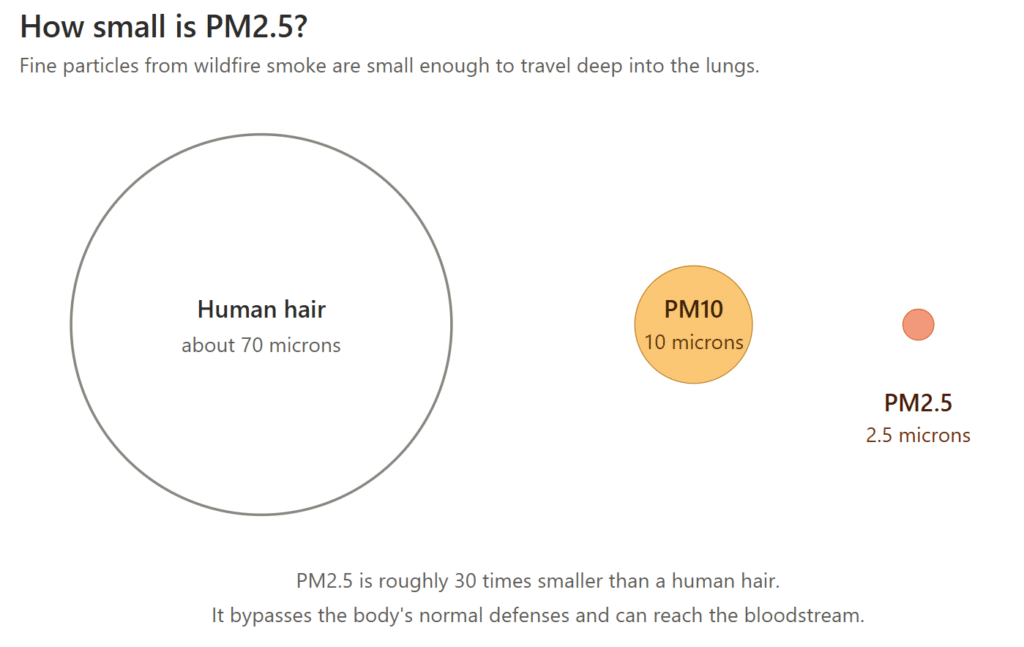
Smoke is not just haze. The thing that matters for runners is a pollutant called PM2.5, which stands for fine particulate matter smaller than 2.5 microns in diameter. To put that in perspective, a human hair is about 30 times wider. These particles are small enough to travel past your body’s normal defenses, deep into the gas-exchanging parts of the lungs, and in some cases straight into the bloodstream.
Once they are in there, they do not sit quietly. PM2.5 triggers oxidative stress and inflammation, which impairs both lung and vascular function. Public health agencies note that exposure can cause coughing, throat irritation, shortness of breath, and chest tightness, and that it can aggravate asthma and heart conditions.
Here is the part every distance coach needs to sit with. Runners are not average bystanders. During hard effort, an athlete’s breathing rate can climb to 15 to 20 times the resting level. That means a runner doing a workout inhales vastly more polluted air than a person standing on the sidewalk over the same stretch of time. We are not just exposed to smoke. We actively pull it in, harder and deeper, exactly when the particle count is high.
That is the whole problem in one sentence. The behavior that makes your team fit is the same behavior that makes smoke dangerous to them.
Research on Wildfire Smoke and Running Performance
Let’s start with performance, because that is what athletes ask about first. A large study out of Brown University, published in Sports Medicine in December 2024, analyzed more than 2.5 million marathon finish times from nine major U.S. races between 2003 and 2019 and matched them to modeled pollution data. The finding was clean. For every one microgram per cubic meter increase in PM2.5, men finished about 32 seconds slower on average and women about 25 seconds slower. The effect was strongest in faster-than-median runners.
Read that again. The most affected group was the fittest runners, not the least fit. As senior author Joseph Braun put it, air pollution is a risk “not just for those who are elderly or susceptible” but can affect “even the most healthy and well-trained among us.” The likely reason is that your best runners breathe the biggest volumes at the highest rates, so they take in the most polluted air.
This is not a single study standing alone. A 2023 paper in Scientific Reports tracked 334 collegiate male distance runners from 46 universities and measured their air pollution exposure over the 21 days before a 5K championship. Higher PM2.5 and ozone exposure during that training window was associated with slower race times, on the order of 11 to 13 seconds. The key word there is training. The damage did not require running the race in smoke. Breathing dirty air during the buildup was enough to show up on the clock weeks later.
Now the health side. The lung function research is sobering, and it is worth knowing before you make a call about a practice. After the 2017 Seeley Lake wildfire in Montana, where residents endured a daily average PM2.5 of 220.9 micrograms per cubic meter for weeks, researchers followed a community cohort. The share of participants with lung function below the normal range more than quadrupled one year later, from about 10 percent to 46 percent, and was still elevated two years out. Studies of wildland firefighters, who work in heavy smoke while exerting themselves, show measurable declines in lung function measures like FEV1 across a single shift, with a meaningful fraction dropping more than 10 percent.
I am not saying an easy run in orange air will scar a teenager’s lungs for life. Those cohorts saw exposures far beyond a typical practice. But the direction of the evidence is not ambiguous. Smoke lowers performance and stresses the respiratory system, and hard breathing amplifies both. That is enough for me to build a policy around.
How to Read the AQI for Running and Athletics
You cannot manage what you do not measure. The tool is the Air Quality Index, or AQI, an EPA scale that runs from 0 to 500 and folds several pollutants into one number with a color code. For wildfire situations, the pollutant that matters is particle pollution, so make sure you are reading the PM2.5 version.
The categories every coach should have memorized:
- Green, 0 to 50, Good. Normal training. No changes.
- Yellow, 51 to 100, Moderate. Generally fine. Keep an eye on your asthmatic and sensitive athletes.
- Orange, 101 to 150, Unhealthy for Sensitive Groups. This is your first decision point.
- Red, 151 to 200, Unhealthy. Everyone is affected. Serious modification.
- Purple, 201 to 300, Very Unhealthy. Move indoors or cancel.
- Maroon, 301 and up, Hazardous. No outdoor activity, period.
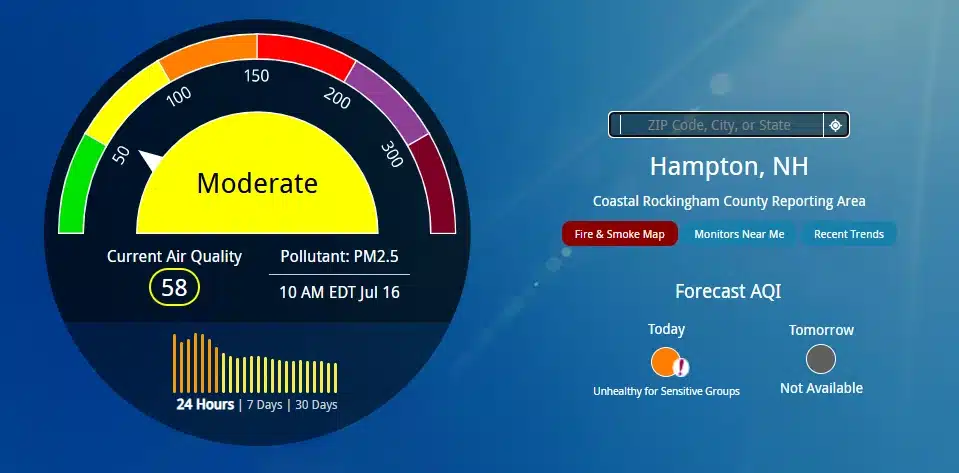
Your two best free resources are AirNow.gov and its Fire and Smoke Map, both run by the EPA. AirNow gives you current readings and forecasts by zip code. Be honest about its one limitation: the monitors are not sitting on your track. During a fast-moving smoke event, readings can lag or differ from what you see and smell at your venue. When the map says one thing and your eyes and throat say another, trust the more cautious signal.
I would also point you to the EPA’s Air Quality Flag Program, which is built for exactly this. Your program raises a colored flag each day that matches the AQI, and everyone from athletes to parents learns to read it at a glance. It is free, it is simple, and it turns an abstract number into a shared team habit.
AQI Color Categories for Training
AQI Thresholds: When to Modify or Cancel Practice
These thresholds come straight from the bodies that govern our sport and the public health agencies that study it. If your athletic director asks why you sent the team inside, or a parent questions your decision to cancel practice, you want to be able to point at the NCAA, not at your gut.
The NCAA Committee on Competitive Safeguards and Medical Aspects of Sports lays out clear guidance:
- At AQI 100 or higher, consider removing sensitive athletes from outdoor practice or competition and monitor everyone for respiratory difficulty. Reduce heavy or prolonged exertion for sensitive individuals.
- At AQI over 150, shorten outdoor activities and reduce intensity for all athletes. Move sensitive athletes indoors.
- At AQI 200 or above, give serious consideration to rescheduling the event or moving it indoors.
Many conferences turn that framework into hard game-day protocol. The Mid-American Conference, for example, requires an AQI reading five hours before competition, monitoring at 30-minute intervals once it hits 150, and an immediate halt if the number surpasses 200 during a contest.
Two important wrinkles for those of us coaching high school.
First, the youth thresholds are stricter. Children and teenagers are more vulnerable than adults because their lungs are still developing and they breathe more air relative to body weight. In June 2026, the Oregon Health Authority tightened its youth guidelines specifically because of “increasing scientific evidence” that smoke harms children at lower levels than previously believed. Under the updated Oregon framework, the red Unhealthy category now recommends canceling outdoor activities. Minnesota, Wisconsin, Washington, and California all publish similar school and youth guidance if you want a model to hand your administration.
Second, do not let a “sensitive groups” label fool you into thinking your varsity is safe at orange. Remember the marathon data. The fittest runners took the biggest performance hit. A distance athlete at threshold effort in AQI 130 is inhaling far more particulate than the sedentary “sensitive” adult that category was written for. I treat orange as a real modification day.
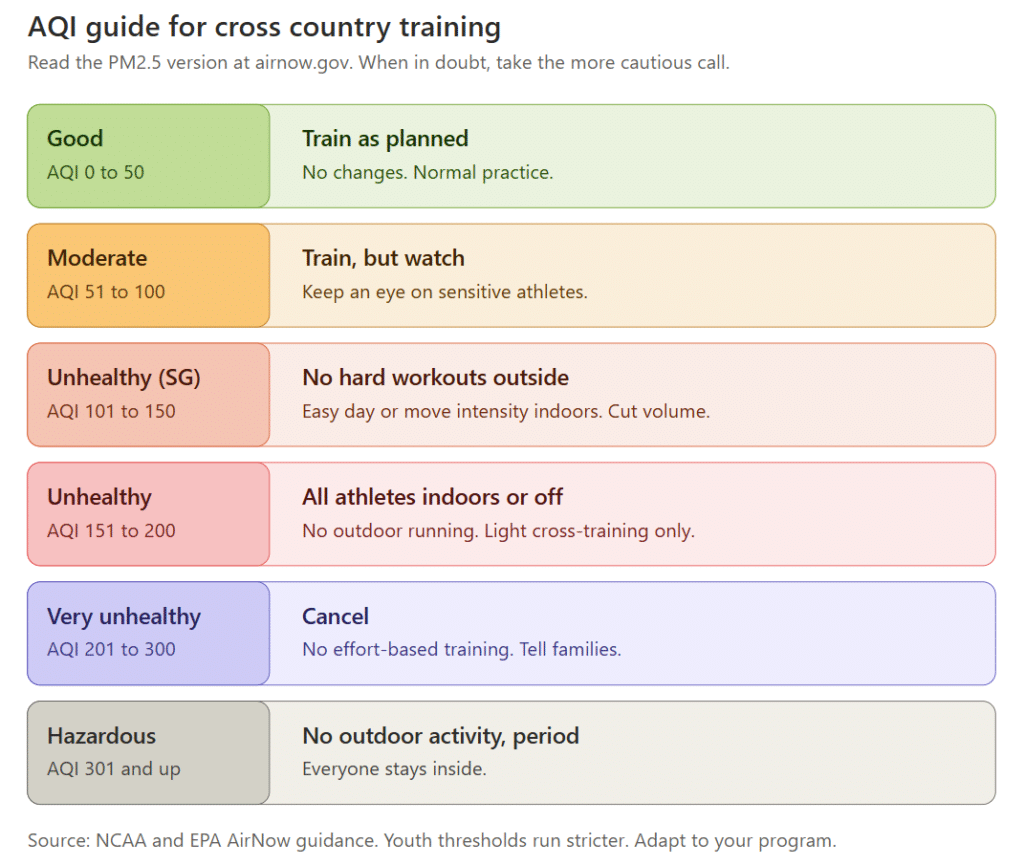
Here is how I translate all of that into a practical team policy. Adapt it to your setting, but this is the spine of what I use.
- Green and yellow (0 to 100): Train as planned. Watch asthmatics on yellow days.
- Orange (101 to 150): Convert to an easy day or move intensity indoors. Sensitive athletes go inside or take the day.
- Red (151 to 200): All athletes indoors or off. No outdoor running. Light indoor cross-training only.
- Purple and above (201+): No training that requires effort. Communicate clearly with families and cancel.
Write your policy down before the season. Share it with your AD, your athletes, and your parents in August. The worst time to invent a smoke policy is standing on a hazy track at 3:45 with 40 kids and a workout on the board.
How to Adjust Your Training Plan for Poor Air Quality
A smoke week is not a lost week. It is a coaching problem, and coaching problems have solutions. The mindset I want you to hold is the one the youth guidance keeps repeating: protect kids from the bad air while keeping them active. We are not choosing between training and safety. We are choosing a different kind of training.
Shift the intensity, not just the location. The single most important adjustment on a moderate smoke day is to lower ventilation. Since the danger scales with how hard and deep your athletes breathe, an easy jog in orange air is meaningfully safer than a threshold session. So the first move is almost always to flip a hard day to an easy day. Save the workout. Smoke does not care about your training calendar, and one rearranged week will not undo a summer of base.
Move the hard work indoors. This is where the treadmill earns its keep. If your building has a forced-air system that filters particles, or better yet a room with a HEPA filter, indoor air can be dramatically cleaner than outside during a particle event. A treadmill is not a punishment. Plenty of accomplished runners have PR’d off training blocks built largely indoors. The treadmill gives you total control of pace, which is a gift for teaching young runners what goal effort actually feels like. You can run a real tempo or a progression session and keep your fitness moving.
Lean on cross-training you can do in clean air. A stationary bike, a pool, an elliptical, or an indoor rowing setup lets you keep the aerobic engine turning without pounding polluted air. This ties directly into the aerobic base you built over the summer, and a smoke stretch is a good time to protect that work rather than lose it. Cross-training builds cardiovascular fitness while sparing the legs the repetitive impact of running, and it can even aid recovery. A smoke stretch is a natural window to bank the aerobic cross-training that usually gets squeezed out of a normal week.
Use the day for the work runners always skip. Strength training and plyometrics improve running economy. A smoky Tuesday is a perfect strength day. Core, hips, single-leg work, mobility, drills you can do in a clean gym. Your athletes get fitter and you keep the team together without asking them to breathe smoke.
Shorten and simplify. If conditions are borderline and you decide a short outdoor easy run is acceptable, keep it short and keep it easy. The public health guidance for children on marginal days is consistent: allow more breaks, keep activities nonstrenuous, and hold them under an hour. This is not the day for a long run or a hill session.
Time it and place it smartly. On mixed days, air quality often improves at certain hours as plumes move and mix. Check the forecast, not just the current reading, and target the cleaner window if there is one. Avoid stacking smoke exposure on top of other pollutant sources by keeping runs away from heavy traffic corridors.
Warning Signs of Smoke Inhalation in Athletes
Numbers on a screen are your first line of defense. Your eyes and your athletes are the second, and sometimes they catch what the monitor misses.
Watch your sensitive athletes first and hardest. Any runner with asthma, a history of exercise-induced bronchoconstriction, or any respiratory or cardiac condition gets managed more conservatively, full stop. Make sure their quick-relief inhaler is on-site and that they have it.
Learn the warning signs and take them seriously. Coughing, wheezing, chest tightness, shortness of breath beyond normal training breathing, throat or eye irritation, unusual fatigue, headache, or dizziness are all signals to stop.
Do not trust a “clearing” sky too fast. Smoke can drop from high altitude to ground level with a shift in the weather pattern. A hazy but breathable morning can turn genuinely unhealthy by afternoon. Recheck before practice, not just the night before.
Remember the delayed effect. The collegiate runner study is the one I keep coming back to as a coach. Its finding was that exposure during the training weeks, not just race day, tracked with slower times. Controlled studies have likewise found performance impairments showing up days after heavy exposure. So a hard week breathed through smoke may not cost you on Tuesday. It may quietly cost you at the meet two weeks later. That is an argument for protecting the buildup, not just the competition.
Do not double up your environmental stressors. Smoke events often ride along with heat domes, since the same stalled high-pressure systems that trap heat also steer the smoke. Heat and smoke together are a bigger physiological load than either alone. My running in the heat article covers how dew point drives that thermal load. When both stressors show up on the same day, tilt further toward caution than you would for either one.
Managing Cross Country Meets in Smoke
Practices you control. Meets are messier, because another program, an official, and a schedule are all in the mix. Get ahead of it.
Check the AQI at the venue, not just at home. Smoke is regional and uneven. And if you are the host, take the readings, monitor them at intervals as the guidance describes, and be willing to delay, shorten, or move a meet.
The bottom line
Canadian wildfire smoke is now a regular part of the summer and fall running calendar across much of the country, and the evidence is clear enough to act on. Fine particulate matter slows even your fittest runners and stresses developing lungs, and the hard, deep breathing of distance training is exactly what pulls the most of it in.
So build the policy before you need it. Know your AQI number and read the PM2.5 version. Treat orange as a real modification day, red as an indoor or off day, and purple as a cancel. Flip hard sessions to easy ones, move intensity indoors to filtered air, and use “smoke weeks” for the strength, cross-training, and recovery work that usually gets skipped. Watch your sensitive athletes, teach everyone the warning signs.
None of this costs you a season. The runners who show up healthy in October are the ones whose coaches made the boring, cautious call in July. Make the call. Keep them breathing clean.
Helpful resources:
- EPA AirNow current conditions and forecast: airnow.gov
- EPA Fire and Smoke Map: fire.airnow.gov
- EPA Air Quality Flag Program: airnow.gov/air-quality-flag-program