


Speed Development for Distance Runners
Speed reserve—the gap between maximum sprinting velocity and race pace—is the ceiling for distance running performance. Building speed as a skill through intentional neuro-muscular training, not just aerobic work, transforms how efficiently runners move at race pace.
Distance runners develop aerobic engines but often neglect the neuromuscular system that determines mechanical efficiency. This gap between physical fitness and movement capability becomes a performance ceiling.
Speed Reserve: The Performance Ceiling
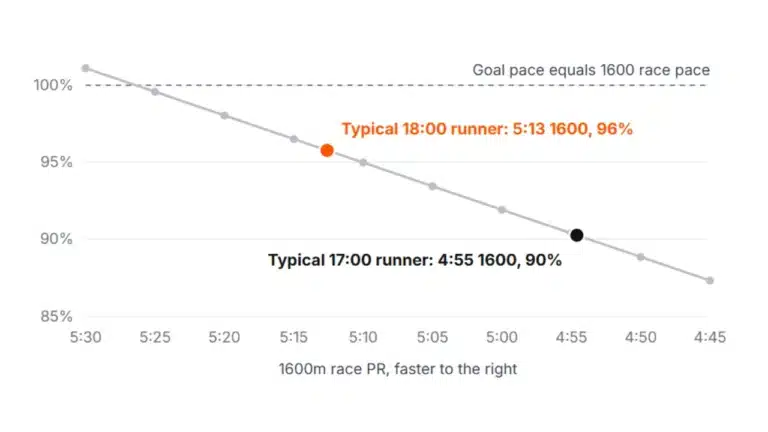
Speed reserve is the functional gap between maximum sprinting velocity and sub-maximal race pace. By increasing top-end speed, a runner reduces the relative intensity of their race pace, making it feel more sustainable.
Consider two runners both attempting to break 5:00 in the mile:
– Athlete A (max 400m: 55s) is running their mile at 73% of capacity
– Athlete B (max 400m: 68s) is running their mile at 90% of capacity
Athlete A is “cruising” while Athlete B is “redlining.” Raising the speed ceiling makes every other pace feel easier. This is the importance of speed reserve.
Research by Paavolainen et al. (1999) demonstrated that explosive-strength training improved 5K times significantly without any change in VO₂max. Athletes simply became more economical, using less energy to cover the same ground.
Three Non-Negotiable Rules for Speed Development
- 100% Intensity — You cannot “sort of” sprint. Running at 90% trains aerobic capacity, not maximum velocity.
- Full Recovery — Neuromuscular adaptation requires a fresh nervous system. Use 1 minute of rest for every 10 meters sprinted.
- Quality over Quantity — A speed session might include only three 30-meter sprints. If athletes look tired, the session is over.
Essential Speed Development Drills
Wicket Drills (Posture Builder)
Mini 6-inch hurdles spaced 5–6 feet apart force runners into upright posture with front-side mechanics, preventing the reaching and heel-striking that kill momentum. Cue: “Step over the pipe, don’t kick the bucket.”
Flying 30s (Speed Ceiling)
The gold standard: 20m build-up → 30m “fly zone” at absolute max velocity → 20m deceleration. This trains the brain to fire muscle fibers at rates distance running never touches. Full 3-minute rest between reps.
Short Hill Sprints (Hidden Weight Room)
A 6–8 second sprint up a steep grade (10%+) at 100% effort forces high knee drive and glute activation. It’s self-correcting—bad mechanics are nearly impossible on steep terrain.
The High/Low Training Model
Don’t sacrifice long runs for speed. Sequence hard workouts together and follow with genuine recovery days:
- Monday: Neuromuscular (Flying 30s + Wicket Drills)
- Tuesday: Aerobic Recovery (30-45m easy + mobility)
- Wednesday: Metabolic (CV Intervals)
- Thursday: Active Rest (30m easy + form drills)
- Friday: Power (Short hill sprints)
- Saturday: Long Run (conversational pace)
Weekly Execution
Monday: Neuromuscular Speed
– 15-min easy warm-up + dynamic mobility
– 6–10 wickets at height/speed, 3–4 passes
– 2–5 flying 30s (freshmen do 2, varsity 4–5) with full 3-minute rest
– 3 miles easy finish
Tuesday: Recovery
– 30–40 minutes at conversation pace
– 10 minutes mobility
Wednesday: Metabolic Engine
– 8 x 1000m at CV pace with 200m slow jog recovery (90s)
– Freshmen: 4–6 x 800m; varsity: 8 x 1000m
Thursday: Active Rest
– 30 minutes easy
– 15 minutes form drills (A-skips, B-skips, bounds)
Friday: Structural Power
– 15-min warm-up + 4 strides
– 6–8 x 8-second hill sprints on steep grade
– 2 miles easy finish
Saturday: Long Run
– Steady, conversational effort
– Freshmen: 45–50 minutes; varsity: 75–90 minutes
The Bottom Line
Training only the engine while neglecting the chassis creates runners who break down. By treating speed as a skill practiced with intention and proper recovery, you build athletes who are both aerobically fit and mechanically sound.
See Essential XC Workouts for complementary threshold and CV work, and Strength Training for Distance Runners for the structural foundation this speed work requires.
Related Blog Post
Read the full post: Speed as a Skill: Training HS Distance Runners →