
VDOT vs P-Scale: Setting Training Paces for High School Runners
Jack Daniels taught a generation of coaches that a race tells you how fast to train. Run a 5K, find your VDOT, and his tables give you every training pace. Most race calculators still run on his math, including the race converter inside my own P-Scale calculators.
Daniels died in September 2025 at 92. VDOT is still the best-known pace system in the sport.
So why did I build a different one? Because of the whiteboard. VDOT gives one runner exact paces. A high school coach writes one workout for thirty runners, and every one of them needs a different split.
This article puts the two systems side by side. It covers what each one is, how the zones line up, one runner’s paces in both, and how to move a VDOT team over.
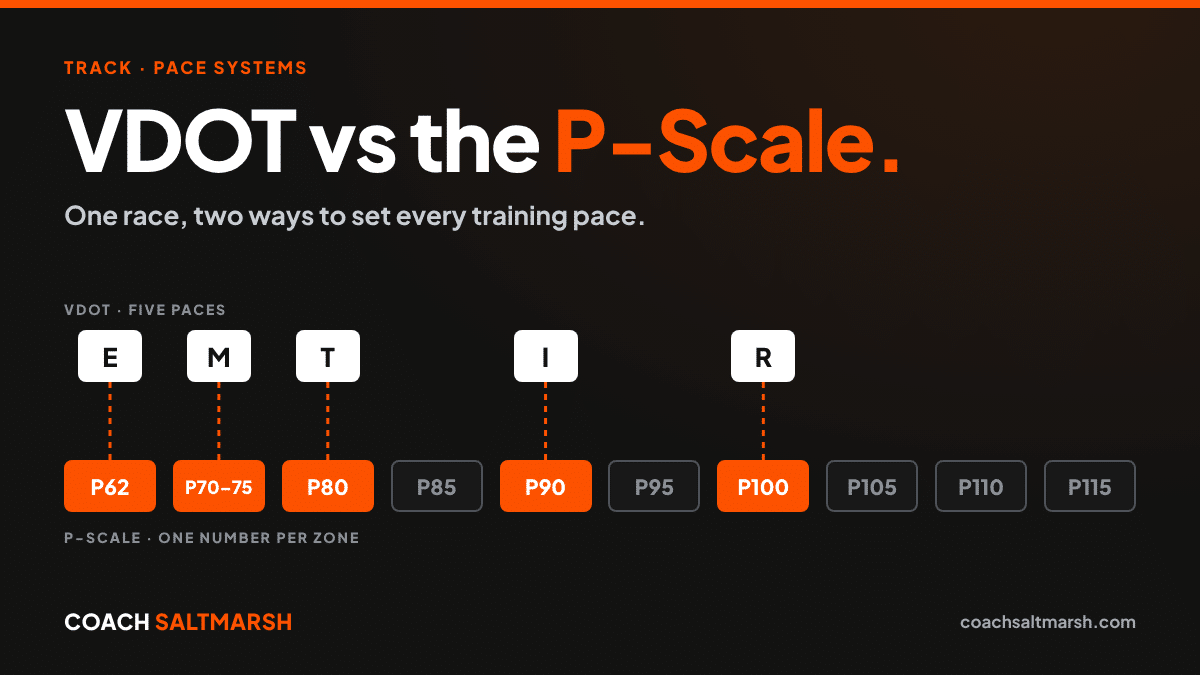
The short version. Both systems set training paces from a recent race. VDOT turns the race into a fitness score and reads five paces off a table: E, M, T, I and R. The P-Scale turns the race into current mile pace and writes every zone as a percent of it, from P62 to P115. VDOT is more exact for one runner. The P-Scale gives a whole team one number per zone. For fast runners the two land within about a second a lap. For slower runners the P-Scale runs a few seconds a lap easier, on purpose.
P-Scale Pace Calculator
Enter one recent race and get every P-Scale zone for one athlete, with the split for each rep. Racing a 5K? Use the cross country version.
Open the calculatorWhat is in this article
What VDOT is
In the 1970s, Daniels and his colleague Jimmy Gilbert studied the race times and lab-tested VO2max of elite middle and long distance runners. Runners who raced equally well were given the same aerobic score, whatever their lab number said. Daniels called that score VDOT, a pseudo VO2max.
That is the key idea. VDOT is not a lab test. It is a race result turned into one number. A 20:00 5K scores about 50, and so does any other race of the same quality.
From that number, Daniels set five kinds of training:
- E, easy. Most of the miles, at about 59 to 74 percent of VO2max.
- M, marathon pace. Mostly for marathoners.
- T, threshold. Comfortably hard. Tempo runs and cruise intervals.
- I, interval. Hard reps that push VO2max.
- R, repetition. Short, fast reps with full recovery, for speed and economy.
He capped the hard work, too. One T session should total no more than 10 percent of the week’s mileage. R work in one session should be the lesser of 5 miles or 5 percent of the week.
You find your VDOT from his tables or the official VDOT calculator, then read your paces from the same row. Race faster, and you move up a row.
What the P-Scale is
The P-Scale, short for the Saltmarsh Pace Scale, sets every training pace as a percent of the athlete’s current mile race pace. P100 is mile pace. P90 is 10 percent slower, which is about 5K race pace. P80 is threshold. Easy running is P62 or slower.
The math is one line. Multiply mile pace by 2 minus the P number over 100. For P80, that is mile pace times 1.20. A 6:00 miler runs P80 at 7:12 a mile.
Any recent all-out race can set P100. A 1600 counts as it is. For a 5K, divide 5K pace by 1.10. For a 3200, divide by 1.07. For an 800, 1500 or 3000, my calculators convert the race with Daniels and Gilbert’s equations.
The P-Scale takes its main idea from Renato Canova, who writes every pace as a percent of race pace. My one change: 100 is always mile pace, whatever event the athlete trains for. The full P-Scale guide has every zone, with a talk test for each.
VDOT and the P-Scale side by side
| VDOT | P-Scale | |
|---|---|---|
| What sets the paces | A recent race, scored with Daniels and Gilbert’s equations | A recent all-out race, turned into current mile pace (P100) |
| How a pace is written | A time for each distance, read from the athlete’s row in a table or app | A P number, the same for every runner |
| Zones | Five: E, M, T, I and R | Eleven, from P62 to P115, plus hill sprints |
| On the whiteboard | “5 x 1000m at I,” plus a pace chart for the team | “5 x 800m P90.” Each split comes from the athlete’s own P100 |
| Paces between zones | None. Each letter is one pace, except E, which is a range | P70–75, P85, P95 and P105 fill the gaps |
| Best fit | One runner who wants exact paces | A team that trains together off one whiteboard |
How the zones line up
Here is where each Daniels pace lands on the P-Scale. I worked out his paces with the Daniels and Gilbert equations, the math behind his official calculator, for four runners from a 17:00 to a 28:00 5K.
| Daniels | P-Scale | How close |
|---|---|---|
| E, easy | Easy, P62 or slower | Both are a range. Run them by the talk test. |
| M, marathon | P75, the fast end of Steady | M lands at P75 to P76 for all four runners. |
| T, threshold | P80 | T lands at P82 to P85. P80 is a little easier. |
| I, interval | P90 | I lands at P91 to P94. P90 is a little easier. |
| R, repetition | P100 | Short, fast reps at about mile pace. |
| No letter | P85, P95, P105 to P115 | Steps between the zones, from Canova’s percent-of-race-pace idea. |
| No letter | Hill sprints | 8 to 12 seconds up a steep hill, walk back. |
The pattern is simple. The two systems match at easy and marathon effort. At threshold and interval pace, the P-Scale runs a little easier, and the gap grows as runners get slower.
One runner, both systems
Take a 20:00 5K runner. That is a VDOT of about 50 and a P100 of 5:51 a mile.
| Zone | Daniels, VDOT 50 | P-Scale, P100 5:51 |
|---|---|---|
| Steady | M: 7:18 a mile | P70–75: 7:19 to 7:36 a mile |
| Threshold | T: 6:52 a mile, 1:42 a lap | P80: 7:01 a mile, 1:45 a lap |
| Interval | I: 6:19 a mile, 94 a lap | P90: 6:26 a mile, 96 a lap |
On the whiteboard, 5 x 800m P90 means 3:12 each for this runner. Daniels’ I pace would be 3:08.
Now spread it across a roster. Here are the threshold and interval paces per 400m for four runners.
| 5K | VDOT | Daniels T | P80 | Daniels I | P90 |
|---|---|---|---|---|---|
| 17:00 | 60.2 | 88 | 89 | 81 | 82 |
| 20:00 | 49.8 | 1:42 | 1:45 | 94 | 96 |
| 24:00 | 40.2 | 2:02 | 2:06 | 1:52 | 1:55 |
| 28:00 | 33.5 | 2:21 | 2:27 | 2:10 | 2:14 |
For the 17:00 runner, the two systems are about a second a lap apart. For the 28:00 runner, P80 is about 6 seconds a lap slower than Daniels’ T. That is 9:50 a mile against 9:27.
That gap is a choice. The slower runners on a high school team are often the youngest, the newest and the ones still growing. A few seconds a lap easier keeps their threshold days at threshold, so they don’t turn into races.
Where VDOT is the better tool
- One runner, exact paces. If you coach a few athletes one on one, VDOT gives each of them a precise pace for every kind of run.
- Comparing races. VDOT puts a 5K, a 3200 and a mile on one score. That is why my calculators use it to convert an 800, 1500 or 3000.
- Half marathon and marathon training. M pace is built in. The P-Scale was built for the 800m to the 5K.
- Runners headed to college. Many college programs use Daniels’ letters. They are worth learning.
Why I use the P-Scale with a team
- One line on the board. “6 x 800m P80” means the same thing to every runner. Each split comes from the athlete’s own race, and the plan’s calculator prints all thirty on one team sheet.
- Kids learn one number. P80 means the same effort in July, January and May. An athlete who learns it in cross country already knows it in track.
- Every kid runs the anchor race. Every high school distance runner races the 1600. Almost none race a marathon.
- More steps between the letters. High school training needs paces Daniels doesn’t name: P85 for about a 30-minute race effort, P95 between 3200 and mile effort, and P105 for 800 work.
- Easier where it counts. The slower and younger runners get a little more room at P80 and P90.
- The talk test overrules the watch. Heat, hills and growth spurts don’t read charts. Every P zone has a talk test, so effort sessions on grass and hills still have a target.
Moving a VDOT team to the P-Scale
- Keep the races you have. Use each athlete’s most recent all-out race.
- Find P100. A 1600 or mile counts as it is. Divide 5K pace by 1.10, or 3200 pace by 1.07. The free calculator does it for you.
- Rename the workouts. T becomes P80. I becomes P90. R becomes P100. E stays easy. M runs become Steady, P70–75.
- Expect slower runners to notice. Their P80 and P90 will be a few seconds a lap easier than their old T and I paces. Hold them there.
- Reset only after a race. A great workout doesn’t change anyone’s paces. A faster race or an all-out time trial does.
Every plan on the P-Scale
The P-Scale is the pace language of my plans. Each high school plan comes with its own calculator: enter the roster once, and it writes every athlete’s split beside every rep.
Spring track: the 800m, 1600m and 3200m Plans, $39 each, or all three in the P-Scale Track Bundle for $99. Cross country: the 22-Week XC Season Blueprint, $59. Middle school: the Middle School Track Plan, $39. All year: the HS Distance Bundle, $179.
Get the Track Bundle See all P-Scale plansOne purchase covers your whole staff and team. 30-day money-back guarantee.
Common questions
Is the P-Scale based on VDOT?
Not its zones. The P-Scale takes its percent-of-race-pace idea from Canova, with mile pace as 100. It uses Daniels and Gilbert’s equations in one place: my calculators use them to turn an 800, 1500 or 3000 into a mile-pace anchor.
What is P80 in Daniels’ terms?
About T pace. For fast runners they are within a second a lap. For slower runners, P80 is a few seconds a lap easier.
What VDOT is a 20:00 5K?
About 50. A 17:00 5K is about 60, and a 24:00 5K is about 40.
Can I use VDOT and the P-Scale together?
Yes. Use VDOT to compare races of different distances. Use P numbers to write the workouts. Don’t mix the two in one session, or the board stops meaning one thing.
Does VDOT work for high school runners?
The math works. The trouble is practice. A team covers a wide spread of VDOT scores, so the coach ends up reading a chart on the track. High school runners also improve fast, so the rows change often.
When should paces change?
Only after a race or an all-out time trial that beats the current anchor. A great workout doesn’t count, and neither does a slow race in mud or heat.
Keep reading
- The P-Scale. Every zone, the talk tests and the anchor races.
- Jack Daniels VDOT explained. How the VDOT system works.
- What a cross country 5K tells you about spring track. Why a fall 5K undersells mile speed.
- VDOT paces vs heart rate zones. Two ways to set effort.
- Zone 2 vs the Daniels method. What an easy run really is.
Sources
- Jack Daniels, Daniels’ Running Formula, 4th ed. (Human Kinetics, 2021). The five training types, their intensities and the session limits.
- Jack Daniels and Jimmy Gilbert, Oxygen Power: Performance Tables for Distance Runners (1979). The equations behind VDOT.
- Jack Daniels (coach), Wikipedia. How Daniels and Gilbert built VDOT.
- Jack Daniels, Legendary Running Coach and Author, Dies at 92, Marathon Handbook, September 2025.
Daniels’ paces in this article come from the Daniels and Gilbert equations. They match a published VDOT calculator at VDOT 50 (T 6:51 and I 6:18 a mile) and are rounded. An official calculator may differ by a second.