
How to Race the 3200m: Tactics for High School Runners

I’ve watched a lot of 3200s in 23 years of coaching. Sectionals, state meets, dual meets on cold, wet April afternoons where you can see your breath and your fingers ache. And I’ve seen the same race lost the same way more times than I can count.
A talented kid steps to the line. The gun goes off. He sits on the leader’s shoulder through 400 in 70. Comes through the 800 in 2:25. Hits the mile in 4:55, five seconds faster than he’s ever opened a 3200m race in his life. Then around lap five, the wheels come off. By the bell, he’s running 80-second laps and watching three kids he should’ve beaten kick past him on the homestretch. Final time: 10:42, when he was probably in 10:25 shape.
That race wasn’t lost on lap eight. It was lost on lap one.
The 3200m is, in my opinion, is the toughest race- mentally, in high school track. It’s long enough to demand real aerobic fitness, short enough that every misjudgment in pacing is immediately punished, and monotonous enough, eight laps around the same oval, that the mental battle becomes as important as the physical one. Run it well, and it’s one of the most satisfying experiences in the sport. Run it poorly, and you’ll spend the bus ride home replaying the race in your head.
This article outlines the complete 3200m race strategy I discuss with every distance runner I coach before their first big championship 3200m. It covers the physiology, the pacing, the lap-by-lap tactics, and the mental framework you need to execute when your legs are screaming at you to stop.
Why the 3200m Is Different From Anything Else You Race
Before we talk tactics, you need to understand what kind of race you’re running. The 3200m sits in a strange physiological position. It’s not the mile, where you can rely on raw speed and a kick. It’s not the 5K, where you can settle into a steady rhythm and grind. It’s its own thing.
The energy system breakdown most coaches cite, and it’s pretty consistent across the literature, is that the 3200m is roughly 87% aerobic and 13% anaerobic. That means your aerobic base (your weekly mileage, your easy runs, your long runs, your tempo work) is doing the vast majority of the work. But that 13% matters enormously. It’s the difference between hanging on in the last 600m and being passed by three kids you should’ve outrun.
What this means tactically: you cannot race the 3200m like a long sprint. Going to your anaerobic well too early dumps lactate into your legs that you can’t clear, and the slow-burn fade that follows is not something you can will yourself through. The physiology dictates the strategy. You have to respect the aerobic nature of the event in the first half so you have something left when the anaerobic component starts to matter in the final 600m.
For the science underneath this, the NYRR overview of common physiology terms does a good plain-English job of explaining VO2 max, lactate threshold, and running economy. These are the three variables that, more than anything else, determine your 3200 ceiling.
The Pacing Principle: Even or Negative Splits Win
If you remember nothing else from this article, remember this: the fastest 3200s in history were almost all run with even or negative splits. Not the other way around.
When Steve Prefontaine ran his legendary 8:41.5 two-mile in high school, his coach Walt McClure didn’t have him go out hard and hang on. He had him run the first six laps at a consistent pace, then bring it home with two blistering laps. That’s the model. That’s how fast 3200s are run.
Coach Jay Johnson, one of the sharper minds in high school distance coaching, uses a framework I love: chunk the race into three sections. The first 600 is for position. The middle 2000 is for groove. The final 600 is for compete. The mental clarity of having three distinct jobs instead of one big eight-lap race is something I’ve found really helps young runners to focus on what they can control in the moment.
What I tell my athletes: you should feel almost too comfortable through 1200 meters. If you don’t, you went out too fast. The people around you sprinting away from the line? Smile. You’ll see most of them again with 600m to go, and they will not be smiling.
A Lap-by-Lap 3200m Pacing Blueprint
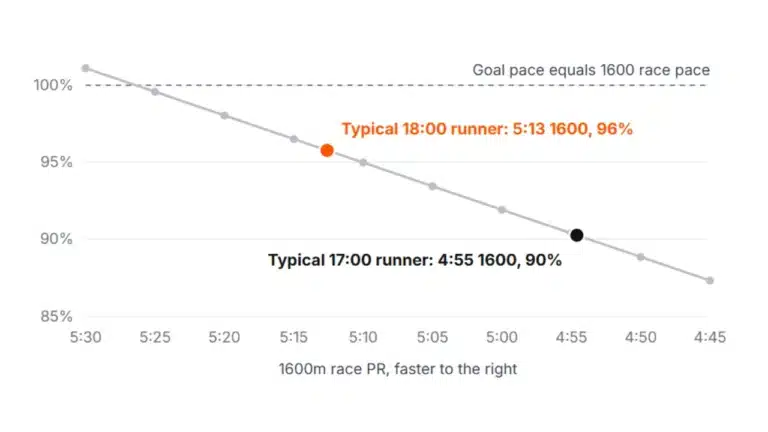
Let’s get specific. The splits below assume a goal time and target lap pace you’ve established with your coach based on your fitness. Your most recent time trials, workouts, and 1600 PR. A rough rule of thumb: a fit high school distance runner’s 3200 is typically 4 to 8 seconds per 400 slower than their open 1600 pace. So a 5:00 kid, would be about a 10:45 in the 3200m. Or a 6:00 kid, would be about a 13:00.
Lap 1: Settle, Don’t Sprint
Get out hard enough in the first 50 meters to find clean position, usually lane 1 or lane 2, depending on how the field is shaking out, and then back off the throttle. The first 100 of a 3200 is always faster than goal pace because of adrenaline and field bunching. That’s fine for 50m.
Target: goal pace or 1-2 seconds slower. If your goal is 5:10 1600 pace (77.5 per lap), running 78-79 here is exactly right. Most kids run 73-74. They are not running smart.
Lap 2: Lock In
This is the most important lap nobody talks about. You’re past the adrenaline of the start. The pack is settling. This is where the race’s pace is set for the next 1600 meters.
Your job: find a runner, ideally one slightly better than you who is a smart runner that runs even splits, and tuck in. Match their cadence. Get your breathing rhythmic. Run on autopilot. Target: dead-even goal pace.
Laps 3-4: The Groove
If you’ve done laps 1 and 2 correctly, lap 3 should still feel manageable and lap 4 should feel like honest work. You should come through 1600 right at goal pace not faster, not slower.
This is where I want my athletes mentally checking in: form check (relaxed shoulders, run tall, arms tracking parallel to the body, hands coming back behind the hips), breathing check (rhythmic, not gasping), position check (where are you in the field?). Don’t think about laps 5, 6, 7, 8. Just run this lap. Keep your mind focused on the lap you are in, not what’s next.
Lap 5: The Lap That Decides Your Race
Kelly Christensen, the head coach at Niwot High School in Colorado, calls lap 5, 6 and 7 “the third lap problem.” It’s the moment in the race where the pace slows almost imperceptibly. Your effort is climbing, your perceived exertion has gone up a full notch, but your watch will tell you your pace has dropped. This is the silent killer of 3200 PRs.
The fix: conscious effort to maintain pace. Don’t try to surge. Don’t try to drop the field. Just refuse to let the pace slip. If you can run lap 5 at the same pace as lap 4, you have already separated yourself from 80% of the field. They are slowing down. You are not.
This is the lap where I want my runners to be thinking, “I can do hard things.” Pick a mantra “I got this,” “no quit” whatever works, and repeat it. Out loud if you have to.
Lap 6: Hold the Line
If lap 5 was about refusing to slow down, lap 6 is about refusing to give up. The pain is real now. Your legs are heavy. Your throat is burning. This is the lap where weaker runners check out mentally, they shift from racing to surviving.
You have to do the opposite. Stay in the race. Eyes up. Look at the back of the runner ahead of you. Match their cadence. The discomfort is information you can use.
Lap 7: Begin the Compete Phase
Make your move with 500 meters to go, not 200. There are good reasons for this. First, the pace tends to slow around the 600-to-go mark because everyone is mentally bracing for “the kick.” Moving early breaks that pattern. Second, a longer, more sustained kick is more effective against tired runners than a desperate sprint over the last 100.
When you cross the line with 600 to go, that’s your trigger. Start picking up the effort. Don’t sprint. Drop your pace 1-2 seconds per lap. Pick a runner ahead of you and reel them in. Pass cleanly, and keep going. Do NOT look back, ever.
Lap 8: Empty the Tank
You’ve got 400 meters left. Whatever you have, spend it. The classic mistake on the bell lap is waiting until the final straightaway to kick. By then, the runners who started their kick at 500 are gone.
Drive your arms. Lengthen your stride without overstriding. Hold your form. With 100 to go, look at the finish line, not your competitors, not the clock, and run through it, not to it. Finish strong.
If you’ve done your job in the first 1600, this last lap will hurt more than anything else in your race. That’s correct. That means you did it right.
The Mental Strategy: Where the 3200m is Really Won
I’ve coached athletes with identical fitness who ran 30 seconds apart in the 3200. The faster one wasn’t fitter. They were mentally tougher in the middle laps. They were competing with the other runners, not the watch.
Mental toughness in the 3200 isn’t about gutting it out through pain. That’s actually the wrong frame of mind.
1. Reframing discomfort as information.
Your brain interprets discomfort as a threat and tries to negotiate you into slowing down. “I’ll just back off a little, then surge later” is the most expensive lie in distance running. The discomfort you feel on lap 5 isn’t a sign you’re going to fall apart. It’s a sign you’re racing correctly. Label it: “Heavy legs. Hard breathing. This is what racing feels like.”
This is the core insight Steve Magness writes about extensively at Science of Running. The pain you feel during a race is an emotional response, not a hard limit. Your brain is trying to protect you. Your job is to listen, acknowledge, and continue pushing the limit.
2. Chunking the race.
Don’t run a 3200. Run eight 400s. Or three sections of a race. Or simply this lap. When you find yourself thinking about how many laps are left, you’re already losing. Shrink your focus to the lap you are in..
3. Having a pre-built response to the bad patch.
Every 3200 has a bad patch. Sometimes it’s lap 5. Sometimes it’s the back stretch of lap 6. If you haven’t decided in advance what you’re going to do when it hits, you’ll do what feels easiest: slow down.
So decide now. When the bad patch comes, and it will, what’s your response? Mine, when I was racing, was a two-word mantra I can’t write here, and a deliberate form check: run tall, hips forward, arm swing. Pick yours. Practice it in workouts.
Race-Day Execution
The best race plan in the world won’t save you if your race-day execution is sloppy.
The day before: Easy 20-30 minutes with a couple of strides at the end. Eat normally. Hydrate. Go to bed at your usual time. Trying to “carb load” or “extra hydrate” the night before a 3200 mostly just gives you a stomach ache. Trust the work you did in the weeks before.
Race morning: Eat 2-4 hours before your race. Real food, not just a gel. A bagel with peanut butter and a banana, oatmeal with honey, whatever your usual pre-race meal is. Hydrate steadily. Avoid anything fried, greasy, or new.
The warm-up: Start about 40 minutes before your race. The standard structure that works for most of my distance kids:
- 15-20 minutes easy jog
- 5-7 minutes of dynamic mobility (leg swings, lunges, A-skips, B-skips)
- 3-4 strides of 60-80 meters at faster then 3200m race pace, with full recovery
- Spikes on, light shake-out, find a quiet corner, breathe
You want to finish your warm-up about 5-8 minutes before the start. Sweaty, loose, slightly elevated heart rate, but not tired.
On the line: Two deep breaths. Pick your line for the first 50 meters. Remind yourself of your first lap target. Trust the plan. Run your race.
The Mistakes That Cost Runners the Most Time
After watching hundreds of high school 3200s, here are the mistakes I see:
Going out too fast. This is far and away number one. As one veteran coach on LetsRun put it bluntly: “90% of high school runners blow it right here and go out too fast and do a slow fade from there.” The cost is usually 10-20 seconds off your potential time. The fix is mental discipline. Trust that the runners sprinting away from you in lap 1 are not your competition by lap 7.
Letting the pace slip on laps 5-6. The third lap problem. Cost: 5-15 seconds. The fix is conscious effort, mantras, and knowing in advance that this is the lap that will try to break you.
Waiting too long to kick. Saving everything for the final 100 leaves a lot on the table. Cost: 3-8 seconds. The fix is committing to the long kick at 500 to go, not 200.
Racing the clock instead of the field. Your watch can lie. The kid five meters ahead of you cannot. In championship-level races, racing the runners gets you the better time.
Under-warming-up. Kids who roll up 5 minutes before their race and jog half a lap. Build a warm-up template that takes about 35-40 minutes and stick to it.
A Note on Tactical vs. Time-Trial 3200s
Most of what I’ve written assumes you’re trying to run the fastest possible time. That’s the right default for the vast majority of races. But there’s an important distinction:
Time-trial racing (most regular-season meets, time-stamp invitationals): Even or negative splits. Don’t get pulled into someone else’s pace.
Tactical racing (championship finals, dual meets where place matters more than time): Sit with the leaders. Cover moves. Wait for the kick. Your goal is to win, not to PR.
A useful way to think about it: in a tactical race, you’re running the race the field gives you. In a time-trial race, you’re running the race you’ve planned.
What This All Comes Back To
The 3200m race rewards two things above all else: a deep aerobic base and the mental discipline to execute a pacing plan when it would be easier not to.
The fitness gets built in the weeks and months before the race. That’s your mileage, your long runs, your threshold work, and your VO2 max sessions. If you want a closer look at how to structure that buildup, I’ve written about the vVO2max-based training I use with our cross country teams and about the strength gap that derails so many transitioning college runners. Both apply directly to the 3200m.
But the race itself? That gets won on race day. By a runner who trusted the plan in lap 1, refused to let the pace slip in lap 5, started pushing at 500 to go, and crossed the line on empty.
That’s how you race the 3200m.