

Anaerobic Speed Reserve: Why Your 400m Time Predicts Your 1600m PR

A few seasons back, I had a kid come into my office in early March to tell me that he needed my help to break 4:30 in the 1600. He was a junior, had run 4:42 as a sophomore, trained through the summer, won a couple of dual meets in cross country, and now believed he was ready.
He probably was. The aerobic engine was there. The threshold work had piled up. He was logging consistent 40-mile weeks and finishing every long run feeling strong.
There was just one problem.
His 400 personal best was a 60 flat.
When I told him that 4:30 was probably out of reach until he could run somewhere around 56 for an open 400, he looked at me like I had insulted his mother. He hadn’t come to me for a 400 conversation. He had come to me for a 1600 conversation.
But here’s the truth I’ve learned. The 1600 isn’t just a 1600 conversation. It’s a speed reserve conversation.
This article is about why.
Salty Talks Ep. 8 — The Speed Reserve Nobody Talks About
The spoken version, plus what this article doesn’t cover: the four mistakes that make coaches conclude speed work doesn’t do anything, whether sprinting is actually an injury risk, and the relay that made me rethink all of it. Free, no signup.
What Is Anaerobic Speed Reserve (ASR)?
Speed reserve is the gap between the fastest pace you can sustain at maximal aerobic effort and the fastest pace you can run, period. It’s the size of the cushion between race pace and top-end speed.
In the sports science literature, this is called the anaerobic speed reserve (ASR), and it’s defined as the difference between your maximal aerobic speed (the velocity at VO2max) and your maximal sprint speed (MSS). Gareth Sandford and his colleagues at High Performance Sport New Zealand have done most of the heavy lifting on this concept over the last decade, and their work shows that ASR is one of the key variables that distinguishes elite 800m runners from the rest.
For a high school coach, you don’t need a lactate analyzer or a treadmill protocol to apply the idea. You need two numbers:
- The athlete’s race pace per 400 (their goal split)
- The athlete’s open 400 PR (their top-end speed indicator)
If those numbers are too close together, race pace is maximal effort. There’s no cushion. No room to surge, no room to close, no room to recover from a slow opening lap. You’re running at the ceiling the entire race.
That’s not a strategy. That’s a survival exercise.
Speed Reserve Charts: The Numbers That Tell the Story
I keep two charts in my coaching binder. I drew them in pen years ago and I update them every season as standards shift. They tell the story better than I can.
Boys — Elite / State Champion / Ticket to Nationals
| Event | Goal Time | Avg 400 Pace | Required Open 400 |
|---|---|---|---|
| 800m | 1:52 | 56 | 49–50 |
| 1600m | 4:10 | 62.5 | 51–53 |
| 3200m | 9:00 | 67.5 | 53–55 |
Girls — Elite / State Champion / Ticket to Nationals
| Event | Goal Time | Avg 400 Pace | Required Open 400 |
|---|---|---|---|
| 800m | 2:08 | 64 | 56–58 |
| 1600m | 4:50 | 72.5 | 60–62 |
| 3200m | 10:20 | 77.5 | 63–65 |
Boys — Top 10 in Division
| Event | Goal Time | Avg 400 Pace | Required Open 400 |
|---|---|---|---|
| 800m | 2:00 | 60 | 52–54 |
| 1600m | 4:30 | 67.5 | 56–57 |
| 3200m | 10:00 | 75 | 60–62 |
| 5000m | 16:30 | 79.2 | 61–63 |
Girls — Top 10 in Division
| Event | Goal Time | Avg 400 Pace | Required Open 400 |
|---|---|---|---|
| 800m | 2:18 | 69.5 | 61–63 |
| 1600m | 5:00 | 75 | 62–64 |
| 3200m | 11:00 | 82.5 | 67–69 |
| 5000m | 18:30 | 88.8 | 68–71 |
Look at those right-hand columns. That’s the speed you need at rest, on a single open 400, to legitimately compete at those levels. Notice that across every distance and both genders, the required 400 speed is roughly 5 to 8 seconds faster per lap than the average race pace.
That’s the speed reserve. That’s the gap.
A 4:30 1600m averages 67.5 per lap. The kids who actually run 4:30 can run a fresh 400 in the 56–57 range. Or about ten seconds faster than their average. My junior with the 60-second 400 wasn’t running too slow in the workout. He was running at his ceiling. He had no reserve to draw from.
The relationship shows up everywhere. Track and field consortium coaches will tell you the same thing; endurance never creates speed.
The Physiology Behind the Gap
There’s a tempting argument that distance runners shouldn’t care about sprint speed because their races last 2 to 18 minutes, not 10 seconds. That argument is wrong, and the research keeps proving it wrong.
When you race at, say, 67-second 400 pace, your body recruits a certain population of motor units to do that work. If your top-end speed is 70 seconds for a 400, you’re operating at 95+% of your neuromuscular capacity from the gun. Every step. There’s no recruitment headroom. When fatigue sets in, and it always sets in, there’s nothing left to call up.
But if your top-end speed is 56 seconds for a 400, that same 67-second pace is roughly 84% of your max. You’re cruising. Your stride is relaxed. You’re recruiting motor units efficiently. When you need to throw in a surge at the bell, you have something to throw.
Sandford and his colleagues argue this directly in their work on elite 800m runners. Many middle-distance runners today lack the mechanical competence needed to achieve the relaxed race pace speed required for success, which limits their ability to cope with surges, run faster first laps, or close fast. The gap isn’t just about being able to outkick somebody. It’s about being able to run race pace at a relative intensity that doesn’t crush you.
And the recent research on training innovations among elite distance runners points the same direction. A 2024 narrative review of elite training methodology identified two clear advancements driving modern performance: sub-threshold interval volume and the development of maximal sprinting speed. These are the bookends of the speed reserve construct.
If the best in the world are working both ends, your high school athlete should too.
Why Strides Aren’t Optional
Here’s where a lot of coaches go wrong. They read about speed reserve, agree with the premise, and then bolt on a sprint day once a week. That will leave their athletes shredded by Saturday’s meet.
That’s not how you build speed reserve in a distance runner.
You build it the way I tell every athlete I coach: every easy run is a chance to practice the application of speed. Five or six strides at the end of every easy day. Not all-out sprints. Controlled, relaxed, bursts of 15 to 30 seconds at roughly 95% effort with full recovery between.
Steve Magness wrote about this years ago in The Science of Running. Strides reinforce good biomechanics and the recruitment of fast-twitch muscle fibers without accumulating the fatigue that comes from a true anaerobic session. They’re a neuromuscular tool, not a metabolic one. Done consistently, four to six strides after three or four easy runs per week, they produce measurable improvements in running economy and pace capacity within four to six weeks.
Compare that to one “speed day” of 8 x 200 at full tilt. Same volume of fast running, maybe more. But the second approach leaves you wrecked for two days. The first one leaves you faster and recovered for tomorrow’s long run.
This is the principle Tony Holler (Plainfield North HS, IL, of Feed the Cats fame) hammers on relentlessly with his sprinters: speed creates endurance. Holler’s program is built for sprinters. But the underlying principle translates directly: high-quality, low-volume neural work, performed when the athlete is fresh, builds top-end capacity that you can’t get any other way.
The Build: Can’t Skip Steps
This is where I have to slow you down, because there’s a real risk that a coach reads what I just wrote and turns Tuesday into a sprint day before the aerobic foundation is in place.
Don’t do that! There’s an order to this:
1. Build endurance + strides. Aerobic base. Long runs. Easy mileage. Strides woven in to maintain neuromuscular sharpness so the engine you’re building doesn’t go soft on top.
2. Build threshold strength + strides + hills. Tempo work, cruise intervals, hill repeats. Strides still in. You’re raising the floor of what your athlete can sustain at a comfortable hard effort.
3. Add speed + reps + strides. Now you bring in 200s, 300s, broken 400s, race-pace work, true anaerobic sessions. The aerobic and threshold base supports the speed work. The strides have already prepared the neuromuscular system for fast paces.
Can’t skip steps. You don’t get to year three until you’ve done years one and two. You don’t get to phase three of the season until you’ve done phases one and two. The athletes who try to shortcut the order are the same ones who get hurt in week six or peak six weeks too early.
I drew a picture in my notebook one day to explain this to my athletes. It’s two simple graphs. The first one is a straight diagonal line going up, that’s the progress over time most athletes and parents expect. The second is a jagged, zigzag line that mostly goes up, but with plenty of plateaus and dips and frustrations along the way. That’s reality.
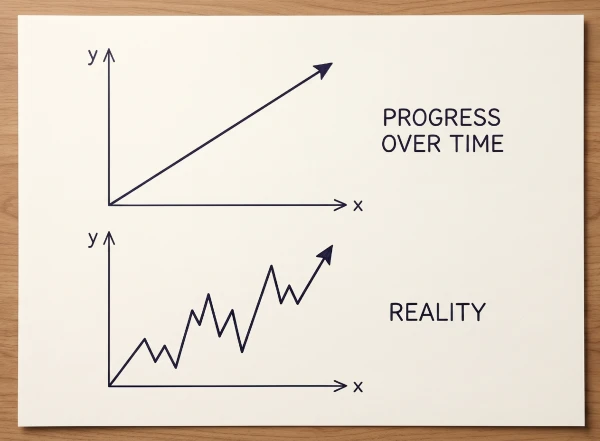
If you’re chasing the smooth diagonal, you’ll wreck your athletes trying to force it. If you accept the zigzag, you’ll get them there.
“I Didn’t PR.” Now What?
I’ve had this conversation a few hundred times. The athlete comes off the track, didn’t hit the goal, and wants an answer. Sometimes the answer is “you raced poorly.” More often, the answer is in the four to twelve weeks of work that came before that race.
Before I’ll let an athlete blame the race, I make them walk through a short list. You can adapt it for your own program:
- Did I trust the consistent training I’ve been doing?
- How is my nutrition? Am I eating enough? Am I eating the right stuff?
- Have I been averaging 8 to 9 hours of sleep every night for the past 7 days?
- Am I listening to my coach and executing the race plan?
- Did I have a strict pre-race meal?
- Did I have a strict bedtime, and did I protect those hours?
- How invested am I? Can I recite my PRs at every distance? (The best athletes I’ve coached always could.)
You cannot race all the time. The only time you advance the thing you’re building is during the quiet morning blocks, the workouts no one is watching, the strides at the end of a recovery jog when your legs are heavy. Racing is like cashing a check at the end of the work week. The less work that gets done, the smaller the paycheck.
Make It a Priority
Speed reserve isn’t a workout. It’s a way of training across years. It’s the way you move your kids the next rung up the ladder.
It’s strides in February when there’s snow on the track and no one wants to be out there. It’s the eight hours of sleep you protect on a school night because your body doesn’t recover otherwise. It’s the long-run Sunday in July that no one sees. It’s the consistent strength and core work that keeps you healthy enough to avoid injury.
Focused, consistent training, every season, every year during vacations and holidays. Core. Nutrition. Strength. Sleep.
If every day you start with the thought how can I get better today? And the honest answer some days is “rest,” but most days is “go run.” Eventually, you’ll find the speed gap closing. Quietly. Over years.
You can’t just wish you were faster.
How to Build Speed Reserve in Your High School Distance Runner
If you want a starting point, this is what I’d suggest as a non-negotiable weekly skeleton, regardless of training phase:
- 4–6 strides after 3 to 4 easy runs per week. 15–30 seconds. Full recovery. Smooth, not all-out. Year-round.
- One short-hill session per week during the base and build phases. 6 to 10 x 10–15 seconds at 95% effort. Walk-down recovery.
- One in-season open 400 time trial per month. Time it. Record it. Track the trend.
- Test the gap. Once a season, compare an athlete’s open 400 PR to their goal race pace per lap. If the gap is under five seconds, speed work needs more attention. If it’s over ten, aerobic and threshold work need more attention.
- Strength twice a week. Even basic. Bodyweight + dumbbells + medicine ball. Posterior chain. Core.
Five things. Year after year. That’s the program.
The Long View
The kid with the 60-second 400 ran 4:38 that spring. Not 4:30. He was disappointed. I wasn’t.
The next year, after a winter of consistent strides, two hill cycles, and a real strength program, his open 400 dropped to 56.4. His 1600 dropped to 4:24. He’s now running in college.
Speed reserve isn’t a magic key. It’s the natural outcome of doing the simple things. Strides, strength, hills, sleep, consistency, for long enough that the body has no choice but to adapt.
Build the engine. Build the gears. Don’t skip steps.