
Middle School to High School Cross Country: A Coach’s Guide to the Hardest Transition in Youth Running

She found me in the parking lot before the second week of August practice, fourteen years old and already crying.
She’d been the top runner on her middle school team since 6th grade. Middle school champion four months earlier.
Her middle school team had practiced three days a week, twenty-minute runs on the grass fields behind the elementary school. Now she was being asked to run six days a week, sometimes for forty-five minutes, in 85-degree heat, with a two-mile time trial coming up at 7AM on Saturday morning. Two of her best friends had gone out for soccer. She hadn’t seen them since June.
“Coach, can I ask you something?”
I knew before she said it. I’d seen the look on enough freshman faces by then.
“I was thinking maybe I should try soccer. I don’t think I’m cut out for this.”
She wasn’t soft and the program wasn’t cruel. She was a 14-year-old in mid-growth-spurt being asked to do, in twelve weeks, what no one had ever asked her to do before. Physically, socially, emotionally, all at once. The schedule that her varsity teammates handled in stride was, for her body and her freshman friend group, a tidal wave.
I told her to give me a week before she decided anything. We’ll come back to her at the end of this article.
What was happening to that girl is the most under-discussed transition in American distance running: the jump from middle school cross country to high school cross country. It eats more talented runners than overtraining, RED-S, and burnout combined. In many cases, it causes all three.
This article is for the coach who keeps losing 8th-grade phenoms, the parent watching their kid disappear into a varsity program they don’t understand, and the runner who’s about to become a freshman and has no idea what’s coming. I’ve coached this transition for over a decade, watched dozens of versions of it, and I want to clearly lay out what changes, what hurts, and what works.
This article pairs with our Freshman Mileage Progression Guide and 4-Year Career-Based Freshman Development framework. If you’ve already read those, this is the prequel.
Why the Middle School to High School Running Cliff Is Different
Every transition in a runner’s life usually involves a step up. Middle school to high school is the only one where the step up happens during peak biological vulnerability.
Consider what changes in roughly twelve weeks:
- Race distance roughly doubles. Most middle school races are 1.5 to 2 miles. High school cross country is 5K (3.1 miles). That’s not just a 50% increase in physiological demand; it’s a different event.
- Practice frequency doubles. Two or three middle school practices per week become five or six high school practices, plus a Saturday meet.
- Periodized training arrives, often without warning. Tempo runs, long runs, structured intervals, and hill workouts are new concepts the athlete has probably never heard of, and are now on the weekly plan.
- The body is mid-growth-spurt. Girls hit peak height velocity around age 12; boys around 14. Many incoming freshmen are still actively lengthening bone, with growth plates open and apophyses (tendon attachment points) under strain.
- The social environment inverts. The 8th grader who was a king or queen of a small middle school team is now the bottom of a roster socially.
Each of those changes is manageable on its own. Compressed into a single summer-and-fall, in a body that’s literally rewriting itself, they’re a perfect storm. The research bears this out: adolescents aged 15 to 19 represent the largest proportion of stress fracture cases in athletic populations: about 42.6% of all athletic bone stress injuries. That’s not a coincidence. That’s the transition phase.
The Physiology: A Freshman Body in Mid-Renovation
Here’s what nobody tells freshmen or their parents at the August parent meeting: your 14-year-old’s skeleton is, mechanically speaking, a construction site.
During the adolescent growth spurt, long bones lengthen faster than the muscles, tendons, and fascia around them can adapt. Tissues mature at different rates, and the growth plate, the cartilage near the end of each long bone, is a known weak link. It’s vulnerable to injury, especially heel pain and knee pain.
Layer the growth dynamics on top of training:
- Peak bone mass is still being built. Up to 90% of adult bone mass is laid down by age 18. The training stimulus during the transition years either deposits bone or, when paired with insufficient fueling and rest, depletes it.
- Aerobic development happens slowly; structural adaptation happens slower. Cardiovascular fitness can improve in 4-6 weeks. Tendon stiffness adaptations and bone remodeling take 6-12 months. The freshman whose VO2 max is climbing isn’t the same freshman whose tibia is ready for that VO2 max.
- Girls mature roughly two years before boys. A 14-year-old freshman girl may be physiologically post-pubescent. A 14-year-old freshman boy may be 18 months from his growth spurt. Scott Christensen of Stillwater High School, four-time USTFCCCA lead instructor in endurance, has emphasized this point for decades: training plans cannot treat 14-year-old boys and girls as the same animal.
I dig deeper into the structural piece in Mind the Gap: Preventing High School Runner Injuries, but the short version is: the freshman year is when the gap between aerobic capacity and structural capacity is widest, and that gap is where injuries live.
The Freshman XC Injury Window: What Actually Goes Wrong
If you’re a coach who’s been at this for a few seasons, you already know the August-to-October injury pattern by heart. The research confirms what your roster tells you. A study of 2,113 middle school runners found that 56% of girls and 50% of boys reported running-related injuries, with girls suffering more shin splints, knee pain, ankle sprains, and bone stress injuries appearing in nearly 7% of girls versus under 4% of boys. Those numbers worsen in the freshman year of high school.
The five most common transition-year injuries in my experience, in rough order of frequency:
- Medial tibial stress syndrome (shin splints). The textbook “freshman injury.” Bone bruising and periostitis from overload that hasn’t yet progressed to fracture.
- Tibial stress reactions and fractures. When MTSS isn’t backed off, this is the next stop. The tibia is far and away the most common bone stress site in adolescent runners.
- Apophysitis Sever’s at the heel and Osgood-Schlatter at the knee being the most common. These are growth-plate traction injuries, almost exclusive to the pre-and-mid-pubertal years.
- Patellofemoral pain syndrome (“runner’s knee”). Especially common in freshman girls, and increasingly tied to underlying signs of RED-S.
- Plantar fasciitis and posterior tibial tendinopathy. Often the result of new shoes, new mileage, and a still-developing foot.
The pattern under all five is the same: a tissue load that worked for a 13-year-old, applied to a 14-year-old with different geometry. The kid grew. The training didn’t account for it.
The two ways I’ve seen coaches consistently prevent this:
- A bridging summer. Not a “couch to varsity” summer. An 8-to-12-week build that runs the kid into freshman practice already adapted to 25-30 minutes of easy running. The kids who get hurt aren’t the ones who ran all summer. They’re the ones who did nothing and then walked into a 35-mile preseason week.
- Strength and form work, not just mileage. A freshman who can hold form through 200m strides has earned a few more miles. A freshman who can’t, hasn’t.
For the female athlete specifically, the additional injury risk multiplier is fueling. RED-S (relative energy deficiency in sport) disrupts bone health, menstrual function, immunity, and cardiovascular health, and in adolescents it can compromise peak bone mass permanently. I won’t redo the whole conversation here, Coaching Female Distance Runners goes deeper, but if you’re a parent or coach of an incoming freshman girl, please read it.
The Social Cliff Nobody Plans For
Coaches plan for the physiology. Almost nobody plans for the social drop.
In middle school, your 8th grader was a known quantity. Maybe a small team. Same kids she’d been running with since 6th grade. The coach knew her parents for years. She had a role.
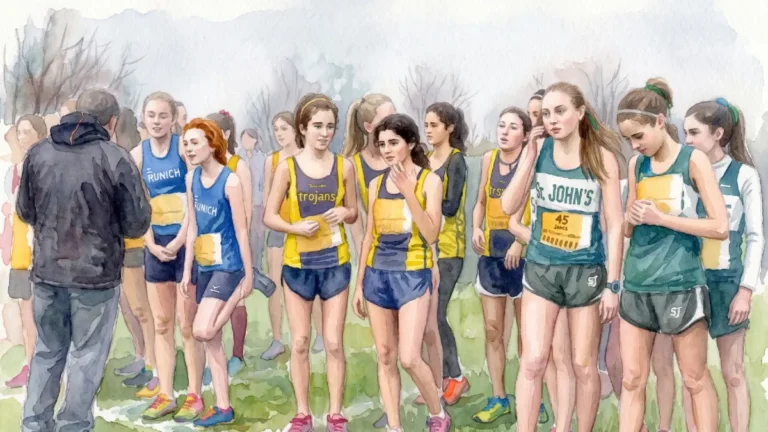
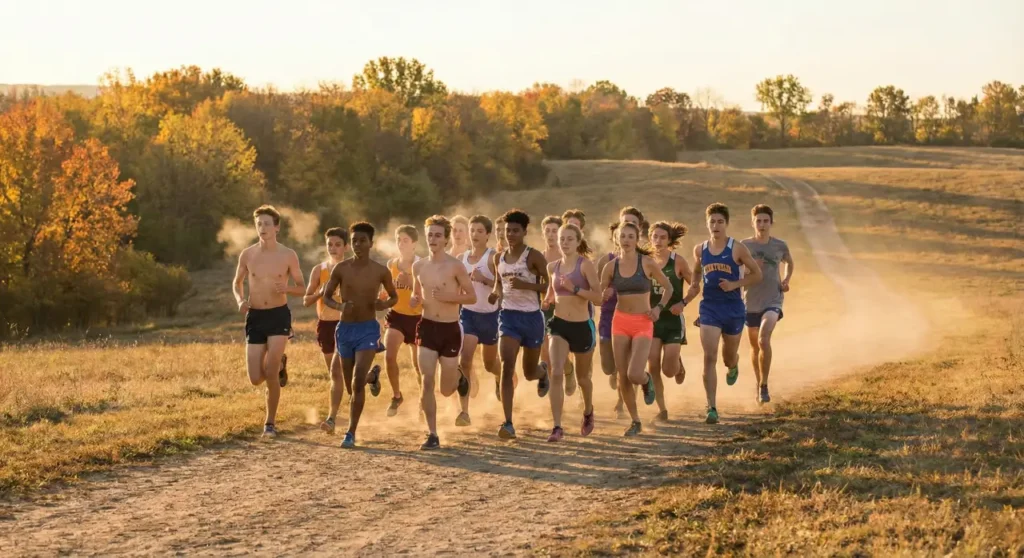
In high school, on day one of practice, she walks into a barn with fifty other runners, eight of whom she knows by face and zero of whom are in her grade. The varsity runners, who looked like adults to her last year at meets, are now the people she’s expected to keep up with on warmups. The hierarchy is real. JV is real. The team usually splits into “varsity” and “everyone else.”
This is the part of the transition that drives retention outcomes, and it’s the part most programs handle worst.
Research on youth sport dropout is sobering. Roughly 70% of young athletes drop out of organized sports by age 13. Of those who survive to high school, the most cited reasons for quitting aren’t “I wasn’t fast enough.” They’re “I didn’t like my teammates,” “I wasn’t having fun,” and “I felt too much pressure.” Studies have repeatedly shown that athletes with lower perceived social competence drop out at higher rates specifically because of teammate issues.
For cross country, this is both a blessing and a warning. XC is one of the most socially intimate sports in high school. Long bus rides, long warmups, hours of side-by-side easy running where the whole point is conversation. The kids who stay tell you, years later, that the team became their defining friend group. But that only happens if the program intentionally builds the on-ramp.
The programs that retain freshmen do a handful of things consistently:
- They pair freshmen with sophomore “mentors” or “buddies” before the first week of practice.
- They run warmups and easy days in mixed-grade pace groups, not in varsity-vs-the-rest segregation.
- They give freshmen a real meet schedule. Frosh races, JV races, real bib numbers, real splits. Not “you can watch from the team tent.”
- They build culture intentionally. Joe Newton, who won 28 state titles at York High School, famously carried over 200 athletes on his roster, most of whom would never score a varsity point. They came back anyway because what he built was worth belonging to. I dig into the culture piece in Team Culture and Success.
One reframe I give every freshman parent at the August meeting: your child is joining a team of friends, a family that will support her for the next 4 years. The point of year one is not a varsity letter. The point of year one is to fall in love with the team. Everything else compounds from there.
High School Cross Country for Parents: What You Get Wrong
Parents new to cross country tend to fixate on the wrong variables. I get the emails, I take the phone calls, I sit through the booster meetings and the questions are predictable.
The most common parent concern: “Is the coach running them too much?”
The actual answer: Probably not, unless you’re seeing your kid run 40+ miles a week as a true beginner. Total volume is almost never the killer for a freshman. Intensity is. Specifically: too much hard running, too soon, on too little aerobic base, in growing tissue. A freshman doing 20-25 miles a week of truly easy running is in vastly less danger than a freshman doing 18 miles a week with two race-pace workouts and a tempo run.
What I tell new parents to actually monitor:
- Sleep. If your freshman isn’t getting 8-10 hours per night, every other variable matters less. Chronic sleep debt is wrecking your season and you can read the case I make for sleep over mileage.
- Fueling. Is the kid eating breakfast? Lunch? An afternoon snack before practice? A real dinner? If you don’t know, find out. Adolescent runners under-eat constantly, and the consequences are dire.
- Mood. Quiet, withdrawn, snappy, sleeping all weekend? These are not just “teenager things.” They can be early signs of overtraining or RED-S. Trust your read of your own kid.
- Pain that persists. Soreness for 48 hours after a hard workout is normal. Pain that’s still there a week later, especially in shins or hips, is not. The single most important parent skill is treating early shin pain as a stop sign, not a “tough it out” moment.
- Joy. Does your kid want to be there? If the answer is “yes, mostly,” everything else can be coached. If the answer is “no, they hate it,” the training program is irrelevant.
If you want a structured conversation to have with your incoming freshman’s coach before the season starts, I built a Pre-Season Parent Meeting Guide that covers the questions parents should actually be asking. Most don’t think to ask the right ones, and the right ones aren’t about workouts.
The Retention Math: Why Year One Is the Whole Game
Here’s a statistic that ought to focus every coach in the country: the freshman who quits before October will tell you, ten years later, that high school cross country wasn’t for her. The freshman who survives to the first championship meet, even at the back of the JV pack, will tell you, ten years later, that cross country defined her high school experience. The gap between those two outcomes is almost never about talent. It’s about whether the first 60 days were good.
The research on what predicts youth sport retention is consistent. The single biggest factor isn’t ability. It’s whether the athlete is having fun, has friends on the team, and feels competent. Coaches obsessed with varsity scoring forget this; the great ones don’t. As Coach Jay Johnson puts it, the operational definition of fun in youth sport is “an achievable challenge.” Not a guaranteed win. An achievable challenge. Something hard the kid can succeed at if they keep showing up.
For the incoming freshman, achievable challenges look like:
- Finishing a 5K when six months ago they couldn’t.
- Beating their own time at the second meet of the season.
- Making it through a Tuesday workout without walking.
- Getting a fist bump from a senior they admire after a hard rep.
None of that requires varsity. All of it builds the kind of athlete who’s still showing up four years later, fitter and faster, with a coach’s letter for college recruiting on the way out. The runners who eventually become great are almost without exception the runners who didn’t quit. Quitting is the only true career-ender at this age.
I’ve written about why some programs hemorrhage athletes between freshman and sophomore year in Zone 2 Training and the 4-Year Burnout Crisis. The short version: programs that lean too hard on intensity in year one lose kids in year two. Programs that build aerobic patience in year one retain kids through year four.
A Training Framework for the Transition Year
If you only remember one thing from this article, remember this: the goal of the freshman year is not to produce a great freshman runner. The goal is to produce a sophomore who’s still running.
That single reframe changes everything about how the transition gets coached, parented, and survived.
Best Practices for Coaches
- Build a bridging summer program that meets kids where they are. Eight to twelve weeks of progressive easy running before the first day of fall practice, with no expectation of speed work. (Our XC Summer Training Plan Generator can scaffold this for an entire incoming class.)
- Cap freshman intensity, not freshman volume. Easy aerobic miles build the chassis. Hard intervals overload growing tissue. Mileage with strides, almost no race-pace work in the first six weeks.
- Run pace groups by ability, not by grade. The freshman who can hang with the varsity warmup group should hang. The varsity senior who needs an easy day should run with freshmen. Don’t let the team self-segregate.
- Pair every freshman with an upperclassman mentor before day one. Cheap, high-leverage, retention-multiplying.
- Treat the first injury as a coaching event, not a kid event. If a freshman gets injured by week four, the training plan failed, not the athlete. Adjust accordingly for the rest of the cohort.
Advice for XC Parents
- Read the Pre-Season Parent Meeting Guide before the meeting.
- Defend sleep and food at home. That’s your job, not the coach’s.
- Don’t compare your kid’s mileage to anyone else’s. Biological age is real and chronological age is a liar.
- Trust your read on persistent pain. If your gut says something’s wrong, get it imaged. Stress fractures caught early are six-week injuries. Stress fractures missed for a month are six-month injuries.
- Resist the urge to compare your freshman to senior times. The senior was a freshman once.
Tips for the Incoming Freshman
- You will be slower than you want to be. Everyone is.
- The seniors looked terrified at the freshman meeting four years ago too.
- The varsity runner you can’t keep up with on warmup was, two years ago, the JV runner getting dropped on warmup.
- Talk to your coach about pain before it gets bad, not after. We’re not impressed by toughness that turns into a stress fracture.
- The team is the point. The race is just the excuse to be on the team.
The Long Game in Youth Cross Country
We gave that freshman girl a different on-ramp. We cut her practice load to four days a week for the next six weeks, paired her with a sophomore who lived two streets over, and gave her permission to skip the Saturday time trial and ride the bus to her best friends’ soccer game instead. By the conference meet in October she’d run a 5K personal best. She didn’t quit. She’s a junior captain now.
I tell that story often, because the alternate version, the one where I’d said “tough it out” or “maybe this isn’t for you” or any of the other quick non-answers was sitting right there waiting to happen. The kid would have quit. She would have told you, twenty years later, that running wasn’t for her. And she would have been wrong, but she’d never know.
That’s the worst-case version of the middle-to-high transition. Not a slow freshman year. Not a stress fracture. A kid who decides at fourteen that running is something done to her, not something she does for herself. Once that decision lands, no training plan in the world can fix it.
The transition from middle school to high school cross country is hard. It’s supposed to be hard. The bodies are growing, the distances are doubling, the social hierarchy is real, the parents are nervous, and the coaches are trying to manage the team while also managing the individuals. None of that is going to change.
What can change is the framing. Year one is a bridge year. Build the bridge, walk across slowly, and the runner you have at the other end is a sophomore who still loves the sport, who’s still uninjured, and who’s just getting started. That’s the entire game.
Related Reading
- The Complete Guide to High School Cross Country Training
- Freshman Mileage Progression Guide with Strides
- Developing the Freshman Runner: A Career-Based Approach
- Mind the Gap: Preventing High School Runner Injuries
- Coaching Female Distance Runners
- Pre-Season Parent Meeting Guide
- Chronic Sleep Debt Is Wrecking Your Season
Frequently Asked Questions
Is the coach running my freshman too much?
Probably not, unless they are running 40+ miles a week as a true beginner. Total volume is almost never the killer for a freshman. Intensity is. A freshman doing 20-25 miles a week of truly easy running is in vastly less danger than a freshman doing 18 miles a week with two race-pace workouts and a tempo run.
What are the most common cross country injuries for freshmen?
The most common injuries during the freshman transition are shin splints (medial tibial stress syndrome), tibial stress fractures, growth-plate traction injuries (like Sever’s and Osgood-Schlatter), and runner’s knee. These almost always happen because a training load that worked for a 13-year-old is suddenly applied to a rapidly growing 14-year-old body without enough easy aerobic adaptation first.
Should an incoming freshman run during the summer before practice starts?
Absolutely. The kids who get hurt in August aren’t the ones who ran all summer; they’re the ones who did nothing and then walked into a 35-mile preseason week. An 8-to-12-week “bridging summer” of progressive, easy running (with no speed work) is the best way to safely prepare an athlete for the fall season.
How can parents best support their freshman runner?
Parents should focus on the variables that happen off the grass: sleep and fueling. Ensure your runner is getting 8-10 hours of sleep a night and eating enough (including breakfast, lunch, pre-practice snacks, and a real dinner). Finally, monitor their mood and treat any persistent pain, especially in the shins or hips, as a stop sign, not a “tough it out” moment.