
Middle School Track: The First Four Weeks, With Games

The first day of middle school track brings everyone. Kids from the fall cross country team. Kids in basketball shoes. Kids who signed up because a friend did. The temptation is to put a mile on the board in week one and see what you have.
Don’t. The first four weeks of a middle school spring decide who is still there in May, and who comes back next year. They are for teaching, not testing.
This is how the Middle School Track Plan runs those four weeks for grades 5 to 8. Three weeks with no meets, then the first meet on a down week. Every quality session is a game, and nobody needs a watch until meet 1. Below are all four weeks for all three levels, day by day, with the games and how to run them.
The short answer. Spend weeks 1 to 3 teaching, not testing. No meets, no time trials and no lap times. Run Chat most days, short smooth reps on the track once a week, hill sprints on Fridays and one Steady game in week 3. Give Tuesday ten minutes to learning the track. Week 4 is a down week with the first meet, and that race sets each runner’s pace for the rest of the spring.
What is in this guide
What the first month is for
Middle school running has the same three jobs in the fall and the spring. Bring them back next year. Build the athlete before the mileage. Teach the language they will use in high school. Spring adds one more: learn what race pace feels like, a little at a time, without learning to dread it.
So the first month is mostly about what you leave out. None of these happen in weeks 1 to 4:
- Time trials. The meets are the tests, and meet 1 is in week 4.
- Lap times and splits. Builders get their first lap card in week 5. Explorers never get one.
- Intervals on short rest. No 800s or 1000s at 2-mile effort, and no long reps at race pace.
- Spikes at practice, doubles or weights. Spikes are for races, if they are worn at all.
- Mileage totals. Runs are written in minutes, and nobody keeps a leaderboard.
Two findings sit behind the caution. The first is about volume. The youth running consensus statement found no studies that support specific distances or training recommendations for youth runners. It does recommend at least one rest day a week and one to two weeks off every three months (Krabak et al., 2021). So the plan keeps volume low, writes it in minutes and takes every Sunday off.
The second is about recovery. Children bounce back from short, hard efforts faster than adults, mostly because they produce less power to recover from (Falk and Dotan, 2006). Short reps with a walk back suit them. The long race-pace reps on short rest that leave high schoolers bent over can wait for high school.
Place every runner before the first run
Every athlete starts in one of three levels, set by training age: continuous months of organized running. Not grade, talent or how much they want it. A fast fifth grader is an Explorer. So is an eighth grader who has never trained. A sprinter moving up to the 800 starts at Explorer too.
| Level | Who it is | Run days | Weeks 1 to 4 | Season peak |
|---|---|---|---|---|
| Explorer | First season of organized running, or back from an injury or a layoff | 4. Tuesday is play | 75, 85, 95, 75 | 115 |
| Builder | One full season of cross country or track done, healthy since | 5 | 100, 110, 125, 100 | 155 |
| Bridge | Two or more seasons, healthy, and handled Builder volume well | 5 | 120, 135, 150, 120 | 180 |
Running minutes a week. Walks, drills, play, the Athlete Base and durability don’t count.
When in doubt, go a level down. Moving up happens between seasons, never in the middle of one, so a healthy Bridge athlete from the fall starts track at Bridge. Moving down happens any time, with no announcement: an injury, an illness that lasts more than a week, a growth spurt with heel or knee pain, or a kid who is dragging.
The spring numbers sit below the fall caps of 15, 20 and 25 miles a week. Spring has no summer of running behind it. It has a meet every week, more fast running and kids who play a second spring sport. For the reasoning behind the fall numbers, see How Many Miles Should a 12-Year-Old Run?
Before the first run, send a health letter home. A current sports physical, any past injuries and the questions about eating and periods go to families and their doctor, not through the coach.
All 12 weeks, for all three levels
The Middle School Track Plan writes out every day for Explorer, Builder and Bridge, with its minutes. The Coach’s Guide has every game, the race plans for the 800 and the 1600, and a Track Craft lesson for every Tuesday.
See the Middle School Track PlanTeach five gears, not paces
Middle schoolers learn effort by the talk test long before they learn it by the watch. The plan uses five gears, the same five as the fall plan. Four of them show up in the first month.
| Gear | Talk test | In weeks 1 to 4 |
|---|---|---|
| 1. Chat | Full sentences, easily | Almost every run |
| 2. Steady | Full sentences, with rhythm | The Caterpillar game in week 3 |
| 3. Strong | Three or four words | Not yet. It arrives in week 6 |
| 4. Race | Race day only | Meet 1, in week 4 |
| 5. Zoom | Too short to talk | Accelerations and hill sprints |
The Gear Check keeps everyone honest. Blow one whistle at any point in any run. Every runner says a full sentence to the person next to them. Anyone who can’t is in the wrong gear, and they know it without a word from you.
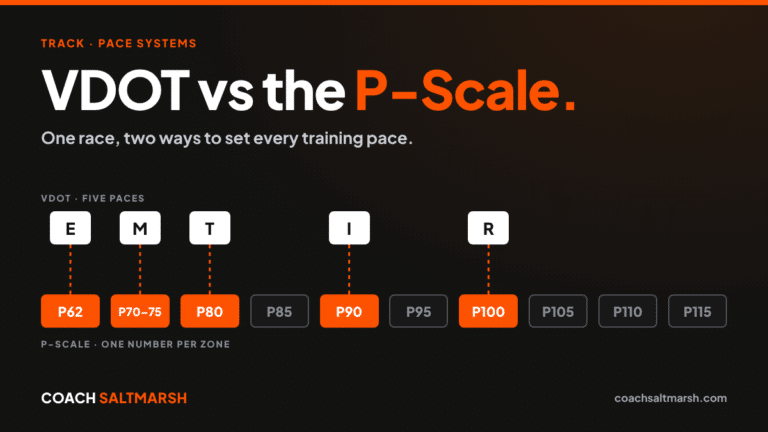
Numbers come later, and only for some. Explorers never see a pace number or a lap time all season. Builders and Bridge athletes get theirs from meet 1. Bridge athletes then learn the P-Scale behind each gear, the same pace language the high school plans use. By eighth grade, the gear and the number mean the same thing.
The shape of a foundation week
Weeks 1 to 3 share one template. In week 4 the meet takes Wednesday, and the rest of the week stays put.
| Day | What happens |
|---|---|
| Mon | Track day. Short, smooth reps on the track, then Durability B. |
| Tue | Chat and 4 strides, plus Track Craft: a 10-minute lesson on the track. Explorers don’t run. They get the Athlete Base, Track Craft and a play block. |
| Wed | Game day. The Quiet Mile in week 1, Gear Check whistles in week 2, the first Steady game in week 3. From week 4, the meet. |
| Thu | Chat, Durability A and a play block. |
| Fri | Long Chat run, with Scavenger Trail or Coin Flip Hills. |
| Sat | Optional adventure run. Never assigned, never tracked. |
| Sun | Off. Every level, every week. |
That is two quality days a week at most, never three. In week 3 they are the track day and the Steady game. From week 4 they are the track day and the meet. Weekly minutes climb by no more than 10 for Explorers and 15 for Builders and Bridge athletes.
The Athlete Base opens every practice. It takes about 17 minutes, on grass, with no equipment: a five-minute movement series, two skills, and on Mondays, Tuesdays and Fridays a short speed block of strides or accelerations. On Thursdays a play block replaces the skills. Short on time? Cut the main session, not the Athlete Base.
Durability comes after the run, twice a week, bodyweight only: Session B on Monday and Session A on Thursday, never the day before a meet. In weeks 1 and 2 the athletes learn each movement at one round. From week 3 they add reps. Calf raises, straight-knee and bent-knee, are in every session.
Week 1: the Quiet Mile and Map Quest
Week 1 has one job: everyone learns Chat. Every run is easy, and the only fast running is four short accelerations on Monday.
| Day | Session | ExplorerExp. | BuilderBuild | BridgeBridge |
|---|---|---|---|---|
| Mon | Chat, then Zoom: 4 × 30m accelerations, building from a walk to near-full speed, walk back. Bridge adds 5 minutes of Chat after. Durability B. | 20 | 20 | 25 |
| Tue | Chat and 4 strides. Track Craft: know your track. Explorers: no run, the Athlete Base, Track Craft and a play block. | 0 | 20 | 20 |
| Wed | The Quiet Mile: Chat with Gear Check whistles. Map Quest starts. | 15 | 20 | 25 |
| Thu | Chat. Durability A. Play block. | 15 | 15 | 20 |
| Fri | Long run: Scavenger Trail at Chat. | 25 | 25 | 30 |
| Sat, Sun | Optional adventure run on Saturday, 20 to 30 minutes, never assigned or tracked. Sunday off. | 0 | 0 | 0 |
| Week | 75 | 100 | 120 |
Running minutes by level. Chat fills the time.
The Quiet Mile (Wednesday)
The whole squad runs at Chat. Blow the whistle at random. Every runner says a full sentence to the runner beside them. A pod, a small group that trains and scores together, earns a point for a run with no failed check.
Map Quest (all season)
Put up a wall map with a pin at the state meet track. The team banks its running minutes toward the pin. Minutes, not miles, so every kid adds the same for the same time on their feet.
Scavenger Trail (Friday)
Hide numbered cones or cards on the long-run loop. Runners collect them in order. The longest run of the week becomes a hunt instead of a distance.
Track Craft: know your track
Walk the lanes, the waterfall line, the 200m, 300m and 400m starts, the break line and which way we run. Two rules start today. Lane 1 is for working reps. Never stop on the track.
Week 2: onto the track
Week 2 moves Monday onto the track. The reps are 100m, smooth-fast, by feel, with a walk back. Smooth-fast means quick and relaxed, never strained. Still no watches.
| Day | Session | ExplorerExp. | BuilderBuild | BridgeBridge |
|---|---|---|---|---|
| Mon | Chat, then on the track: 100m smooth-fast, walk back. Explorers run 4. Builders and Bridge athletes run 6, then finish with Chat. Durability B. | 20 | 25 | 30 |
| Tue | Chat and 4 strides. Track Craft: lane 1 and the box. Explorers: no run, then play. | 0 | 20 | 25 |
| Wed | Chat with Gear Check whistles. 4 strides. | 20 | 20 | 25 |
| Thu | Chat. Durability A. Play block. | 15 | 15 | 20 |
| Fri | Long run at Chat. Coin Flip Hills. | 30 | 30 | 35 |
| Sat, Sun | Optional adventure run on Saturday, 20 to 30 minutes, never assigned or tracked. Sunday off. | 0 | 0 | 0 |
| Week | 85 | 110 | 135 |
Coin Flip Hills (Friday)
Find a short hill and flip a coin at the bottom. Heads is an 8 to 10 second sprint. Tails is a walk to the top. Keep flipping until the dose is done: 4 sprints of 8 seconds for Explorers, 6 of 8 seconds for Builders and 6 of 10 seconds for Bridge athletes.
Track Craft: lane 1 and the box
A full lap in lane 2 is about 7 meters longer than a lap in lane 1, so run the inside lane when you can. The cost of lane 1 is the box: a runner ahead, a runner outside and no way out. Pass on the straight, not the turn.
Week 3: the first Steady game
Week 3 is the biggest of the four. It brings the first Steady running, and Builders and Bridge athletes stretch the Monday reps to 200m.
| Day | Session | ExplorerExp. | BuilderBuild | BridgeBridge |
|---|---|---|---|---|
| Mon | Chat, then on the track. Explorers: 6 × 100m smooth-fast, walk back. Builders 6 × 200m and Bridge 8 × 200m smooth-fast, 200m walk. Chat to finish. Durability B. | 25 | 25 | 30 |
| Tue | Chat and 4 strides. Track Craft: the Waterfall game. Explorers: no run, then play. | 0 | 20 | 25 |
| Wed | First Steady: the Caterpillar. Explorers 15 minutes inside a 25-minute run, Builders 20 inside 25, Bridge 25 inside 30. | 25 | 25 | 30 |
| Thu | Chat. Durability A. Play block. | 15 | 20 | 25 |
| Fri | Long run at Chat. Coin Flip Hills. | 30 | 35 | 40 |
| Sat, Sun | Optional adventure run on Saturday, 20 to 30 minutes, never assigned or tracked. Sunday off. | 0 | 0 | 0 |
| Week | 95 | 125 | 150 |
The Caterpillar (Wednesday)
Single file. The last runner moves up the line to the front at Steady, then the next runner goes. Nobody sprints. Steady is full sentences with rhythm, and the Gear Check still applies.
Smooth 200s (Monday)
Builders and Bridge athletes run their first 200s, smooth-fast with a 200m walk. Still no watch. They should finish every rep knowing they could run another.
Track Craft: the Waterfall game
The 1600 starts from a curved line with everyone together. Practice it: four 60m starts from the waterfall line. Get out clean, find a spot, settle by the cone. Pods score clean starts, not first place.
Week 4: meet 1, on a down week
Week 4 runs about a fifth less than week 3, and the first meet lands on Wednesday. The down week is where the meet fits. Monday is short, Friday is an easy run with strides, and there is no long run.
| Day | Session | ExplorerExp. | BuilderBuild | BridgeBridge |
|---|---|---|---|---|
| Mon | Chat, then 4 × 30m accelerations and 2 × 100m smooth. Durability B. | 20 | 20 | 25 |
| Tue | Chat and 4 strides. Track Craft: the 800 lane start and the Break Line game. Explorers: no run. | 0 | 15 | 20 |
| Wed | Meet 1. One race. Warm-up, race and a 10-minute squad cool-down. | 20 | 25 | 30 |
| Thu | Chat. Durability A. Explorers add a play block. | 15 | 15 | 20 |
| Fri | Chat and 4 strides. | 20 | 25 | 25 |
| Sat, Sun | Optional adventure run on Saturday, 20 to 30 minutes, never assigned or tracked. Sunday off. | 0 | 0 | 0 |
| Week | 75 | 100 | 120 |
What meet 1 is for
Each athlete runs one race, the 800m or the 1600m. A relay leg of 400m or shorter, or a field event, can go with it. Nothing more.
Explorers never get a goal time, at this meet or any other. Give them three goal behaviors instead: go out controlled, pass one person, finish hard. Builders get the same three. Bridge athletes get no goal time before their third race.
For Builders and Bridge athletes, the 1600m does one more job. It sets P100, their current mile race pace. Every lap card for the rest of the spring comes from that race until a new race or a PR changes it. Every Bridge athlete runs the 1600m at meet 1, and so does every Builder who can.
Give them the 1600 as four laps with four jobs:
- Get out and settle. Every middle school 1600 goes out too fast. Get clean off the waterfall, find a spot, then shift down.
- Relax. Shoulders down, hands loose. Find someone to run with.
- Pass one person. That is the whole job, and every kid in the race can do it.
- The bell. Everything left.
No splits during the race for Explorers or Builders. Builders see their lap times after it. The warm-up is the race version of the Athlete Base: 8 to 10 minutes of Chat, the movement series, two skips and 4 strides building to race rhythm, finished 10 to 15 minutes before the gun. After the race, every athlete cools down with the squad for 10 minutes.
Track Craft: the 800 lane start
The 800 starts in lanes. Run the first turn in your lane, then angle in gradually from the break line. Cutting straight across adds distance. In the Break Line game, runners do 3 × 150m relaxed and the coach scores the straightest legal path. The same lesson covers meet day: check-in, heat sheets and when to start the warm-up.
Turn one race into a lap card
Enter a Builder’s or Bridge athlete’s 1600m from meet 1 in the free P-Scale Pace Calculator. A 7:00 runner gets 52.5 seconds per 200m at P100, 49.9 at P105 and 23.6 per 100m at P110. That is the week 5 lap card.
Open the free calculatorFour rules that keep a game from turning into a race
Hand eleven-year-olds a set of reps and it becomes a race by the second one. A game changes what winning means. When points go to the pod with no failed Gear Check, or the cleanest start, running as hard as possible stops being the winning move.
- The dose is yours. The game is theirs. Decide the minutes and the reps first, then pick the game. Never let a game set its own dose.
- Handicap everything. If the fastest kid wins by default, everyone else learns to stop trying.
- End it early. Stop while they still want another round.
- Rotate the winners. Use enough different games that a lot of different kids win something. Score control, honesty and improvement, not just speed.
The points carry across the season. Pods score for attendance, clean Gear Checks, durability sessions and game wins, and once the meets start, for improvement over their own last race. Accuracy scores. Speed does not.
The fun is not decoration. A systematic review of why children and teenagers drop out of organized sport found five main themes. Lack of enjoyment was one. The others were how competent kids felt, social pressure, competing priorities, and injury and growth (Crane and Temple, 2015). A game can’t fix all five. It fixes the first, and a handicapped game helps with the second. The fall version of these rules, with twelve more games, is in 12 Middle School Cross Country Workouts Disguised as Games.
What to watch for in the first month
The track brings its own problems, mostly from turning left and from spikes. Here is what to look for in the first four weeks.
| What you see | What it may mean | What to do |
|---|---|---|
| Heel pain at the start of runs, worse on the track or in spikes | Sever’s disease, at the growth plate in the heel | Cut track minutes, no spikes, keep the calf raises. Refer if it is no better in two to three weeks. |
| An ache in one foot, shin, knee or hip, usually the inside leg | Turning left every day | Move half the minutes off the track, and run Chat laps in the outer lanes. Refer if it changes how they run. |
| Pinpoint pain on a bone that gets sharper during a run, or hurts on a one-leg hop | Possible bone stress | No running today. See a physician. Never run through it. |
| Sore calves after the first race in spikes | New spikes and a lower heel | Spikes are optional at this age. If worn, races only. |
| Coughing or wheezing after hard efforts in cold spring air | Something for a physician to look at | Refer through the family. Longer warm-up, more layers. Don’t diagnose it. |
| Stomach aches on meet day, dreading the race | Race anxiety | Goal behaviors, not times. Let them sit out a meet. Talk with them about something other than running. |
Girls are at higher risk of running injury than boys and lose more time when they are hurt. A past injury raises the risk of the next one. Both findings carry the consensus statement’s strongest grade of evidence (Krabak et al., 2021). An athlete coming back from an injury starts at Explorer, whatever their grade.
What weeks 5 to 12 add
The first four weeks look much the same for every level. The rest of the spring is where the levels pull apart.
- Week 5: the first lap card and the first Rhythm game, Split Sniper. Run 200m at your card time with no watch. Within a second scores. Too fast loses, the same as too slow.
- Week 6: the first Strong running, with Traffic Light. Green is Chat, yellow is Steady, red is Strong.
- Week 7: Builders and Bridge athletes split into 800 and 1600 groups on the track day. Rolling 200s start for the 1600 group.
- Week 8: a down week with an off-event meet: a 400, a relay leg, a jump, or sit out and cheer.
- Weeks 9 to 11: Bridge athletes run their Rhythm session at goal pace in week 9 and a readiness check for their event in week 11.
- Week 12: the championship. Then two weeks completely off.
Coaching the high school team too? The middle schoolers share the warm-up and durability and keep their own main session. For the high school side of the same spring, see Plan Your Spring Track Season.
Common questions
What should middle school distance runners do in the first week of track?
Learn Chat and learn the track. Plan four or five runs of 15 to 30 minutes at Chat, four short accelerations, a game with Gear Check whistles, a scavenger-hunt long run and a 10-minute lesson on the track. No time trial and no lap times.
Should middle schoolers run a time trial at the first practice?
No. The meets are the tests. Meet 1 comes in week 4, and for Builders and Bridge athletes the 1600m there sets the pace for their lap cards. Explorers never get a goal time.
How many minutes should a middle school distance runner run in week 1?
It depends on training age, not grade. In the Middle School Track Plan, week 1 is 75 running minutes for Explorers over four days, 100 for Builders and 120 for Bridge athletes over five. Walks, drills and play don’t count.
Do middle school distance runners need spikes?
Not at practice. Spikes are optional at this age. If a runner wears them, keep them for races, and watch for sore calves and heel pain after the first race in them.
How do I coach fifth graders and eighth graders in one practice?
Run the same session, the same game and the same whistle, and change only the dose. Each level has its own minutes and reps. Explorers run four days a week, and their Tuesday is play.
How many events should a middle schooler run at a meet?
In this plan, one race of 800m or longer per meet, plus a relay leg of 400m or shorter or a field event if you like. Bridge athletes can double in the 800 and 1600 at up to three meets, never in back-to-back weeks. Your league’s limit comes first.
Can middle schoolers train with the high school team?
They can share the warm-up, the durability work and the close. The main session stays separate. A middle schooler never runs the high school session at any dose, and a fast seventh grader never trains with the high school 800 group.
Weeks 5 to 12 are written out too.
The Middle School Track Plan is twelve weeks of 800m and 1600m training for grades 5 to 8, in three levels. The Day-by-Day Schedules give every day for Explorer, Builder and Bridge, with its minutes. The Coach’s Guide has every game, both race plans and the Track Craft lessons.
Coach cross country in the fall too? The MS Distance Bundle adds the Middle School XC Coach’s Kit, on the same three levels and the same five gears.
Get the Middle School Track Plan · $39 Fall and spring: MS Distance Bundle · $69One purchase covers your whole staff and team. 30-day money-back guarantee. The bundle is $19 less than buying both plans separately.
Keep reading
- 12 Middle School Cross Country Workouts Disguised as Games. The fall games and the four rules behind them.
- Your First Week Coaching Middle School Cross Country. Day one to day five, for a new middle school coach.
- How Many Miles Should a 12-Year-Old Run? A Coach’s Answer. What the guidance says about volume, and what it doesn’t.
- Heel Pain in Young Runners: A Coach’s Guide to Sever’s Disease. What to do about heel pain in a growing runner.
- The First 4 Weeks of Spring Track: A Head Coach’s Survival Guide. Staffing, attendance and the parent meeting for the whole team.
- The P-Scale. The pace scale Bridge athletes take to high school.
Sources
- Krabak BJ, Roberts WO, Tenforde AS, et al. Youth running consensus statement: minimising risk of injury and illness in youth runners. British Journal of Sports Medicine. 2021;55(6):305-318. bjsm.bmj.com
- Falk B, Dotan R. Child-adult differences in the recovery from high-intensity exercise. Exercise and Sport Sciences Reviews. 2006;34(3):107-112. journals.lww.com
- Crane J, Temple V. A systematic review of dropout from organized sport among children and youth. European Physical Education Review. 2015;21(1):114-131.
- Saltmarsh J. Middle School Track Plan: Coach’s Guide and Day-by-Day Schedules. 2026.
General education, not medical advice. Clear any existing injury with a qualified professional. Minutes and doses come from the Middle School Track Plan’s Day-by-Day Schedules.