
Josh Kerr Training: Mile World Record Breakdown & Mileage
How Josh Kerr Broke a 27-Year-Old World Record on 65 to 70 Miles a Week, Why His Coach Skips Lactate Testing and Double Days, and What a Simple System Executed Completely Teaches Every Coach
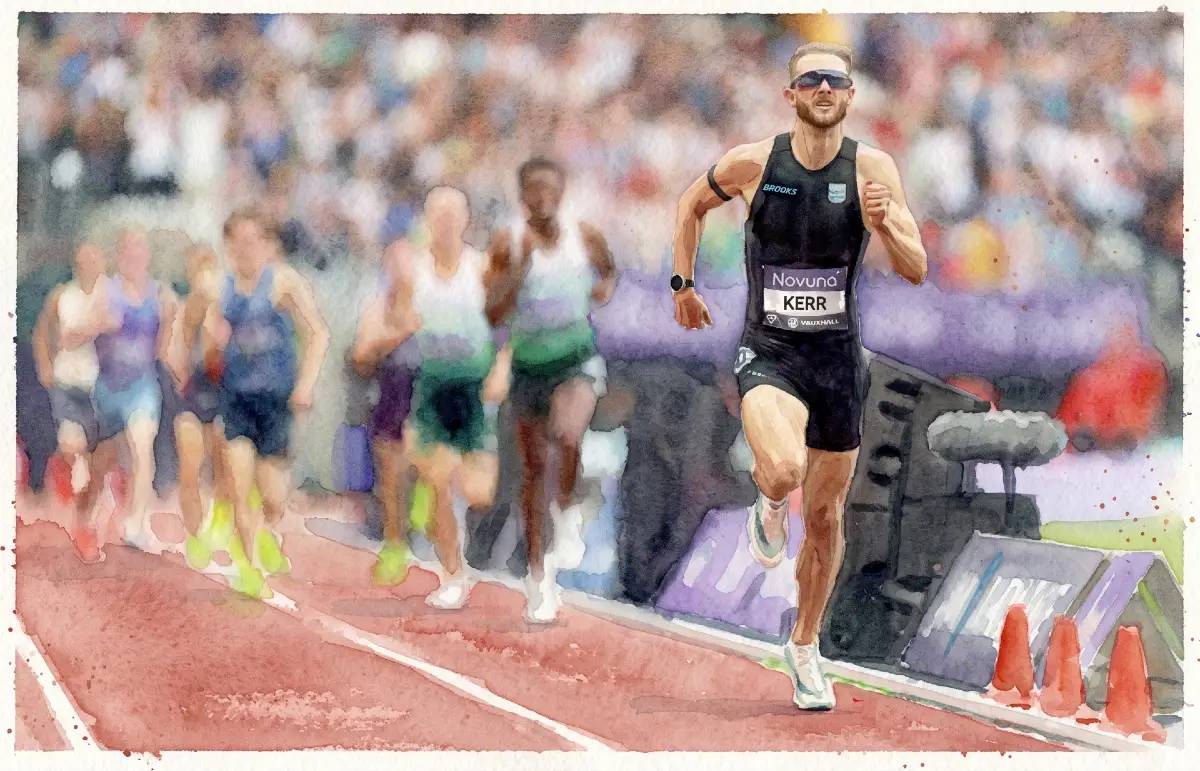
On July 18, 2026, at London Stadium, Josh Kerr ran a mile in 3:42.66. He is the first human being to break 3:43 for the distance, and the record he erased, Hicham El Guerrouj’s 3:43.13, had stood since 1999. Kerr was two years old when it was set.
Twenty-seven years is a strange drought for one of the sport’s marquee events. Between 1913 and 1999 the mile record fell 31 times, roughly once every three years. Then it stopped. Jakob Ingebrigtsen got within six tenths in 2023. Yared Nuguse got within eight tenths in the same race. Nobody else came close. A record 14 men broke 3:30 for 1500m in 2025 and the mile record still did not move.
Prefer to listen? I broke down the Kerr blueprint on the podcast:
So when it finally fell, you might expect the man who did it to be running 100-mile weeks, doubling every day, and pricking his ear for lactate readings between reps like the Norwegians. He is not. Kerr runs 65 to 70 miles a week, six days out of seven, with two structured workouts, no double run days, and no lactate meter anywhere in sight.
His coach of nearly a decade, Danny Mackey of the Brooks Beasts, was asked why El Guerrouj’s record survived so long. His answer: “It’s hard.” That plainness runs through everything this group does, and it is exactly why the system is worth studying. Here is how Kerr was built, and what the blueprint offers those of us in the coaching trenches.
Who Is Josh Kerr? Career Milestones & Records
Born October 8, 1997, in Edinburgh, Scotland, Josh Kerr is the world record holder in the mile and the indoor two mile, the 2023 world 1500m champion, and a two-time Olympic medalist, with bronze from Tokyo and silver from Paris, where his 3:27.79 made him the third-fastest 1500m runner in history at the time. He came up through Edinburgh Athletic Club, crossed the Atlantic to run for the University of New Mexico, won three NCAA titles there under Joe Franklin, and then turned down Nike! Instead, he signed with Brooks in 2018 to join the Beasts in Seattle under Danny Mackey. He has since extended that contract through 2034.
Career at a Glance
| Year | Milestone | Mark |
|---|---|---|
| 2015–18 | Three NCAA titles, University of New Mexico | – |
| 2021 | Olympic 1500m bronze, Tokyo | 3:29.05 |
| 2023 | World 1500m champion, Budapest (beat Ingebrigtsen) | 3:29.38 |
| 2024 | Indoor two-mile world best, Millrose Games | 8:00.67 |
| 2024 | World indoor 3000m champion, Glasgow | 7:42.98 |
| 2024 | Bowerman Mile champion, Prefontaine Classic | 3:45.34 |
| 2024 | Olympic 1500m silver, Paris | 3:27.79 |
| 2026 | World indoor 3000m champion, Toruń | 7:35.56 |
| 2026 | Mile world record, London Diamond League | 3:42.66 |
The Foundation: A Teenager Who Overtrained, and a Coach Who Never Let Him Do It Again
The most instructive part of Kerr’s story is not the record. It is the mistake that came a decade before it. By his own account, Kerr overtrained through his teenage years in Edinburgh, chasing volume and intensity. The lesson stuck. THis entire professional system is organized around not repeating that error.
The University of New Mexico years built the aerobic engine at altitude in Albuquerque, a city that still anchors his training today. Then came the sponsor decision. Nike came calling for the NCAA champion, and Kerr chose Brooks instead, in large part because of the coach. Danny Mackey holds degrees in engineering and exercise science, worked in a biomechanics lab, and founded Brooks Beasts in 2013. Kerr and Mackey have now been together for close to ten years, and the 2034 contract extension tells you everything you need to know about the partnership.
“He’s one of these athletes where I wish that time kind of froze so I could coach him forever. His identity is not attached to the sport, so he’s really secure about whatever the result’s going to be.” Danny Mackey, FloTrack’s Project 222 film
Read that quote again, because it is doing a lot of work. Mackey is describing psychological security as a performance asset. An athlete whose self-worth is not tied to his results. It gives him the confidence to announce a world record attempt four months in advance, absorb a bad tune-up race without spiraling, and stand on a start line in front of 60,000 people watching his attempt.
Josh Kerr Training Volume and Weekly Schedule
Here is the number that should stop you. The man who broke the mile world record runs 65 to 70 miles per week. Studies of world-class middle and long distance runners put average volume around 85 miles per week, and plenty of elite 1500m men run more than that. Kerr sits well below the norm, and he gets there without a single double run day. Six days of running, one of them a long run, one full recovery day, and that is the week.
Compare that to the athlete he beat for the 2023 world title. Jakob Ingebrigtsen’s Norwegian system is built on double threshold days, twice-daily sessions steered by blood lactate readings. Kerr’s system is the counterargument: no lactate testing, no doubles, no complexity. His typical week looks like this:
| Day | Session | Purpose |
|---|---|---|
| Mon | Recovery run, easy | Absorb the weekend |
| Tue | Structured workout + weights | Primary stimulus |
| Wed | Easy run | Aerobic volume |
| Thu | Easy run | Aerobic volume |
| Fri | Structured workout + weights | Second stimulus |
| Sat | Long run | Aerobic durability |
| Sun | Rest or light recovery | Full recovery |
Approximate total: 65 to 70 miles with two hard days and zero doubles. The easy days are run with the Beasts group at conversational pace, and Kerr has been explicit that the point of the structure is repeatability and consistency. In his words to World Athletics: his training is not extraordinarily hard. What he does well is stay injury-free so he can stack training days, and the stacking is what produces the fitness.
That is the whole thesis. Kerr and Mackey have concluded that the limiting factor for most elite middle distance runners is not the quality of their best week but the number of uninterrupted weeks they can string together. Every choice in the training plan, the moderate volume, the two-workout cap, the full recovery day, serves consistency first.
“Train Like a 5K Runner”: The Aerobic Logic Behind a Miler
Kerr has a phrase he repeats in interviews: 1500m runners need to train like 5K runners. It sounds like a slogan until you look at the physiology. Research by Spencer and Gastin found that roughly 84 percent of the energy in a 1500m race comes from the aerobic system. The event feels like a sprint from the stands, but it is overwhelmingly an endurance race, and the runners who treat it that way have the deepest reserves in the last 200 meters.
Kerr lives that principle. In 2021, as a 1500m specialist preparing for the Tokyo Olympics, he ran a half marathon in 1:01:51 as an aerobic check. Let that sink in: a miler, running 4:43 pace for 13.1 miles, as a fitness test!
The science supports the structure too. A systematic review of training intensity distribution in middle and long distance runners found that pyramidal and polarized models, mostly easy running with a small share of high intensity, outperform threshold-heavy approaches. Kerr’s week, with the large majority at easy pace and two concentrated hard days, is a textbook pyramidal distribution. He arrives at the same destination as the lactate-tested Norwegians by a much simpler road.
Inside the Workouts: Josh Kerr’s Key Track Sessions
For years, Kerr’s signature pre-championship session was 8 x 400m with 90 seconds rest, averaging 54.8 per rep, with an extended four-minute break inserted between reps four and five. Notice what that session is: race-pace volume, controlled rest, twice the race distance, and nothing exotic. It told Mackey what he needed to know, and Kerr won a world title and two Olympic medals off of it.
The world record build asked for more, and the progression Mackey chose is a small clinic in how to modify a proven session rather than replace it. According to Mackey’s interview with LetsRun.com, the marquee workout became four sets of 200-600-200 on the track, with 90 and 60 seconds rest between reps and four and a half minutes between sets. That is 4,000 meters of quality instead of the old 3,200, run at Albuquerque’s 5,000 feet of elevation. Kerr averaged 25.99 for the 200s and 1:22.26 for the 600s. World record pace is 27.72 and 1:23.18.
Three and a half weeks out, he also ran a 12-mile fartlek averaging 5:13 per mile, including the float portions, again at elevation. And in the final week, his team released video of a 1200m time trial in 2:42.45, comfortably inside record rhythm. Strength work stayed where it always is: twice a week, attached to the workout days, so the easy days stay untouched. Kerr calls the lifting his game changer, and he credits it for the injury resistance that protects the training consistency.
One more detail matters for coaches. Mackey made the buildup more specific, not harder. London had exactly one scenario: even splits from the front behind Wavelight pacing. So the workouts became rhythm-based, single-pace, and metronomic.
“This is the first time we’re trying to run a specific time and have it be really regimented. We generally know what he needs to run July 18th, so we’re really specific in workouts, targeting that type of pace.” Danny Mackey, FloTrack
Mackey even named the fitness benchmark in advance: if Kerr was in 1:43 shape for 800m by mid-July, the record was on. Kerr lowered his 800m best to 1:44.60 in May, then ran a scrappy, wind-affected 1:45.46 in his final tune-up in Los Angeles. The workouts, not the race result, carried the final verdict, and the workouts said go.
The Recovery System: Twelve Hours in Bed and an Altitude Room
Kerr has a line that should be taped inside every locker room: anyone can do good training; the difference is made in between, in sleep, nutrition, and recovery. During the record build, that was not a talking point. It was a big part of the training plan.
Kerr and his wife converted a bedroom of their Albuquerque home into an altitude chamber simulating over 2,400 meters, roughly 3,000 feet above the city’s already substantial elevation. He slept eight hours overnight, plus daytime blocks that included a 90-minute nap, reaching almost 12 hours out of every 24. The simulated altitude environment was used to drive red blood cell production.
His pre-championship camps have included a dedicated chef and regular sessions with a mental coach. Even the ice baths in the buildup lasted exactly three minutes and 42 seconds, a wink at the target time, but also a sign of how completely the daily routine was pointed at one race.
It is worth being clear about what your athletes should copy here and what they should not. The altitude room is an elite marginal gain. The 12 hours of rest is not a gimmick. Kerr trains roughly two hours a day and spends half the day recovering from it. Most high school athletes invert that ratio, grinding through six classes, practice, homework, and a phone until midnight, then wondering why the workout felt flat. The training is the stimulus. Sleep is where the adaptation happens.
The Racing Model: Peak Once, Peak Completely
Kerr races less than almost any of his rivals, and that is a strategy, not a limitation. While much of the circuit chases appearance fees and Diamond League points, Kerr builds his entire year around one target and arrives at it in the best shape of his season. Across the four global championships from 2021 to 2024, he won three medals and ran his season’s best in the final every single time. The focused plan says peak on the day that matters, and the plan has delivered.
The 2025 season showed the model’s honest downside. Kerr arrived in Tokyo to defend his world title reportedly fitter than ever, tore his calf at the end of his semifinal, and limped home last in the final. When you concentrate a whole year into one week, one injury can erase the year.
Mackey admitted he was curious how Kerr would respond. The response was Project 222: Kerr asked for a 2026 season pointed not at a championship but at the record itself, announced it publicly on March 28 before his outdoor season had even opened, and let Brooks build spikes, a custom speed suit, and a YouTube series around the attempt.
That public declaration is a Kerr trademark, and it is worth studying as a mental skill. In November 2023 he announced he would break Mo Farah’s indoor two-mile best at Millrose; two months later he ran 8:00.67 and did it. Calling your shot removes the option of a quiet retreat, and Kerr uses that pressure as fuel. It works for him because, as Mackey says, his identity is not attached to the outcome.
The Record Race: How 3:42.66 Actually Unfolded
The execution in London was even-paced front running, exactly as rehearsed. Brooks Beasts teammate Brannon Kidder towed the field through 400m in 54.75 with Kerr a few strides back at 55.3, then through 800m, Kerr passing in 1:51.1. When the second pacer stepped off, Kerr ran the last 700 meters alone against the Wavelight, hitting 1200m in 2:46.39 and 1500m in 3:27.62, faster than his own British 1500m record, before holding form to the line in 3:42.66. Yared Nuguse, who had planned to go with him, could not hold the closing pace and finished second in 3:45.69, three seconds adrift.
| Split | Kerr’s Time | Lap | Notes |
|---|---|---|---|
| 400m | 55.3 | 55.3 | Kidder pacing, 54.75 at the front |
| 800m | 1:51.1 | 55.8 | Right on even-split plan |
| 1200m | 2:46.39 | 55.3 | Alone, running off Wavelight |
| 1500m | 3:27.62 | – | Inside his British 1500m record |
| Mile | 3:42.66 | 56.3 (last 409m) | World record by 0.47 |
“Out there, I am just the body, but there is an incredible amount of work behind the scenes. Today is a result of all that hard work. The last lap was incredible. I was deaf in the last 110 metres.” Josh Kerr, World Athletics, July 18, 2026
Compare his splits to El Guerrouj’s from 1999, roughly 55.2, 1:51.2, 2:47.9, and a ferocious 55.2 last lap. Kerr’s race was flatter and more metronomic, which is precisely what a Wavelight-paced time trial allows and precisely what his rhythm-based buildup trained. The race he ran was the race he practiced. Nothing about the day required improvisation, because the entire spring was spent removing the need for it.
Five Coaching Lessons from the Kerr Blueprint
1. A simple system executed completely beats a complex system executed partially
No lactate meters, no doubles, no exotic periodization. Two workouts, easy days, a long run, weights twice, sleep. The sophistication is in the execution rate: every week, all year, for a decade. Most programs need better consistency, not better ideas.
2. Cap the training so the athlete can repeat it
Kerr’s 65 to 70 miles is modest by elite standards because it is calibrated for repeatability, not for show. The question that governs the plan is whether this week can be absorbed and run again. Guard the streak of healthy weeks above everything else.
3. Train the 84 percent
The 1500m is an aerobic event wearing a sprinter’s costume. Kerr trains like a 5K runner, checked his engine with a 1:01:51 half marathon, and kicks off the strength that base provides. Middle distance kids who skip the aerobic work are building the roof before the walls.
4. Make recovery a scheduled skill
Twelve hours a day in bed during the record build. Ninety-minute naps. Nutrition plans, mental preparation, no-phone nights. Adaptation happens between sessions, so the between deserves as much planning as the sessions. See the nutrition guide for the fueling half of that equation.
5. Specificity means rehearsing the exact race
When the target changed from championship racing to a paced time trial, the workouts changed from gear-shifting to rhythm. The result was a race that looked like a rehearsal because it was one. Ask what your athlete’s goal race will actually demand, and make the last six weeks look like it.
Frequently Asked Questions
Who coaches Josh Kerr?
Josh Kerr is coached by Danny Mackey, the founding coach of the Brooks Beasts Track Club in Seattle. Mackey has a background in engineering, exercise science, and biomechanics, and has coached Kerr since he turned professional in 2018. Kerr’s contract with Brooks runs through 2034.
What is Josh Kerr’s training like?
Kerr runs 65 to 70 miles per week across six days, with two structured workouts (typically Tuesday and Friday) paired with weight training, easy runs on the other days, a weekend long run, and a full recovery day. He does not run doubles and does not use lactate testing. His philosophy is that 1500m runners should train like 5K runners, building a large aerobic base and protecting consistency above all.
How many miles per week does Josh Kerr run?
Roughly 65 to 70 miles per week, which is below the norm for world-class middle distance runners. He compensates with near-perfect consistency, twice-weekly strength training, and an unusually disciplined recovery routine.
What was Project 222?
Project 222 was Kerr’s public campaign to break Hicham El Guerrouj’s mile world record of 3:43.13, named for the 222 seconds (3:42) he targeted. Announced in March 2026, it included an altitude camp in Albuquerque, a bedroom altitude chamber, custom Brooks spikes and speed suit, and a YouTube series documenting the buildup to the London Diamond League on July 18, 2026.
What is the mile world record now?
3:42.66, set by Josh Kerr at the Novuna London Athletics Meet on July 18, 2026, pending the usual ratification process. It broke El Guerrouj’s 3:43.13 from Rome in 1999 by 0.47 seconds, ending the longest drought in the record’s history.
Key Takeaways for Coaches
- Consistency is the training plan. Everything in Kerr’s system exists to protect the streak of healthy weeks.
- Volume is a tool, not a scoreboard. 65 to 70 miles broke a record that 100-mile systems could not touch.
- Recovery is scheduled, not hoped for. Sleep is the cheapest performance enhancer your athletes are not using.
- Peak for the race that matters. Season’s best in the final, four global championships in a row, is not luck.
- Confidence is built on identity, not results. Kerr calls his shot because missing would not break him.
Related Coaching Guides
- Cam Myers training: the complete 1500m blueprint, the lactate-guided counterpoint to Kerr’s simple system
- Cooper Lutkenhaus: the 30-mile 800m blueprint
- Keely Hodgkinson training: the complete 800m blueprint
- The Norwegian method, adapted for high school
- Anaerobic speed reserve for distance runners
Sources: World Athletics race report · LetsRun.com: Chasing 3:42 · FloTrack Project 222 film via Marathon Handbook · Josh Kerr weekly training breakdown · LetsRun Track Talk Podcast with Josh Kerr · Josh Kerr’s Project 222 YouTube series