
Why Your 18:00 Runners Won’t Go Out at Sub-17 5K Pace
You have five guys under 18:00. None of them will go out at sub-17 5K pace. Every team ahead of you at the championship has three who will.
The race-day pattern is familiar. They go through the mile in 5:35 or 5:40, feel fine, and never get the time back. It looks like a courage problem. It is a speed problem, and you solve it in June, not October.
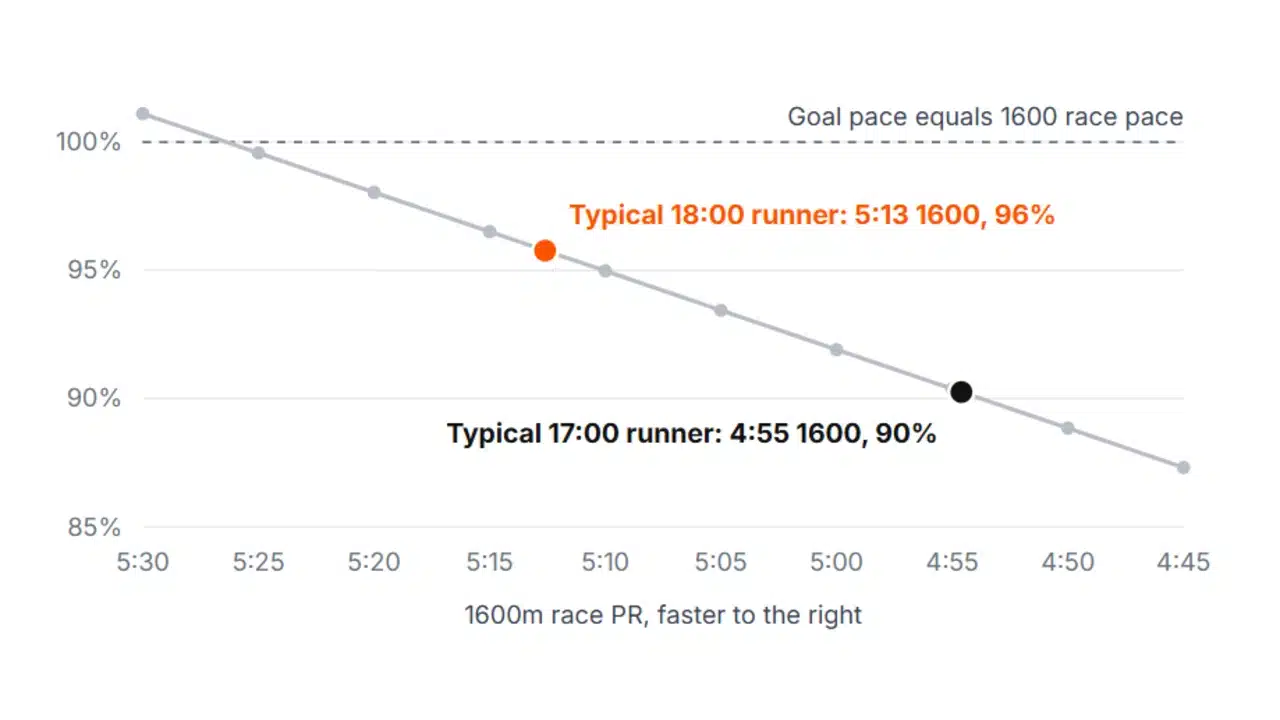
A sub-17 5K is 81.6 seconds per 400. A typical 17:00 runner has about a 4:55 1600, so that pace is 90% of his mile speed. A typical 18:00 runner has about a 5:13 1600, so the same pace is 96%. Close the gap with mile-pace work early in the summer, then sharpen 5K pace in the fall.
Why sub-17 5K pace feels like a mile race
Run the numbers before you question anyone’s toughness. The same 81.6-second lap is a strong rhythm for one runner and a near-mile effort for another. The difference is how fast each can race 1600m.
Every 5 seconds off the 1600 lowers sub-17 pace by about 1.5 points of mile speed. In lap terms, the 18:00 runner has 3.5 seconds per 400 between his mile pace and sub-17 pace. The 17:00 runner has 7.9.
Here is the number that stops coaches cold. A typical 18:00 runner races the 3200 at about 83.6 seconds per lap. Sub-17 asks him to run 81.6 for more than 1.5 times as far. You are asking for a 5K faster than his current 3200 pace.
These equivalents come from Jack Daniels’ VDOT equations, so treat them as round figures. Plug your own runners into the race time predictor, and read more on the system in our Jack Daniels VDOT guide. Set paces from the track 1600, then adjust 5K targets for your course.
Speed reserve: the 1600 sets the 5K ceiling
Speed reserve is the gap between a runner’s top speed and the speed where their aerobic system maxes out. The bigger the gap, the more comfortable any given race pace feels. We covered the 400-to-1600 version in anaerobic speed reserve. The 5K works the same way one rung up the ladder. The 1600 sets the ceiling, and sub-17 5K pace sits underneath it.
No study has tested “more mile-pace work early” head to head in high school runners. The case rests on converging evidence.
Want the long version? Listen to Salty Talks Ep. 8: The Speed Reserve Nobody Talks About.
Why mile-pace work belongs early in the season
Speed adaptations take weeks. In Paavolainen et al. 1999, swapping 32% of training for explosive work improved 5K time and running economy over nine weeks. The endurance-only group improved VO2max but not its 5K.
In Bangsbo et al. 2009, trained runners cut volume 25%, added 30-second sprints, and dropped their average 10K from 37.3 to 36.3 minutes in 6 to 9 weeks. Those were short sprints, not mile reps. The timeline is the point. A reserve you start building in October arrives in December.
The major coaching systems agree on the order. Three of these four put mile pace or faster in the first third of the build and sharpen 5K pace last.
The practical blend for a high school calendar: Lydiard volume for the engine, Daniels sequencing for the quality.
A June-to-October plan for building the speed reserve
Set every pace from current fitness, not goal fitness. An 18:00 runner trains at 18:00 paces until a time trial says otherwise. Here is what a sub-17 5K build looks like for him.
| Pace (18:00 runner) | Per 400 | Where it shows up |
|---|---|---|
| Current 1600 pace (R pace) | 78 s | Summer R reps |
| Sub-17 goal pace | 81.6 s | Late-summer dashes, then pack miles |
| Current 3K pace | 83 s | In-season intervals |
| 17:30 step goal | 84 s | First pack miles and the next race target |
| Current 5K pace | 86.4 s | Where he races today |
-
Summer weeks 1 to 4
Wake up the speed
Strides after easy runs and short hill sprints, twice a week. No pace targets. This block is mechanics and neuromuscular work. The drills are in speed as a skill, and the reasoning for daily strides is in strides on easy days.
-
Summer weeks 5 to 8
Add one R session a week
Start with 8 to 10 x 200 at current 1600 pace with a full 200 jog. Progress to 6 to 8 x 400 with a 400 jog. Every rep stays fast and relaxed. Keep one threshold workout alongside it.
-
Weeks 9 to 12
Hold the reserve, introduce goal pace
R every 10 to 14 days. Add short dashes of goal pace after threshold work, such as 4 x 400 at 82 seconds. Finish the block with a 1600 time trial and reset every pace from the result.
-
In season
Sharpen the 5K
Intervals near current 3K pace. Pack mile repeats at the step goal, then at sub-17 5K pace. A small R dose every 7 to 10 days so the reserve doesn’t fade. Rolling 200s work well here.
How to make sub-17 5K pace feel normal
Bravery is mostly evidence. Runners commit to a pace they believe they can hold, and belief comes from having held it.
In Stone et al. 2012, nine cyclists raced an avatar they thought was their best 4K. It was secretly 2% faster. They beat their baseline by 1.7%. An earlier study used a 5% gap, and riders faded. Going from 18:00 to 17:00 cuts 5.6% off the time. Ask for 17:30 first, a 2.8% cut. If belief is the wall, start with self-limiting beliefs.
In Casado et al. 2024, 15 trained runners ran 5000m three ways. Drafting lowered heart rate from 1000m to 3500m, lowered effort ratings late, improved how runners felt, and produced a faster last 500m. Run every goal-pace session as a five-man pack. The pack attack workout builds exactly this.
Hettinga et al. 2017 found a fast-starting opponent drags athletes into a fast start, and runners commonly start faster than they can sustain. Open goal-pace sessions exactly as you want the race to open: 82-second laps, together, no chasing. A mile they have run ten times in practice stops feeling like a gamble. The full race plan is in our 5K race strategy guide.
If it’s already October
You can’t build the reserve in three weeks. You can make the pace familiar. Add short goal-pace dashes after threshold work, rehearse the opening mile as a pack, and set the step goal for the championship.
Then plan the reserve for spring. The 1600 season is the best speed-reserve block of the year. Start with the Winter Training Block and the free 12-week 1600m training plan.
Frequently asked questions
What 1600 time do you need to run a sub-17 5K?
Daniels’ VDOT equivalents put a 17:00 5K next to about a 4:55 1600. Runners with a slower 1600 can still break 17, but they race closer to their ceiling and need a stronger aerobic profile to do it.
What is R pace?
R pace is Jack Daniels’ repetition pace, roughly current mile race pace. It is run in short reps, usually 200m to 400m, with full recovery so every rep stays fast and relaxed.
When should high school runners start speed work?
Strides and short hill sprints from the first week of summer. Structured mile-pace reps after about four weeks of base. Goal 5K pace last, in the final weeks of summer and through the season.
Does speed work replace mileage?
No. Mileage decides how close to mile speed a runner can race the 5K. Mile-pace work raises the ceiling. Mileage raises the floor. A sub-17 runner needs both.
How do I get my runners to go out faster in a 5K?
Make the pace familiar before you ask for it. Use a step goal, run goal-pace work as a pack, and rehearse the opening mile in practice. Then trust the plan on race day.
Sources
Pace equivalents are computed from the Daniels-Gilbert VDOT equations.
- Støren et al. 2021, Aerobic and Anaerobic Speed Predicts 800-m Running Performance in Young Recreational Runners, Frontiers in Physiology
- Sandford 2018, Applications of the Anaerobic Speed Reserve to Elite 800m Running, AUT PhD thesis
- Nimmerichter et al. 2017, Validity of Treadmill-Derived Critical Speed on Predicting 5000-Meter Track-Running Performance, JSCR
- Paavolainen et al. 1999, explosive-strength training and 5K performance, J Appl Physiol (summary)
- Bangsbo et al. 2009, speed endurance training and 10K performance (University of Copenhagen release)
- Stone et al. 2012, Effects of Deception on Exercise Performance, MSSE
- Casado et al. 2024, light-guided pacing and drafting during a 5000-m run, IJSPP
- Hettinga et al. 2017, The Science of Racing against Opponents, Frontiers in Physiology
- Review of the Jack Daniels 5K to 10K plan, Running with Rock
- Funnel periodization, All Things Running
- Six takeaways from The Science of Running, Running with Rock
- Periodisation the Lydiard way, Coach Ray