
Racing Cross Country in the Cold and Mud
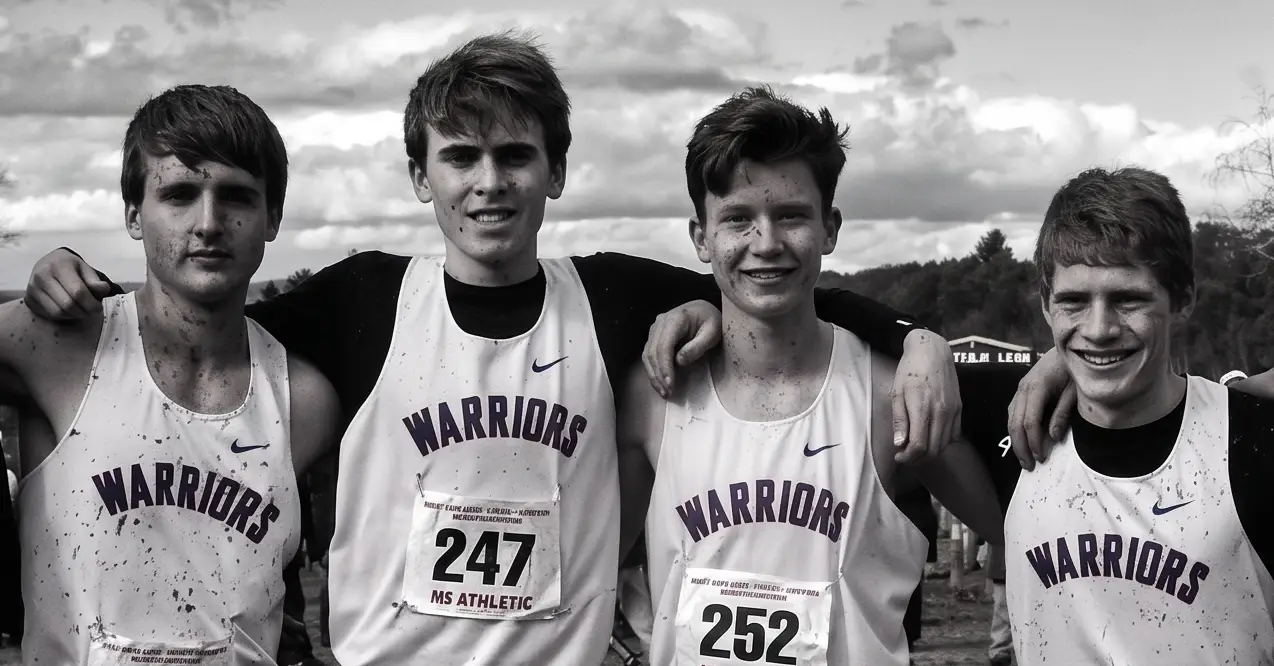
Derryfield Park. New England Championships. 2018.
We brought a young team to Manchester that November. Five sophomores led the squad. Derryfield is a demanding course on a good day. That day it had mud on the course and snow on the ground. Our starting box sat in standing water, ankle deep and freezing. That is where our runners stood while they waited for the gun. Not ideal, but XC has never been about comfort.
They finished 15th out of 30 teams. Every one of them ran under 17:40. They crossed the line exhausted and covered in mud. Five minutes later they were euphoric.
Fitness got them to New Englands. By late October, fitness is set for everyone. What a cold race decides is how much of that fitness shows up. Some things are beyond your control, but much of it comes down to details: where they stand, what they wear, how long they wait, and what happens in the ten minutes after they finish.
Championship season in New England means cold, wet and muddy is the default. Here is how to prepare a team for it.
The short version
Read the meet sheet for spike limits, because the national rule allows far more than most coaches think. Keep the gap between the end of the warm-up and the gun as short as the meet allows, and keep warm-ups on until the final call. Under NFHS rules, compression layers can be any color. Whatever school-issued top or tights a runner starts in, they finish in. Get every runner into dry clothes within minutes of finishing.
The night before: read the meet information sheet
Cold races start the night before, with a piece of paper most coaches skim.
Spike length is a meet rule, not a national one
Ask a room of coaches what the spike limit is in cross country and you will hear a quarter inch. Maybe a half. The NFHS rule is far longer than either. In cross country, the sole and heel can carry spikes up to 1 inch long. The rule also lets the games committee set the length on all-weather surfaces.
That 1 inch is a ceiling, not a guarantee. Your state association, your meet host or the course owner can set something shorter, and some courses on golf courses and in public parks do. The meet sheet is the rule that counts. Read it the night before, not in the tent.
Determine spike length on the course walk
Spike length depends on the conditions, which is why the decision belongs on the course walk, not at home. Firm, dry ground calls for shorter ones. Soft ground and mud call for longer ones, inside whatever the meet allows. Carry mixed lengths and a spike wrench in the team bag. Change spikes in the tent, not in the box.
Keep the shoes on
Mud pulls spikes off feet. Every championship season, somebody somewhere finishes in one shoe. Double knot. Tuck the laces under the crossed laces. Some teams tape over the laces and around the midfoot. If you plan to tape, practice it in a workout first so nobody discovers on race day that it rubs.
The box is where cold races are lost
A warm-up has one main job. It raises muscle temperature. In short, explosive efforts, performance improves 2 to 5 percent for every 1°C rise in muscle temperature. A cross country start is a short, explosive effort with real consequences. The first 400 meters decides where your runners sit for the next mile.
That warmth fades fast. Body temperature starts dropping the moment exercise stops, and the drop is significant within about 15 to 20 minutes. Championship meets are built to make you wait. Box check-in. Final instructions. A delayed gun. Twenty minutes of standing can erase a warm-up you planned to the minute.
Then there is the box itself. You don’t choose it. In 2018 ours was underwater.
What the research says about staying warm
Sports with long gaps between the warm-up and the start have studied this problem closely. Swimmers, rowers, rugby players and bobsledders have all used heated garments or insulated jackets in the gap. A 2022 meta-analysis found that passive heating between an active warm-up and competition raised peak power output in every study it included, with a moderate effect. The authors note the number of trials is small. The direction is clear.
A study of soccer players found the same thing in the cold. Heated leggings slowed the drop in muscle temperature.
One caution. In longer efforts, too much passive heat can backfire, because it leaves the body less room to store heat before performance suffers. A 5K is long enough for that to matter on a mild day. Dress them warm in the box when it is cold. Don’t bake them in parkas when it’s 60.
How we run the box
You can’t control where the box is. You can control how long your runners stand in it cold.
- Work backward from the gun. Start the warm-up late enough that it ends close to the final call, not 25 minutes before it.
- JV holds the box. On our team, JV runners hold the box during the varsity warm-up and collect layers. Varsity stays moving.
- Warm-ups stay on until the final call. Jacket, pants, hat and gloves stay on through instructions. Hand warmers go in the pockets.
- Layers go in trash bags. Gear stays dry and JV carries it out. A spare bag gives runners something to sit on besides wet grass.
- Re-warm in the box. Strides, skips and bounces. Short and sharp. Keep the legs moving until the gun.
For the full warm-up sequence, listen to the pre-race warm-up episode of Salty Talks.
What to wear on the line
These are the bands I use. Temperature means temperature at the gun, not at breakfast.
| At the gun | What they wear |
|---|---|
| 40°F and above | Singlet and shorts. Arm sleeves if they want them. |
| 25°F to 40°F | Gloves and hat to start. Long-sleeve compression shirt under the singlet. |
| Below 25°F | Gloves and hat. Long sleeves. Tights recommended. |
Wet or windy? Dress them one band colder.
These are starting points, not a team uniform. The ACSM recommends choosing cold-weather clothing for each athlete rather than mandating one outfit for a whole group. Some kids run hot. Some kids run cold. Let them adjust inside the band.
The undergarment rule changed
For years, anything visible under the uniform had to be a single solid color. That rule is gone at the NFHS level. Any visible garment under the uniform top or bottom is now a foundation garment, and foundation garments carry no color or logo restrictions.
A 2025 NFHS interpretation made it concrete. A team in black shorts with compression underneath in different colors and lengths is legal, unless the state association has a stricter rule. Hats and sunglasses are legal too, unless the state association or games committee says otherwise.
Check your state handbook before the championship. State associations can be stricter than the national rule.
Two rules that still bite
Your team has to look like a team. Outer garments must show, through predominant color, school logo and color combination, that your runners are from the same school. Outer layers are a team decision. What goes underneath is individual.
What starts on, stays on. A school-issued or school-approved outer garment, like a team long-sleeve or team tights, becomes part of the uniform once it is worn. Removing any part of the uniform in the competition area is illegal. The first time is a warning. A repeat is a disqualification. Hats and gloves aren’t uniform garments, which is why runners routinely toss them in the first mile. Tops and tights are different. Decide before the gun. If you are unsure how your officials read it, ask the clerk.
Skip the Vaseline for warmth
Plenty of runners still smear petroleum jelly on their faces before a cold race to stay warm. It doesn’t work. Finnish military researchers studied it. Conscripts who used protective ointments on their faces in the cold had a higher risk of frostbite on the cheeks, nose and ears, not a lower one. The ointments provided almost no insulation. The researchers pointed to a false sense of protection.
Cross country temperatures rarely threaten frostbite. The lesson still holds. Vaseline is for chafing. A hat and gloves are for warmth.
Racing in mud
Mud changes the race more than the cold does. Plan for it on the course walk.
- Find the dry line. Walk every turn and every climb. Note where water collects and where the footing holds.
- The shortest line isn’t always the fastest. A few extra meters on firm ground can beat a straight line through deep mud. Decide before the race. Runners in oxygen debt make bad decisions about footing.
- Shorten the stride. Quicker turnover, feet under the hips, arms a little wider for balance. Overstriding in mud is how runners end up on the ground.
- Control the downhills. Mud on a descent punishes braking and punishes reckless speed. Stay light and quick.
- Splits lie. Mile splits in mud mean almost nothing. Race by effort and by place. Count people, not seconds.
For more on walking a course with purpose, listen to Reading the Course. For race plans that hold up when the course doesn’t, see 5K race strategy for coaches.
Breathing cold air
Some runners cough hard after cold races. For some of them it is more than a cough. Exercise-induced bronchoconstriction, a temporary narrowing of the airways, is far more common in athletes than in the general population. A recent review puts it at 10 to 50 percent of elite athletes, against 5 to 10 percent of everyone else. Breathing large volumes of cold, dry air is one of the main suspected triggers. Symptoms often show up 5 to 15 minutes after hard exercise. That is the cooldown.
- Athletes with a prescribed inhaler follow their doctor’s plan on race day. Make sure it is in the bag.
- A kid who coughs hard for 20 minutes after every cold race needs a doctor, not a coach’s diagnosis. Tell the parents.
The cold weather running policy covers airways and cold air in more detail.
Fuel and fluids when it is cold
Nobody thinks about drinking when it is 35 degrees. Athletes pay less attention to hydration in cold weather, and they still lose fluid. Put warm fluids on the bus and in the tent. Keep breakfast familiar. A cold championship is not the day to test a new bar. Use the pre-race nutrition calculator to time the last meal around a late start.
The ten minutes after the finish
Back to 2018. Five minutes after the finish, our runners were euphoric. They were also soaked, muddy and cooling fast. The race was over. The cold wasn’t.
Wet skin cools faster than dry skin, and the ACSM’s current consensus on cold-weather exercise says wet clothing should come off. The finish chute is where a great day turns into a miserable bus ride. Here is the routine.
- Every runner packs a dry bag. Dry socks, a dry base layer, a hat and gloves, sealed in a trash bag so it stays dry in the tent.
- Chute, tent, dry clothes, then cool down. In that order. The cooldown happens in dry layers.
- Someone meets every finisher. Station an adult or a JV runner at the end of the chute to walk each runner straight to the tent.
- Something warm to drink. A thermos in the tent.
- Know the warning signs. Shivering they can’t stop, fingers that won’t work a zipper, confusion or slurred words. That runner goes to the athletic trainer or the medical tent now.
The coach’s cold-race kit
Everything above depends on a bag that is already packed.
Pack it by late October
- Spare 1/4-inch spikes and a wrench
- Athletic tape
- Hand warmers, 40-pack
- Throwaway cotton gloves, 36 pairs
- Contractor trash bags, 50 count
- Towels, 12-pack
- Insulated thermos, 40 oz
- 10×10 pop-up tent
- Changing robe
- Mylar blankets, 100-pack
The links in this list are Amazon affiliate links. As an Amazon Associate I earn from qualifying purchases, at no extra cost to you.
For the rest of meet day, see the cross country meet checklist and the coach gear guide. Hand your athletes the race day packing list.
Back to Derryfield
Five sophomores. Fifteenth out of thirty. Ankle-deep water in the box, mud on the course and snow on the ground. Every one of them under 17:40.
You don’t control the box, the weather or the course. Nobody does. You control how ready your team is for them. Read the meet sheet. Shorten the wait. Dress them right. Get them dry. Then watch them run.
Free download
The season ends. The cold doesn’t.
The one-page cold policy puts the thresholds, the call time, the communication plan and the winter checklist on a single page. Edit the numbers to match your school and send it to your athletic director before the first cold morning.
The rest of the winter. Week 1 of winter training is the week after your last race. The Winter Training Block writes out all twenty weeks, day by day, with two paths and four levels.
Common questions
How long can cross country spikes be?
The NFHS rule allows spikes up to 1 inch in cross country. State associations, games committees and course owners can set shorter limits, so the meet sheet is the rule that counts.
Can high school cross country runners wear hats and gloves?
Yes. A 2025 NFHS interpretation confirmed that hats and sunglasses are legal unless the state association or games committee says otherwise. Gloves are standard at cold meets.
Do compression shirts and tights have to match the uniform?
Not under NFHS rules. Visible garments worn under the uniform are foundation garments with no color or logo restrictions. Check your state handbook, which can be stricter.
Can a runner take off a long-sleeve shirt during the race?
Not if it is a school-issued or school-approved outer garment. Once worn, it is part of the uniform. Removing it in the competition area draws a warning, and a repeat draws a disqualification. Decide on layers before the gun.
How close to the start should the warm-up end?
As close as the meet allows. Body temperature falls significantly within about 15 to 20 minutes of stopping. Keep warm-ups on until the final call and re-warm with strides in the box.
What should a runner wear for a 35-degree race?
Gloves and a hat to start, and a long-sleeve compression shirt under the singlet. If it is wet or windy, dress one band colder and add tights.
Does Vaseline keep runners warm?
No. Research on Finnish conscripts found that facial ointments provided almost no insulation and were linked to a higher risk of frostbite. Use it for chafing, not warmth.
Keep reading
- Peaking for XC championship season. The taper, the mental game and the final week.
- When to run the last hard workout before the championship.
- How long should runners take off after cross country. What happens after the last race.
This article is general coaching education, not medical advice. Confirm uniform and equipment rules with your state association and meet officials before championship day. An athlete with breathing symptoms that don’t settle, or with signs of hypothermia, needs medical attention rather than a coaching decision.