What Sam Ruthe’s 3:48 Mile Teaches Every High School Coach About Long-Term Development
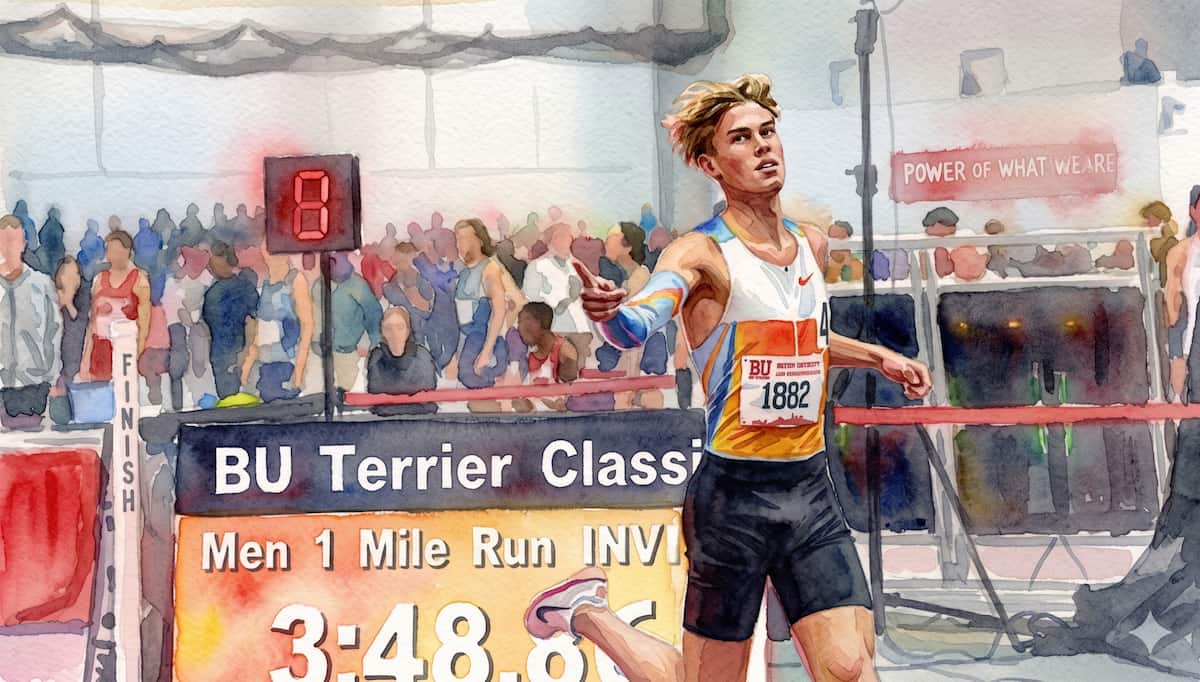
On January 31, 2026, in Boston, on a frigid twelve degree day, a sixteen-year-old from Tauranga, New Zealand, ran 3:48.88 for the indoor mile at the BU Terrier Classic.
He had traveled fifty hours to get there. He had been stranded in San Francisco by snowstorms. He had never run on a banked 200-meter indoor track before in his life. He ran the eleventh-fastest indoor mile in history and became the youngest man ever to break 3:50, by over a full year, while dismantling a forty-four-year-old national record set by Olympic champion Sir John Walker.
He does this on 37 to 43 miles per week during the track season. He does no weight training. He trains once a day. He is, by his coach’s estimate, at roughly forty to fifty percent of the training ceiling he will eventually reach as a professional.
For high school coaches, every part of that paragraph is worth sitting with.
The Family Behind the Athlete
Before examining the training, you need to understand what Sam Ruthe is working with. Not to dismiss the lessons for ordinary athletes, but because the genetic context reframes what “talent” looks like and why certain development decisions make sense in his case.
His grandmother is Rosemary Wright, who won 800m gold at the 1970 Commonwealth Games for Scotland and was a 1972 Munich Olympic finalist. Her 2:00.15 personal best stood as the Scottish national record for thirty years. She also won European gold in the 4x400m relay. His grandfather Trevor Wright ran a 2:13 marathon debut that set a world record in 1971 and won silver at the European Marathon Championships. His mother Jessica Ruthe won five New Zealand national titles in middle distance. His father Ben Ruthe was the 2002 New Zealand 1500m champion and the 2006 national 5K champion, ran 3:41 for 1500m, and now serves as Sam’s race strategist and logistics coordinator.
This is not a kid who showed up with talent. This is the product of four generations of aerobic adaptation arriving in one athlete. Ben Ruthe’s framing is useful here: Sam and his sister Daisy’s natural talent is like a block of marble. You need a great coach to sculpt it into a work of art. “Craig,” he says, “is Michelangelo.”
The reason the genetic context matters for your coaching is this: when someone with this aerobic ceiling is running 43 miles a week and setting world records, it tells you something important about where the ceiling actually comes from. It is not the mileage.
What Sam Was Doing Before He Started Running
Here is the fact that reframes everything else in this story. Sam Ruthe has been running seriously for three years.
He won his primary school cross country every year. It was never close. His parents watched it happen and their response was to say no. No training runs. No mileage. No early specialization.
Ben Ruthe’s explanation is direct: “We wouldn’t let him run. He was asking to go for training runs and we were saying ‘no, you’re not allowed to.’ It can be quite hard for kids when they’re young, if they’re doing really well, to get overtaken. They can struggle with that if they’re not mentally prepared. We didn’t want to put them in that position. By 13, they started to get a level of emotional and mental maturity to understand and accept that part of the journey.”
What was Sam doing while other talented kids his age were logging miles? Playing rugby and swimming competitively. Every bit of the aerobic capacity he built before age thirteen came from multi-sport activity with zero orthopedic wear from running.
The fastest sixteen-year-old miler in human history has been running for three years.
That is not a coincidence or an origin story anomaly. It is a deliberate developmental philosophy executed by parents who understood the trap that elite early performance creates and chose not to walk into it. If you have a seventh or eighth grader on fifty-mile weeks right now because she is exceptional, Ben and Jess Ruthe’s decision is worth considering.
Craig Kirkwood: The Coach Behind the Record
Craig Kirkwood ran 2:13 for the marathon and competed at the 2002 Commonwealth Games. Before that, he apprenticed under Kim McDonald, the Kenya-based coach who trained multiple world record holders including Haile Gebrselassie and Paul Tergat. That apprenticeship is the foundation of Kirkwood’s coaching philosophy in a way that matters. He learned to develop world-class distance runners from the coach who was doing it most successfully in the world.
He has since produced Olympic triathlete Hayden Wilde, two-time Olympic 1500m runner Sam Tanner, twenty athletes who earned full-ride US college scholarships, and nineteen New Zealand national championships in 2025 alone.
But the thing you need to understand about Kirkwood before you try to copy his methods is how he coaches, not just what he prescribes. Sam’s description of his training environment is as instructive as any workout detail:
“Craig gives us the program just when we turn up, so we never know what we are going to get until we get there. He never tells us off or is ever disappointed; he really just gives us the work, and it’s up to us to do it and do it well. It’s good because it’s our responsibility, and there aren’t highs and lows with Craig; it’s just about consistency and training correctly.”
No pre-loaded anxiety. No emotional volatility. No coach broadcasting expectations through a megaphone. The athlete shows up. The coach hands them a plan. The culture of the group does the rest.
Kirkwood’s squad in Tauranga has around thirty athletes training together, including Sam Tanner. NCAA college athletes fly in over Christmas break to train with the group. The culture Kirkwood has built is the mechanism by which the training plan works.
One coaching decision worth naming specifically: Kirkwood uses effort-based descriptions rather than pace targets for most sessions. In an 8 × 300 workout, he describes how each rep should feel rather than giving splits to hit. This is not imprecision. It is deliberate. For a developing athlete, teaching the internal calibration of effort is more valuable than teaching the ability to hit a prescribed pace on a GPS watch. The athlete who knows what controlled threshold effort feels like can race intelligently in any conditions. The athlete who has only ever chased a number cannot.
Kirkwood extends this principle to lactate testing: he explicitly avoids it for young athletes. Not because the physiology is wrong, but because he wants them to develop feel for effort rather than depend on external measurement. Watch the athlete, not the number. This aligns directly with Lydiard’s foundational principle, which Kirkwood absorbed through McDonald: the athlete’s response to training over time tells you more than a single lab snapshot.
The Volume Paradox: Periodized, Not Static
Most articles about Sam Ruthe cite his mileage as a fixed number. It is not. It is periodized across the season with a purpose.
During his winter base-building phase, Ruthe runs approximately 80 kilometers (50 miles) per week. When the track season arrives and race frequency increases, that drops to 60–70 kilometers, or 37–43 miles. During intense racing blocks, such as his five-race US tour, Kirkwood pulled it back further. The highest volume he has ever reached is 90 kilometers, just under 56 miles, as a ceiling approached gradually over three years of training.
His longest run is currently 17 kilometers, just over ten miles. Not because he could not go longer, but because Kirkwood has not needed him to yet. Every training tool stays in the toolbox until there is a reason to pick it up.
The ceiling Kirkwood has in mind for Sam as a fully mature professional is 140–150 kilometers per week. Sam is currently at roughly forty to fifty percent of that ceiling. Kirkwood stated it plainly: “There’s heaps of room for growth. He can quite legitimately get to 140, 150 before he’d really be reaching his peak.”
For context, the comparison that matters here is not Sam Ruthe versus a typical American high school program. It is Sam Ruthe at sixteen versus Sam Ruthe at twenty-six. Kirkwood is not training the sixteen-year-old in front of him. He is building the infrastructure that the twenty-six-year-old will use to attack Hicham El Guerrouj’s 3:43.13 world record.
The American high school habit of pinning peak mileage through the entire competitive calendar, 70 or 80 miles per week from September through February, is one of the primary reasons athletes are ground down and stale by indoor season. The load needs to cycle. More in base. Less when racing frequently. Your athletes will run faster in March if they are not exhausted from January.
The Training Structure: What He Actually Does
Kirkwood’s training philosophy overlaps significantly with Norwegian method principles, built around consistent aerobic volume at controlled threshold intensity rather than frequent race-pace hammer sessions.
The core principle of the Norwegian method worth understanding: most American distance programs operate in what coaches call the gray zone, the 92 to 97 percent of max heart rate range that is too hard to do frequently and not hard enough to produce race-specific adaptations. It is the intensity that costs the most and returns the least. Threshold intervals that are controlled, sustainable, just below the second lactate threshold can be run two to four times per week. All-out race-pace efforts cannot. Kirkwood’s program lives in the former and avoids the latter.
Squad-based sessions. The thirty-athlete training group is not a backdrop to Ruthe’s development, it is the mechanism. Sam Tanner, a two-time Olympic 1500m finalist, regularly runs ahead of Ruthe and pulls him through workouts. When asked which athlete he admires most, Sam’s answer was not Jakob Ingebrigtsen or Cole Hocker. It was Sam Tanner: “He is just so positive, he really enjoys all of the training and has been so good helping me out right from the start. He has all the tips.” An athlete who trains daily alongside an Olympian who genuinely loves the process learns something about how to be a professional athlete before he is even out of high school.
Threshold intervals. The backbone of the program. Controlled, effort-calibrated, repeatable. Kirkwood uses feel descriptions rather than split targets. The session where he runs 8 × 300 is not about hitting a specific time, it is about replicating a specific sensation across eight reps, with the later reps requiring deliberate effort to sustain what the earlier ones produced more easily.
Plyometrics — stacked after the track session. This is the detail most coaches miss when they read that Ruthe does “no weights.” He does no traditional resistance training. No squats, no Olympic lifts, no CrossFit circuits. His skeletal system is still developing, and heavy loading at this stage can compromise running economy and raise injury risk. What he does do is core stability work and plyometrics: bounding, hurdle hops, single-leg work. And Kirkwood stacks them immediately after track sessions, not on separate gym days. You finish your threshold intervals, you stay on the track, and you do the plyometric work right there. The logic is clean: neuromuscular fatigue from the track session primes specific adaptations, and keeping it in one block means the remaining days stay genuinely aerobic. You get the neuromuscular stimulus without adding a second hard day to the week.
One session per day. No doubles. The single session keeps total stress manageable and ensures that each quality session is actually quality rather than accumulated fatigue dressed up as training load.
Cycling. One to two sessions per week on the bike as a supplementary aerobic stimulus that produces no ground-impact stress. Not injury-recovery cross-training. Part of the plan.
The Benchmark Workout and the Racing Philosophy
The tactical execution of the 3:48.88 at BU is the product of everything the training built. His final 400 meters was 55.98 seconds, nearly two seconds faster than his opening lap. His split progression across the eight 209m laps: 28.97, 28.56, 28.84, 29.20, 28.68, 28.16, 28.12, 28.38. Remarkably even through the first six, then a progressive surge. That is not natural talent. That is what daily training alongside an Olympian and regular competition against professionals produces in a developing athlete who has never over-raced at the junior level.
The North Carolina race two weeks later, where Ruthe finished seventh in 3:52.16 in a deep professional field, boxed in and unable to find clean air, is arguably the more important data point. Kirkwood kept that race on the schedule deliberately. He wanted Sam to experience that chaos before a Commonwealth Games start line. Sam’s own assessment, at sixteen years old: “The first race, I didn’t learn that much. But going down to North Carolina, entering a field with such depth, I learned you’ve gotta really fight for your place and running’s more competitive at the top level. Time’s only a number, and a time can be run once, but experience is forever.”
The race where your athlete finishes seventh might be the most important race of their season. Stop protecting your best athletes from losing.
The Support System Beyond the Track
Ben Ruthe manages race logistics. Jessica Ruthe oversees nutrition. Sam’s pre-race meal is a Vietnamese chicken bowl the night before every major competition. The same meal, every time. Not superstition. Variable elimination. GI distress is not a risk the support system allows to become a factor.
Physiotherapist Leanna Veal monitors stride mechanics as Sam’s body changes through adolescence. Growth spurts kill running economy in developing athletes. The limb lengths change, the leverage changes, the stride mechanics that worked six months ago stop working. Catching that in real time and correcting it is a specific, underrated part of what has allowed Ruthe to improve as fast as he has without structural injury.
Sam puts himself to bed early voluntarily because he understands that growth hormone release during deep sleep is where adaptation actually happens. He is sixteen. That level of self-directed discipline is the hidden work that never appears in highlight footage.
In 2026, Ruthe qualified for the senior World Indoor Championships in Poland. His family turned it down. School came first.
Ben Ruthe’s framing of his parenting role applies directly: “He’s climbing high, and we are his spotters.” Spotters do not guide the climb. They are present, they watch carefully, and they catch a fall if one comes. That is a precise description of what good parenting looks like in the context of elite junior development, and it is a clear-eyed distinction between support and interference.
What’s Next
Ruthe’s 2026 target is the Commonwealth Games in Glasgow July 29th through August 1st. Followed by the World Under-20 Championships in Eugene, Oregon, less than two weeks later. Three hard races in eleven days with a transoceanic flight in the middle.
The Commonwealth Games carries a generational weight that is worth noting. His grandmother Rosemary Wright won 800m gold at the 1970 Edinburgh Commonwealth Games for Scotland. Glasgow is in Scotland. The symmetry is not lost on anyone in the Ruthe family.
The longer horizon is already in view. Kirkwood mentions El Guerrouj’s 3:43.13 outdoor world record: “That’s only five seconds. It’s only 40m on the track or so. Who knows what’s going to happen.”
For Coaches: What the Ruthe Model Teaches
Multi-sport development is not a consolation prize.
The Ruthes held Sam back from running until thirteen. The burnout risk from early specialization is real.
Cycle the load.
Peak mileage held constant through the competitive calendar is one of the clearest ways to produce stale, overcooked athletes.
Teach effort, not pace.
Kirkwood uses feel descriptions rather than split targets for most sessions, and explicitly avoids lactate testing for young athletes because he wants them to develop internal calibration. An athlete who knows what controlled threshold effort feels like can race intelligently in any conditions. An athlete who chases a Garmin number cannot. The GPS watch has a place. It should not be the primary instrument of effort regulation for a developing runner.
Stack plyometrics after the track session.
Ten to fifteen minutes of bounding, hurdle hops, and single-leg work at the end of a threshold session accomplishes more than a standalone gym session. You get the neuromuscular stimulus without adding a second hard day to the week. Keep it on the track. Keep it simple.
Build the training culture before you build the program.
Kirkwood’s thirty-athlete group which includes Olympians, pulls NCAA athletes across the Pacific for Christmas training camps, and operates with no emotional drama and full athlete ownership is the mechanism by which the training plan works. Not a backdrop to it. The single biggest developmental tool in the system is not a workout. It is who shows up to training. Can your best sophomore do sessions with your seniors? Can you arrange a monthly joint workout with the local college team? One session a month training with older, faster athletes will do more for tactical maturity than a season’s worth of age-group races where your athlete wins by forty seconds.
Race them where they might lose.
A seventh-place finish in a professional field taught Sam Ruthe something the 3:48 could not. Go find the race where your athlete is not the favorite, then go find another one. The experience is permanent. The time is just a number.
Know what your role is in the system.
When Kirkwood is asked what occupies his attention at the elite coaching level, his answer is not a periodization chart. Elite coaching is half logistics and relationship management for every part that is actual training design.
The Bottom Line
Sam Ruthe’s 3:48.88 mile is not just a record. It is a case study in what happens when you resist the urge to extract everything from an athlete before they are ready.
He has been running seriously for three years. He runs once a day. He does no weights. He runs 37 to 43 miles per week during the track season. He is at approximately forty to fifty percent of the training ceiling his coach projects for him as a professional. And he has run the eleventh-fastest indoor mile in history.
Jakob Ingebrigtsen, who owns the indoor mile world record at 3:45.14, was developed through a similar philosophy on a Norwegian foundation. Craig Kirkwood, who apprenticed under the coach of Gebrselassie and Tergat, built a version of that foundation in Tauranga. The five seconds between 3:48 and 3:43 will be covered by an athlete trained intelligently over a decade, not squeezed out in high school.
The greatest developmental tool in your program is not a workout. It is the environment you create, and the patience to let it work.