

The Grant Fisher Training Blueprint: How the World’s Fastest Distance Runner Was Built on 45 Miles a Week
Introduction: The Shocking Reality of Low-Volume
There is a number that stops most elite running coaches cold when they first hear it: 45 to 50 miles per week.
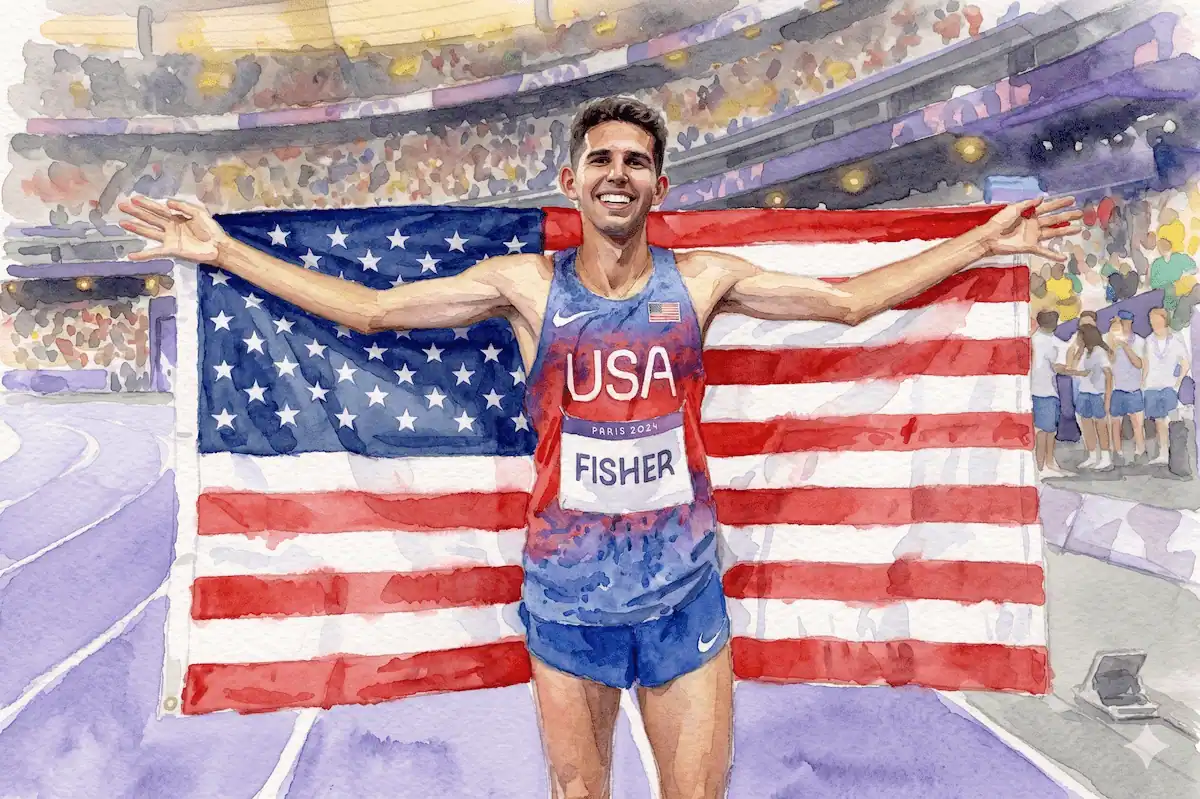
That’s it. That’s the weekly training load of Grant Fisher, the man who, on a February night in Boston in 2025, shattered Kenenisa Bekele’s 21-year-old 5,000m indoor world record with a 12:44.09. The same man who stood on the Olympic podium in Paris, bronze medals around his neck in both the 5,000m and 10,000m – the first American to medal in both events at a single Olympic Games.
Forty-five miles a week. When coaching conversations orbit around 100-mile weeks and double workouts, Grant Fisher is out rewriting the record books on mileage that many high school runners already log. And that is not an accident. It is the product of one of the most precisely engineered training philosophies in the sport.
From Grand Blanc to the Starting Line: The 40–50 MPW System
Grant Fisher grew up in Grand Blanc, Michigan, with a baseline understanding of athletic excellence (father, Dan, Pac-10 runner; mother, Sonia, University of Houston middle distance). What Coach Mike Scannell did was meet that baseline with a highly structured training system.
Scannell’s high school philosophy was built on:
- Mileage Caps: Fisher never ran more than 40-50 miles per week at Grand Blanc High School. Scannell never deviated from this range, ensuring durability and consistent stimulus without breaking the structural integrity of a developing athlete.
- Lactate-Based Intensity Control: Long before it was trendy, Scannell enforced strict pace discipline based on physiological feedback.
The Results of the HS System:
- Back-to-back Foot Locker Cross Country National Championships.
- Seventh American high schooler to break the four-minute mile.
After an NCAA career at Stanford and American record success with the Bowerman Track Club (American records in 3K, 5K, and 10K), Fisher shocked the community by leaving Bowerman in October 2023. His reason: Training in a large group meant losing the individualized fine-tuning that he believed was the key to his success.
The Return: Irreplaceable Data and Park City Altitude
He chose to return to his high school coach, Mike Scannell.
Grant Fisher had access to every professional resource in American running. He chose a high school coach because Scannell knew Fisher’s physiology better than anyone alive. The relationship that produces true excellence accumulates knowledge across years. Bowerman gave great training and great results, but Scannell offered something non-transferable: irreplaceable individual data collected over a decade and a healthy long-term relationship.
The Training System: Individualization over Generalization
Scannell’s system is lean, built around lactate precision. Altitude training (Park City 6,900ft, Flagstaff 7,000ft) ensures elevated physiological demand year-round. Adaptation happens from precise stress applied consistently, not from maximizing volume.
Specific Workout Structure & Tools
To understand how 45 miles is sufficient for world records, you must look at the precision of the individual workouts:
| Segment / Session | Description / Target | Precision Parameter |
| LT2 Threshold Tempo | Key session; designed around the individualized anaerobic threshold. | Millimoles: 3.8 to 4.0 mmol/L. Pace Discipline: Kept within two seconds of the prescribed LT2 pace every single session. |
| Monday AlterG Cutdown | Reduced-impact workout completed after the primary session. | Volume and aerobic work without increasing skeletal/impact load. |
| Race Sharpening (7–10 days prior) | Prime the neuromuscular system before major competitions. | Short interval sessions run at lower altitude, tightly controlled with minimal rest, specifically run below 5K race pace. |
| Infrequent 400m Work | Sprint-quality work done very rarely | Specific 49.9 400m repeat sessions. |
| KICKR RUN Treadmill | Capabilities used for dynamic training support. | Used specifically in RunFree mode where the belt adjusts dynamically to the runner’s position. |
Racing Intelligence: Scannell’s Three-Step Move
Scannell’s influence on Fisher’s racing IQ is as significant as his physiological development. Fisher executes the signature three-step move flawlessly. This involves a sudden, three-stride surge mid-race to probe and test competitors’ responses. It is a tactical probe, not a finishing kick. At the Paris Olympics, his bronze medals in both the 5,000m and 10,000m deep fields were perfect executions of these race plans.
What World Records Look Like From the Inside
On February 8, 2025, at the Millrose Games in New York, Fisher ran a world indoor 3K record (7:22.91). Six days later, at the Boston University Valentine Invitational, he ran 12:44.09 in the 5,000m, shattering Bekele’s 21-year-old record by over five seconds.
Two world records in six days. On 45 miles a week.
What This Means for Coaches
The Fisher-Scannell model offers powerful, but often misapplied lessons. The training number (45 mpw) is not universal; what is universal is the principle: calibration to the individual, not replication of a generic template.
Coaching Takeaways:
- Calibration matters more than copying. The system works because Scannell has decades of accumulated individualized data confirming exactly where Fisher’s LT2 curve sits, how his lactate clears between intervals, and his specific response to altitude vs. sea level. Without that decade of calibration, 45 miles would be insufficient.
- Long-term coaching relationships compound. Continuity at every level of coaching matters. Scannell knew Fisher’s injury warning signs and physiological baseline.
- Intensity precision over general volume. If your athletes’ tempo runs are scattered across a large pace range based on feel, you are leaving adaptation on the table. Precise stress applied consistently drives adaptation. Use my training pace calculator.
- “Speed work kills” (pro-longevity). Scannell’s caution about high-speed work protects young bodies from structural load. High-quality sprint sessions are done infrequently; speed emerges from extraordinary aerobic and lactate machinery, not sprint accumulation. Hill training, terrain variety, and altitude are useful force multipliers.