Why Jane Hedengren is the Blueprint for the Modern Distance Runner

Why Jane Hedengren Is the Blueprint for the Modern Distance Runner
As coaches, we often talk about “generational talents”-athletes who don’t just win, but fundamentally shift the paradigm of what we believe is possible at the high school and collegiate levels. We saw it with Mary Cain, we saw it with Katelyn Tuohy, and now, we are witnessing it with Jane Hedengren.
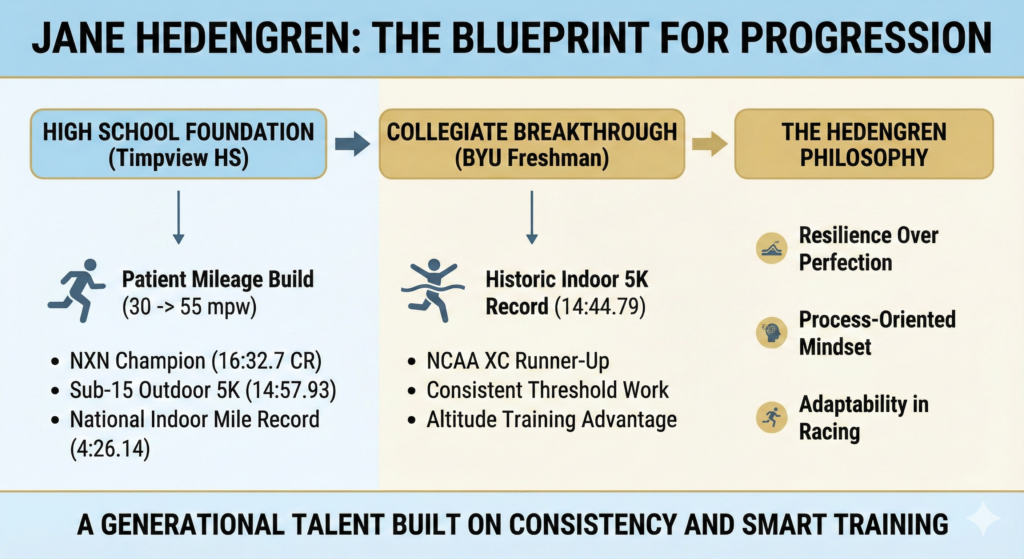
If you’ve been following the race results this week, you likely saw the headline that stopped the running world in its tracks: Jane Hedengren, a freshman at BYU, just obliterated the collegiate indoor 5000m record with a 14:44.79 at the Boston Season Opener. This historic performance by Hedengren also ranks as the second-fastest ever by an American!
Let that sink in. A freshman, just months out of high school, dipping under 14:50 for 5000m.
But as impressive as that is, the story behind that incredibly fast time is what we need to share with our athletes. I’ve dug into her background, her training progression, and her mindset to pull out the lessons that matter most.
The Background: Built, Not Born
It’s undeniable that Jane has elite genetics in her corner. Her father, John, was an All-American at BYU, her brother Isaac runs for the current BYU men’s team, and her mother was a solid high school runner. Yet, talent alone doesn’t explain a sub-14:45 5K. To reach this elite level requires far more than just good DNA; it demands a disciplined, progressive approach to training-a methodology that every coach can, and should, learn from.
Running for Timpview High School in Utah, she didn’t start by running 60-mile weeks. Reports indicate her freshman year volume was around 30 miles per week. By her senior year, she had built that to a modest 55 miles per week.
For the Coaches: This is a critical takeaway. In an era where we see high schoolers burning out on collegiate-level volume, Hedengren’s progression was patient. She dominated because she was healthy and developing, not because she was redlining from the beginning. This is exactly why Zone 2 training and patient aerobic development are so critical for long-term success.
The Resume: Rewriting the History Books
Before she even donned a BYU jersey, Hedengren left a scorched-earth legacy in high school (Class of 2025):
- NXN 2024 Champion: She didn’t just win; she ran a 16:32.7 course record at Glendoveer, breaking Katelyn Tuohy’s legendary mark by over 5 seconds and winning by 41 seconds.
- The Sub-15 Barrier: In spring 2025, she became the first high school girl to break 15 minutes in the outdoor 5K with a 14:57.93.
- Range: She also holds the high school national record for the indoor mile (4:26.14).
Training Insight: The “Boring” Work
What does her training look like? It’s refreshingly simple. It’s consistent threshold work, altitude training in Provo, Utah, and specific race-pace workouts.
A staple workout cited from her senior year was 3 x 3200m (2-mile repeats) at altitude.
- The Pace: She was hitting these in the 10:35–10:40 range (Daniels Threshold pace).
- The Rest: Short rest (60 seconds).
- The Lesson: This isn’t flashy sprinting. This is aerobic strength. It teaches the body to clear lactate efficiently and the mind to endure discomfort for long durations.
For our high schoolers, this reinforces the value of running the intended workout. Not turning one workout into something else by going too fast. Her approach shares a lot in common with the Engelhardt Blueprint-controlled intensity, progressive overload, and trust in the process.
The Human Element: Resilience Over Perfection
Leading up to her historic NXN win in 2024, Jane wasn’t in a great place. She dealt with a concussion and illness in the weeks prior. She had to modify training. She had to rest. Most athletes would panic.
Jane leaned into what she calls “gratitude for the sport.” She focuses intensely on the process-the daily routine, the recovery, the sleep-rather than obsessing over the outcome. In interviews, she often credits her father for the “boxer analogy”-you only lose when you don’t get back up. That mental resilience allows her to race hard and not crumble under the pressure of being the “next big thing.”
Coach Saltmarsh’s Takeaways for Aspiring Athletes
- Patience Pays Off
You don’t need to train like a pro when you are 15. Enjoy and appreciate the process. Build your mileage slowly, year over year. A 6-month base building plan is how you lay that foundation. - Range Matters
Jane didn’t just run the 3200m. She raced the mile. She raced cross country. She developed speed and strength. - Handle the Hype
Jane stays grounded by keeping her circle tight and focusing on her team (now the BYU Cougars) rather than her Instagram comments and own fame. - Adaptability
Whether it’s muddy conditions at NXN or a tactical NCAA race, the best runners are those who can adapt their race plan on the fly and persist. Understanding how to prevent breakdown during the transition to college running is part of that long-term adaptability.
Jane Hedengren is a generational talent, yes. But she is also a product of smart coaching, supportive parenting, and a relentless work ethic.
For a look at the actual work she was putting in during her high school build-up, check out this video. It demonstrates the controlled intensity she brings to practice-no heroics, just work. Training with discipline-long reps, controlled breathing, and focus-is where great runners are made.
Coach’s Library
Want the full reference breakdown? Jane Hedengren: Blueprint for Female Runners →
Part of the Middle Distance Training System
Hedengren’s development is a case study in what’s possible when the system is right, the high school middle distance training → is that system.