
Keely Hodgkinson Training: The Complete 800m Blueprint (2026)
Keely Hodgkinson Training: The Complete 800m Blueprint
From Leigh Harriers to Paris Gold, a World Record on the Day She Was Born, and a Shot at the Most Unbreakable Mark in Track and Field
On February 19, 2026, at an indoor track in Liévin, France, Keely Hodgkinson ran 1:54.87 for 800 meters.
The number that gives it meaning: 1:55.82. That was the existing world record, set by Slovenia’s Jolanda Čeplak in Vienna on March 3, 2002. That date is not incidental to this story. It is the day Keely Hodgkinson was born. For nearly 24 years that record had outlasted multiple generations of middle-distance runners, surviving advances in training, nutrition, shoe technology, and sports science that reshaped almost every other event on the track. (It is also worth noting that Čeplak tested positive for EPO five years after setting it.)
Hodgkinson broke it by nearly a full second.
Five weeks later, on March 22 at the World Athletics Indoor Championships in Toruń, Poland, she won gold in 1:55.30, the second-fastest indoor 800m in history, behind only the run she had produced in Liévin. Then, on June 7, 2026, in her first outdoor 800m of the season at the Stockholm Diamond League, she ran 1:54.33, a British national record, finishing second to Switzerland’s Audrey Werro, who ran 1:53.98. The two fastest active 800m runners in the world, racing each other in June.
There is one more number worth knowing: 1:53.28. That is Jarmila Kratochvílová’s outdoor world record, set in 1983. It is the longest-standing record in all of track and field, older than every one of Hodgkinson’s competitors, set in an era and a system many in the sport have questioned, but it stands in the official books and it is the legitimate target. Trevor Painter, who coaches Hodgkinson, believes she can break it. She has adopted it as a career goal. This is what it looks like when a coaching system works. Here is how it was built.
Who Is Keely Hodgkinson? The Short Version
Born March 3, 2002, in Atherton, Greater Manchester, Hodgkinson is the reigning Olympic 800m champion, the world indoor record holder, the 2026 world indoor champion, and the British outdoor record holder. She won Olympic silver at 19 in Tokyo, three consecutive global silvers, then Olympic gold in Paris in 2024. She was BBC Sports Personality of the Year for 2024 and was awarded an MBE. The interesting part, for coaches, is the seven-year development arc that produced all of it.
Career at a Glance
| Year | Milestone | Mark |
|---|---|---|
| 2021 | Olympic silver, Tokyo (age 19), broke Kelly Holmes’ British record | 1:55.88 |
| 2022 | World Championships silver, Eugene (0.08s behind Mu) | 1:56.38 |
| 2023 | World Championships silver, Budapest (passed Mu, 2nd to Moraa) | 1:56.34 |
| 2024 | Olympic gold, Paris | 1:56.72 |
| 2025 | World Championships bronze (off an injury-hit season) | 1:54.91 |
| 2026 | Indoor 800m world record, Liévin | 1:54.87 |
| 2026 | World Indoor Championships gold, Toruń | 1:55.30 |
| 2026 | British outdoor record, Stockholm (2nd to Werro) | 1:54.33 |
The Foundation: Leigh Harriers and the British Club Pipeline
Hodgkinson grew up in Atherton, a post-industrial town in Greater Manchester, and joined the Leigh Harriers athletics club at age nine. This matters more than it appears.
Leigh Harriers is not a private performance academy. It is a grassroots British running club, Saturday morning cross country, junior track meets, volunteer coaches, a competitive culture built on participation and long-term development. She was coached there in her early years by Joe Galvin, and when she won her European indoor title in 2023 she dedicated it to him days after his death, saying he had believed in “little 10-year-old me.” That is the kind of foundation that does not show up in a results database but shapes everything that follows.
She was not scouted by an elite specialized program. She progressed through the established club system on talent and work ethic. Before committing fully to running she was also a competitive swimmer with the Howe Bridge Aces and even competed in modern biathlon (run and swim) as a ten-year-old, a multi-sport background common in British junior athletics that builds physical literacy across movement before specialization narrows the focus. At Fred Longworth High School she was classmates with Ella Toone, who became a star for Manchester United and England. Two world-class athletes from the same comprehensive school, formed in an environment where sport was woven into everyday life rather than isolated as a hyper-specialized career track.
Actionable Tip, Coaches
The British club system produces world-class talent not through early elite specialization but through competitive grassroots environments where athletes develop long before anyone treats them as professionals. The high school coaches reading this are the direct American equivalent of what Leigh Harriers gave Hodgkinson. Your club, your team, your program matters more than you think.
Trevor Painter, Jenny Meadows, and the M11 Track Club
In 2019, at 16, Hodgkinson began working with Trevor Painter and Jenny Meadows, joining what would become one of the most effective coaching partnerships in British athletics history.
Painter founded the M11 Track Club in Manchester, an elite middle-distance group specializing in the 400m, 800m, and 1500m. He is among the most effective sprint-to-middle-distance coaches in the world, and in 2024 World Athletics awarded him its Coaching Achievement Award. Jenny Meadows, Painter’s wife and co-coach, is a former elite 800m runner who won World Championship bronze in Berlin in 2009. Hodgkinson frequently describes Meadows as a second mother, a phrase reflecting a depth of daily relationship built over seven years of shared work, setbacks, and breakthroughs rather than professional warmth alone.
Together, Painter and Meadows made a defining early decision: they deliberately resisted overloading her. When her talent became obvious, the temptation to accelerate would have been real. Painter has been open about resisting the urge to do too much in those early years, drawing on lessons from talented young athletes whose excessive early loading produced short-term gains followed by stagnation or injury. At 24, with a world indoor record and an outdoor mark already within a second of Kratochvílová’s, Painter believes Hodgkinson is still years from her physical peak.
Actionable Tip, Coaches
The greatest coaching failure with a talented young athlete is rarely doing too little. It is doing too much, too soon, to prove how talented they are. The M11 system protected Hodgkinson’s development timeline for seven years before she broke a 24-year-old world record. The patience was the performance.
The Silver Medal Years: Patience as a Strategy
Between Tokyo 2021 and Paris 2024, Hodgkinson won three consecutive silver medals at major championships: Olympic silver in Tokyo at 19, World silver in Eugene in 2022, and World silver in Budapest in 2023.
The “always the bridesmaid” narrative that accumulated is exactly the kind of external framing that breaks young athletes who lack a strong internal development model. Painter and Meadows ignored it and held to the long-term plan.
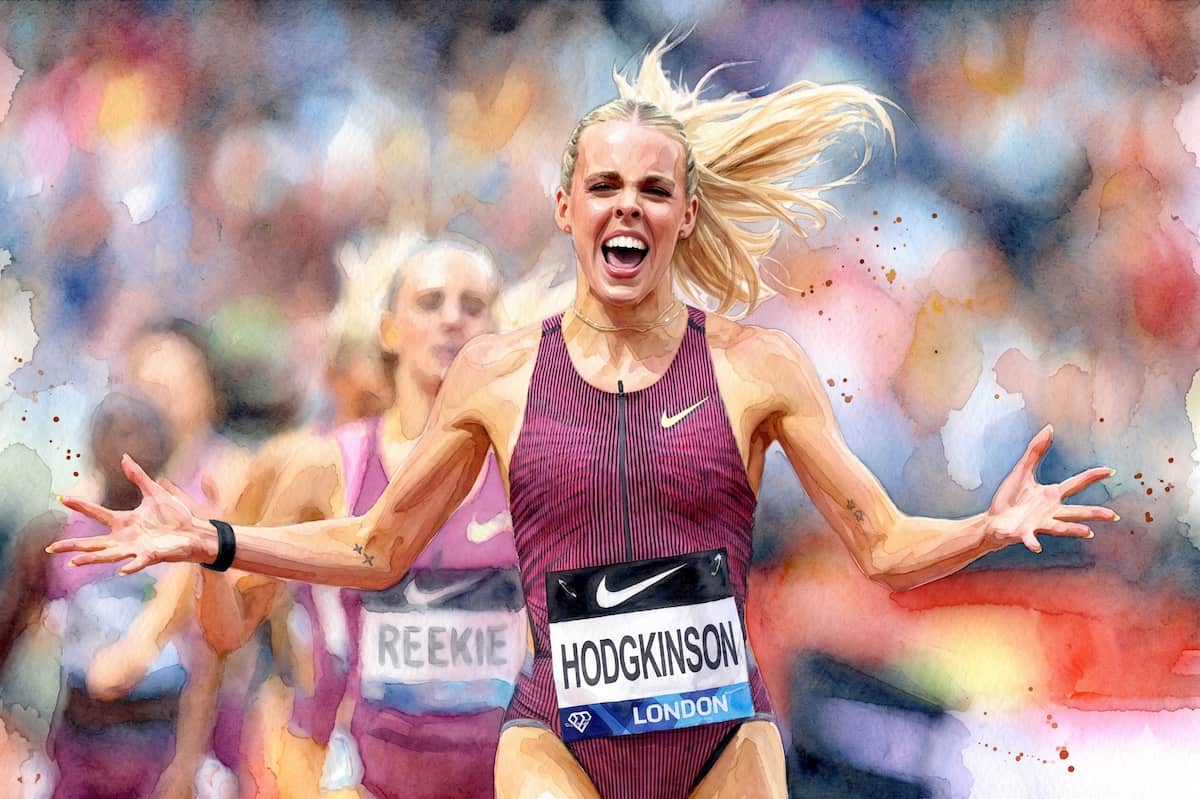
Then Paris. At the 2024 Olympics, Hodgkinson ran 1:56.72 to win gold, leading from near the start and breaking away in the final 100m. Painter and Meadows were named UK Coaches of the Year. The most telling image in the footage is how she crossed the line: not relief, not surprise, but the calm certainty of someone whose preparation had pointed at that exact moment for three years. Those three silvers were not failures tolerated on the way to success. They were rungs on a development ladder built to peak at the right time.
Her 2025 underlines the point in a different way. A hamstring injury limited her to just four meets all season, and despite that she still ran 1:54.91 for bronze at the World Championships. A system that keeps an athlete competitive at the global level through a badly disrupted year is a robust one, and it set up the healthiest winter of her career and the record-breaking 2026 that followed.
The M11 Training System: Speed on an Aerobic Base
Painter’s foundational philosophy treats the 800m as a speed event built on an aerobic platform, not an aerobic event with a fast finish. That distinction shapes every decision in the program.
The 800m demands elite sprint mechanics alongside serious aerobic capacity, and the training must develop both at once:
- The aerobic engine, through threshold work, steady aerobic running, and altitude training that builds mitochondrial density and improves lactate clearance
- The neuromuscular system, through top-end speed work that develops and maintains the explosive mechanics required to run 800m splits at world-record pace
These two objectives are in constant tension, and managing that tension is the core coaching challenge of the event. Interestingly, when Hodgkinson was younger her coaches identified speed, not endurance, as her weakness. She has said her coaches consider her naturally strong, so the early work focused on developing her basic speed while she was young enough to build it.
Altitude Training: Why Potchefstroom, Not Iten
The M11 group trains in Manchester, which is cold, wet, and variable. To supplement, Painter and Meadows use altitude camps, notably Potchefstroom, South Africa (about 1,350m) and the Pyrenees. The choice of a moderate altitude over higher-elevation sites in Kenya or the U.S. is a deliberate physiological decision.
| Location | Elevation | Primary Benefit | Key Consideration |
|---|---|---|---|
| Potchefstroom, RSA | ~1,350m | Moderate EPO stimulus + speed retention | Optimal for 800m; aerobic and anaerobic work both viable |
| Iten, Kenya | ~2,400m | Maximum red blood cell production | Compromises the quality of fast interval work |
| Flagstaff, USA | ~2,100m | High aerobic stimulus | Better for distance runners; harder on speed events |
At roughly 1,350m, Potchefstroom offers a meaningful altitude stimulus, elevated EPO production, higher red blood cell concentration, improved oxygen-carrying capacity, without the extreme elevation that degrades anaerobic work quality. Because Hodgkinson needs elite sprint mechanics as much as aerobic capacity, training at extreme altitude would systematically undermine half of the system. She also famously supplements with brutal sand dune work on the beach at Formby to build strength.
What an M11 Training Week Looks Like
Hodgkinson has described her training as intensely demanding, sessions that leave her completely exhausted, set inside a recovery framework that lets her absorb the stress. The general shape, drawn from her own public descriptions:
Aerobic foundation:
- Daily easy-to-moderate running, roughly 8 to 12 miles depending on phase
- Longer aerobic runs on weekends, around 60 to 75 minutes at controlled effort
- Pool or bike cross-training during recovery phases
Threshold and tempo:
- Lactate-controlled threshold intervals and steady runs of 20 to 30 minutes
- Precise, monitored efforts at the upper end of aerobic function, not all-out
Race-specific intervals:
- 400m repeats at 800m race pace with controlled recovery
- 200m repeats at faster than race pace for top-end speed
- Over-distance 600m and 1000m reps to build race tolerance
Strength:
- Gym 2 to 3 times weekly, primarily lower body and posterior chain
- Athletic strength for force production and injury resilience, not bodybuilding volume
- Plyometrics and reactive work to maintain fast-twitch recruitment
Actionable Tip, Coaches
Notice that Hodgkinson’s training is not “aerobic heavy” or “speed heavy.” It is both, systematically. This is why training the 800m like a mile event, or like a 400m event, both produce incomplete athletes. The event requires both qualities, and the coaching system has to develop both deliberately.
The Strategic Intelligence: Race Selection as Coaching
The indoor world record at Liévin was not spontaneous. Jenny Meadows chose that venue and date after analyzing the European indoor circuit for optimal record conditions. The Liévin track is known for fast times, and a February meet with a world-class field and pace lights set to an aggressive 1:53.8 created the context for a maximal effort without the pressure of a championship medal on the line. Hodgkinson had sharpened the week before with a solo 1:56.33 British record, then went out even faster than planned in Liévin, hitting 200m in about 26.8 and 400m in 56.0 before closing the record off.
This is what elite coaching looks like at the top. Workout design is one component. The competitive calendar is itself a coaching tool: which race, on which track, against which field, at which point in the build are all coaching decisions made from years of accumulated data. When the record fell, it was because Meadows put the right athlete on the right track in the right condition at exactly the right moment. That is not luck. That is coaching.
There is a fitting symmetry to the World Indoor gold that followed. Hodgkinson won it in Toruń, the same venue where she had claimed her first senior title in 2021, the European indoor crown at 19. A world indoor medal had eluded her despite Olympic, World, and European honors. She returned to where it began and finally took it, leading wire to wire in a championship record 1:55.30, then running a 50-second leg on the 4×400 relay an hour later for good measure.
The Kratochvílová Record: What It Would Mean
1:53.28 has stood since July 26, 1983. It is the longest-standing world record in track and field. For scale, the men’s 800m world record (David Rudisha, 1:40.91) is more than a decade younger. No event has a comparably aged women’s record at the top.
The mark has been questioned for decades given the context of Eastern Bloc athletics in the 1980s, but it stands in the official books and is the legitimate target. Hodgkinson’s 1:54.33 at Stockholm was run in a competitive June race, not a peak-condition solo time trial, which leaves the gap to 1:53.28 at just over a second, in an event measured in hundredths, from an athlete whose coaches believe has not yet reached her ceiling. Whether she breaks it in any given season is uncertain. Whether she is the right athlete, with the right coaching behind the attempt, is not.
Four Coaching Lessons from the M11 System
1. Protect the development timeline
Painter deliberately held back Hodgkinson’s training load when she was younger. Early performance gains are not worth the cost of accelerated physiological depletion. The athletes running fastest at 24 are often the ones managed most conservatively at 16. See how this connects to avoiding overtraining in young runners.
2. Reframe silver medals as building blocks
Three straight global silvers is not a failure pattern, it is a development arc, and a disrupted 2025 that still produced a global bronze is evidence of a durable system. Coaches who keep athletes grounded in process rather than outcome during those years are doing their most important work.
3. Match the altitude protocol to event demand
The choice of Potchefstroom over Iten shows that altitude training is not one-size-fits-all. The 800m needs speed retention that extreme altitude compromises. Know the physiological tradeoff before you send any athlete to altitude.
4. Coaching continuity is a competitive advantage
Painter and Meadows have coached Hodgkinson since 2019. Seven years of continuous relationship means they understand her training responses, recovery timelines, and psychology at a level no new coach could replicate. If you have an athlete for four years of high school, use that time to build that same depth of understanding. The relationship is part of the method.
Frequently Asked Questions
Who coaches Keely Hodgkinson?
Trevor Painter and his wife and co-coach Jenny Meadows, through the M11 Track Club in Manchester. They have coached her since 2019. Her first coach, in her youth at Leigh Harriers, was Joe Galvin.
What is Keely Hodgkinson’s training like?
It develops speed and aerobic capacity simultaneously. A typical week mixes daily aerobic running (8 to 12 miles), lactate-controlled threshold work, race-specific 400m and 200m intervals at 800m pace and faster, over-distance reps, and 2 to 3 weekly strength sessions with plyometrics. Altitude camps at moderate elevation (Potchefstroom) supplement the base.
How fast is Keely Hodgkinson’s 800m?
Her outdoor British record is 1:54.33 and she holds the indoor world record at 1:54.87. Her Olympic-winning time in Paris was 1:56.72.
Why does Keely Hodgkinson train at altitude in South Africa instead of Kenya?
Potchefstroom sits at roughly 1,350m, a moderate altitude that delivers an aerobic stimulus while still allowing high-quality fast interval work. Higher-elevation sites like Iten maximize red blood cell production but compromise the speed work an 800m runner depends on.
What world record is Keely Hodgkinson chasing?
Jarmila Kratochvílová’s outdoor 800m world record of 1:53.28, set in 1983, the longest-standing record in track and field. Her coach Trevor Painter believes she can break it.
Key Takeaways for Coaches
- Patience is a method, not a personality trait. Seven years of protected development preceded a 24-year-old world record. Resist accelerating a talented young athlete to prove what they are.
- Develop the 800m as both events at once. Speed on an aerobic base, not a miler’s training or a quarter-miler’s, but a deliberate blend of both.
- Calibrate altitude to the event. Moderate elevation protects the speed an 800m runner cannot afford to lose.
- Treat the race calendar as a coaching tool. The right race, track, field, and timing turned a record attempt into a record.
- Continuity compounds. A long coaching relationship understands an athlete in ways a new one cannot. Use your years with an athlete to build that depth.