

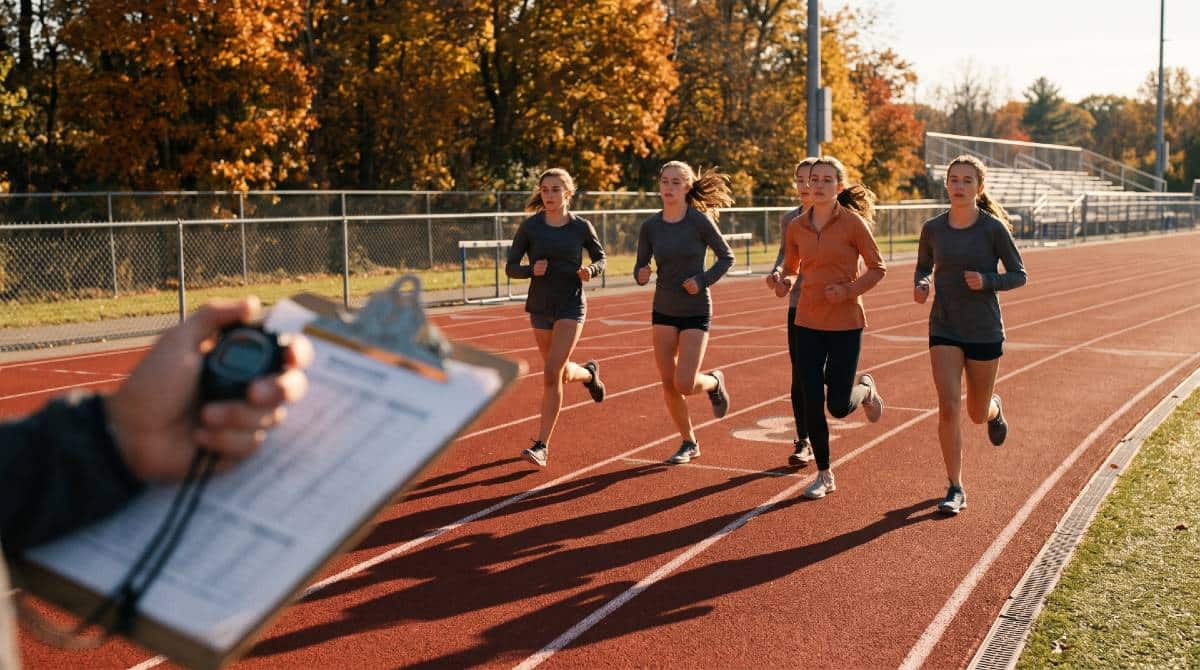
Our girls ran this workout in four pace groups. I’m sharing full splits from three of our runners, each assigned to a different pace group.
One of them ran the entire session a gear too fast. Her 1Ks landed close to 5K race pace. Her 600s came in faster than her mile pace. By the time she reached the 200s, she had no faster gear left to shift into.
That is the whole lesson of this workout in one athlete. The paces matter. The rest matters more. And the session only works if nobody races it.
This is our October sharpening session. Four sets, four paces, each set shorter and faster than the one before. It introduces speed late in the season without burying anyone. Below is the workout, a run sheet you can take to your own track, a pace chart, and the science behind every piece of it.
The short answer
The Four-Gear Ladder is 2×1K at threshold, 3×600 at 3200 pace, 3×400 at 1600 pace, and 3×200 at 800 pace. Rest 60 seconds between 1Ks, 45 seconds between 600s and 400s, and roll an easy 200 jog between 200s. Take 3 minutes between sets. Run it in October, at least four days before a race, and never let athletes race it.
The workout
Four gears. Each one shorter and faster than the last. The bars below are drawn to scale by distance.
The Four-Gear Ladder
The structure does the coaching. Short rests inside each set build stamina. Longer rests between sets let each new gear actually be faster. The speed comes last, on tired legs, which is exactly where cross country races are decided.
The run sheet
Print it, clip it to the board, and run it as written. On a 400 meter track every rep below finishes at the finish line, which makes timing four groups much easier.
Warmup
Dynamic routine, 15 to 20 minutes easy, then 4 relaxed strides.
Set 1: 2 × 1K at threshold
60 seconds rest. Start at the 200 meter start line, run two and a half laps. Call splits every 200. This is the set athletes rush. Hold them back.
Set 2: 3 × 600 at 3200 pace
45 seconds rest. Start at the 200 meter start line. Even splits. The third rep should look like the first.
Set 3: 3 × 400 at 1600 pace
45 seconds rest. Start at the finish line. Relaxed shoulders, quick arms. Fast, not frantic.
Set 4: 3 × 200 at 800 pace
Start at the 200 meter start line. After each rep, keep moving. Jog easy around the curve and down the backstretch, which brings the athlete right back to the start. No standing. Roll into the next one.
Cooldown
10 to 15 minutes easy.
Coach’s job: one watch per group, and someone reads every rest interval out loud. Rest that drifts from 45 seconds to 70 because the group is chatting is not the same workout. Neither is rest that gets cut to 30 because a kid is feeling good.
The pace chart
Find the athlete’s current 5K time and read across. The paces are equivalent performances from Jack Daniels’ VDOT formula, with threshold set at his T pace. If an athlete has a recent track time at 3200, 1600, or 800, use that instead. Our own group targets come from each runner’s numbers, so they won’t match this chart to the second.
| Current 5K | 1KThreshold | 6003200 pace | 4001600 pace | 200800 pace |
|---|---|---|---|---|
| 15:00 | 3:15 | 1:44 | 65 | 31 |
| 16:00 | 3:27 | 1:51 | 69 | 33 |
| 17:00 | 3:40 | 1:58 | 74 | 35 |
| 18:00 | 3:52 | 2:05 | 78 | 37 |
| 19:00 | 4:04 | 2:13 | 83 | 39 |
| 20:00 | 4:16 | 2:20 | 87 | 41 |
| 21:00 | 4:28 | 2:27 | 92 | 43 |
| 22:00 | 4:40 | 2:34 | 96 | 45 |
| 23:00 | 4:52 | 2:41 | 1:41 | 47 |
| 24:00 | 5:04 | 2:48 | 1:46 | 49 |
| 25:00 | 5:16 | 2:56 | 1:50 | 52 |
| 26:00 | 5:28 | 3:03 | 1:55 | 54 |
Times in minutes:seconds, or seconds for the shorter reps. For athletes between rows, use the Training Paces calculator for threshold and the Workout Split Calculator for the rest.
Speed-type runners will often have an 800 pace faster than the chart predicts. That’s fine. Use their real number. Diesel-type runners may find the chart’s 200s plenty fast. Also fine. The 200s are about turnover and form, not a time to chase.
Why four gears
Each set targets a different system. The order is not random.
Gear 1: Threshold sets the floor
Threshold is the fastest pace a runner can hold before lactate builds faster than the body can clear it. Daniels describes it as comfortably hard. George Brooks spent decades showing that lactate is a fuel, not a waste product, shuttled between muscle fibers and to the heart to be burned (Brooks, 2018). Threshold running trains that shuttle.
Two 1Ks with 60 seconds rest is a small dose. That’s on purpose. This set isn’t the main stimulus. It raises oxygen uptake, warms up the lactate machinery, and gives the athlete a reference point. Everything after this is faster. If the first gear is run at the right speed, the athlete has room to shift up three more times. If it isn’t, the ladder is already broken. (For the full threshold session, see our 3×6 and 3×8 minute threshold workout.)
Gear 2: 3200 pace pushes the ceiling
For most high school runners, 3200 race pace sits right around what Daniels calls interval pace, the speed that drives oxygen uptake toward its ceiling (Daniels, 2022). Billat (2001) showed why intervals at this intensity work: they let a runner accumulate more time near VO2max than a continuous effort would allow.
The 45 second rest is the key. It’s too short for oxygen uptake to fall back to baseline. Buchheit and Laursen (2013) describe this as the central lever in interval design: short recoveries keep oxygen uptake elevated, so the second and third reps start high instead of from scratch. Three 600s with short rest give you a lot of quality aerobic time for only 1,800 meters of running.
Gear 3: 1600 pace builds economy at speed
Mile pace is what Daniels calls repetition pace. Its job is speed and running economy: teaching the body to move fast without wasting energy. Daniels usually pairs it with generous recovery. We don’t, on purpose. The volume is small, only three reps, and the goal is to hold mile-pace mechanics on legs that have already done two sets. That’s a cross country skill. The middle of a race asks for exactly that.
Gear 4: 800 pace sharpens the finish
The 200s are neuromuscular work. Fast running recruits fast-twitch fibers and rehearses powerful mechanics. Paavolainen and colleagues (1999) showed that improving neuromuscular power improved 5K time and running economy in trained runners without changing VO2max. Speed matters to distance runners.
It also matters for a reason most coaches feel but rarely name. Sandford and colleagues (2019) found that the anaerobic speed reserve, the gap between a runner’s aerobic speed and top speed, separates good 800 runners from great ones. The bigger the gap, the more relaxed race pace feels and the more is left for the finish. That’s the whole argument of my speed reserve article, and the 200s at the end of this session are a small, regular deposit into it.
The rolling 200 jog between them comes from Mihaly Igloi. His athletes ran fast reps with short, continuous jogs, never standing, which kept the aerobic system working between bursts. It’s the same idea behind our Rolling 200s workout. The Igloi article has the history.
The rest intervals are the workout
Coaches tend to treat rest as dead time between the real work. In this session the rest is the design. Change it and you have run a different workout.
Inside each set: 60 and 45 seconds
These rests are too short for full recovery. That is deliberate. Each rep starts with oxygen uptake already high and a little fatigue already on board. This is where stamina comes from: the ability to keep holding a pace while fatigue accumulates. Lengthen these rests and the session drifts toward a speed workout. Shorten them and it drifts toward a race.
Between sets: 3 minutes
Phosphocreatine, the fuel for the first seconds of hard running, rebuilds fast at first and then more slowly, with most of it back within a few minutes (Harris and colleagues, 1976). Three minutes also gives the body time to start clearing lactate. Light movement helps. Belcastro and Bonen (1975) and Menzies and colleagues (2010) both found that active recovery clears lactate faster than standing still.
The point of the 3 minutes is simple. It lets the next gear actually be faster. The jump in pace between sets is the stimulus. Without it, the gears blur together.
Between 200s: rolling
The easy 200 jog keeps the athlete moving and the lactate shuttle working. It’s long enough to restore some turnover and short enough that the last 200 still has a little fatigue on it. That’s the end of a race in miniature.
Don’t let them race it
This is the rule I repeat most often during this session. It is not a time trial. Nobody wins a Tuesday.
Racing it costs three things. First, recovery. A raced session takes days to absorb, and in October those days belong to the weekend’s race. Second, the stimulus. This workout works because of separation: four distinct paces, each one faster than the last. When early sets run too fast, the paces converge. Third, the skill. Pace discipline is one of the most valuable things a young distance runner can learn, and every rep is a chance to practice it.
A useful check is session RPE, the method Foster and colleagues (2001) developed: an effort rating from 0 to 10 after the session. This should feel controlled and honest, not empty. If athletes walk off the track rating it a 9, the workout got raced.
What it looked like on our track
Here are the three athletes with full splits. Names are out. Targets come from each athlete’s own paces.
Athlete A
Top pace group
| Set | Target | Ran |
|---|---|---|
| 1K | 4:15 | 4:12, 4:10 |
| 600 | 2:17 | 2:17, 2:18, 2:17 |
| 400 | 1:25 | 1:23, 1:25, 1:26 |
| 200 | 37 | 40, 41, 39 |
Near perfect through three gears. The 200s came in 2 to 4 seconds slow, barely quicker than her mile-pace 400s. That isn’t a discipline problem. It’s a speed reserve conversation.
Athlete B
Second pace group
| Set | Target | Ran |
|---|---|---|
| 1K | 4:45 | 4:25, 4:30 |
| 600 | 2:32 | 2:20, 2:26, 2:21 |
| 400 | 1:36 | 1:24, 1:30, 1:31 |
| 200 | 41 | 41, 41, 36 |
Every set a gear too fast. The 1Ks were near 5K pace, the 600s beat her mile pace, and her first 400 was close to 800 pace. By the 200s there was nothing left to shift into. Then she kicked the last one.
Athlete C
Fourth pace group
| Set | Target | Ran |
|---|---|---|
| 1K | 5:23 | 5:10, 5:09 |
| 600 | 2:51 | 2:46, 2:52, 2:51 |
| 400 | 1:49 | 1:44, 1:45, 1:45 |
| 200 | 49 | 49, 50, 49 |
The 1Ks drifted 13 seconds fast and the 400s ran a few seconds quick. After a quick first rep, the 600s settled in, and the 200s were right on target. Mostly disciplined, with the same first-set drift as everyone else.
Splits in orange ran faster than target.
All three ran the 1Ks faster than target, two of them by 13 seconds or more. That is the most predictable error in this workout. Threshold is the slowest pace of the day, the legs are fresh, and it feels too easy. Athletes bank time they pay for later.
Athlete B shows what racing it costs. She’s a competitor, and that’s a good problem to have. But look at her numbers. Her 400s and 200s came out at almost the same speed. The four gears collapsed into one long hard effort. That’s the same trap I warned about with the Michigan: instead of distinct stimuli, the athlete gets one anaerobic grind.
Athlete A shows something useful. Her pacing discipline was excellent, and the top gear still came up short. One session doesn’t diagnose anything. But when an athlete’s 200s won’t separate from her 400s, the next thing to check is her open 400.
Why October
By October the aerobic base is in place and the championship is a few weeks away. The work shifts from building to sharpening. Sharpening doesn’t mean more. It means a small dose of faster running on top of the same aerobic routine. (The championship season guide covers the full phase.)
This session fits that brief. It introduces three faster paces without a large volume of any one of them. Each piece sits inside the per-session limits Daniels recommends for its intensity, even for a runner at 30 miles per week. It forces some adaptation. It doesn’t dig a hole.
In September this would be too much, too soon. I said it about the Michigan and I’ll say it again: wait until October. Place it at least four days before a race. Once or twice in the month is plenty.
Scaling by experience
Rep count is the dial. The paces don’t change.
| Athlete | 1KThreshold | 6003200 pace | 4001600 pace | 200800 pace | Totalmeters |
|---|---|---|---|---|---|
| Rookie First-year runner | 1 | 2 | 2 | 3 | 3,600 |
| Returner One or more seasons | 2 | 3 | 3 | 3 | 5,600 |
| Veteran Upperclass, high volume | 2 | 3 | 3 | 3 | 5,600 |
Veterans don’t get extra reps. They get tighter pacing. The whole point of this session is that it stops short.
Common mistakes
Running the 1Ks fast
Every athlete we timed did it. Call splits every 200 in the first set and slow them down early. Seconds banked on the 1Ks are borrowed from the 200s.
Letting the rest drift
Run the clock. Read the rest out loud. Forty-five seconds means forty-five seconds.
Kicking the last 200
The last rep is the same as the first. Athletes who want to prove something can save it for Saturday.
Grouping by ego
Groups are set by current fitness, not by who wants to run with whom. A runner hanging onto a faster group is racing whether she means to or not. (More on that in coaching multiple training groups.)
Ignoring the conditions
Wind on the backstretch and an unseasonably warm afternoon both change what a pace costs. Keep the effort, adjust the pace. The Heat and Humidity Adjuster helps on the warm days.
Frequently asked questions
What is a good cross country workout for October?
A sharpening session that adds a small dose of faster running to the aerobic work already in place. The Four-Gear Ladder does that: 2×1K at threshold, 3×600 at 3200 pace, 3×400 at 1600 pace, and 3×200 at 800 pace, with controlled rests. It touches four paces without a large volume of any one.
How much rest should runners take between sets?
Three minutes between sets. Inside the sets, 60 seconds between 1Ks, 45 seconds between 600s and 400s, and an easy rolling 200 jog between 200s. The short rests build stamina. The 3 minutes lets each new gear be faster.
What paces should high school runners use?
Threshold for the 1Ks, then 3200, 1600, and 800 race pace for the 600s, 400s, and 200s. Use the pace chart above from a current 5K, or the athlete’s recent track times if you have them.
Can freshmen run this workout?
Yes, with fewer reps: 1×1K, 2×600, 2×400, and 3×200. That’s 3,600 meters of work at the same paces as everyone else, and the team still finishes together.
How close to a race can you run it?
At least four days out. In a Saturday race week, Monday or Tuesday works. Easy running and strides fill the days in between.
What if an athlete feels great and wants to go faster?
Hold the pace. Feeling great at the end of this session means the dose was right. The fitness shows up on race day, not on the stopwatch at practice.
Build the whole season around sessions like this
The 22-Week XC Season Blueprint lays out a full periodized summer and fall at three athlete levels: Rookie, Returner, and Veteran. Every day is planned. Every level trains together.
See the Season BlueprintReferences
Belcastro, A. N., and Bonen, A. (1975). Lactic acid removal rates during controlled and uncontrolled recovery exercise. Journal of Applied Physiology, 39(6), 932-936.
Billat, L. V. (2001). Interval training for performance: A scientific and empirical practice. Special recommendations for middle- and long-distance running. Part I: Aerobic interval training. Sports Medicine, 31(1), 13-31.
Billat, L. V. (2001). Interval training for performance: A scientific and empirical practice. Special recommendations for middle- and long-distance running. Part II: Anaerobic interval training. Sports Medicine, 31(2), 75-90.
Brooks, G. A. (2018). The science and translation of lactate shuttle theory. Cell Metabolism, 27(4), 757-785.
Buchheit, M., and Laursen, P. B. (2013). High-intensity interval training, solutions to the programming puzzle. Part I: Cardiopulmonary emphasis. Sports Medicine, 43(5), 313-338.
Daniels, J. (2022). Daniels’ Running Formula (4th ed.). Human Kinetics.
Foster, C., Florhaug, J. A., Franklin, J., et al. (2001). A new approach to monitoring exercise training. Journal of Strength and Conditioning Research, 15(1), 109-115.
Harris, R. C., Edwards, R. H. T., Hultman, E., Nordesjö, L. O., Nylind, B., and Sahlin, K. (1976). The time course of phosphorylcreatine resynthesis during recovery of the quadriceps muscle in man. Pflügers Archiv, 367(2), 137-142.
Menzies, P., Menzies, C., McIntyre, L., Paterson, P., Wilson, J., and Kemi, O. J. (2010). Blood lactate clearance during active recovery after an intense running bout depends on the intensity of the active recovery. Journal of Sports Sciences, 28(9), 975-982.
Paavolainen, L., Häkkinen, K., Hämäläinen, I., Nummela, A., and Rusko, H. (1999). Explosive-strength training improves 5-km running time by improving running economy and muscle power. Journal of Applied Physiology, 86(5), 1527-1533.
Sandford, G. N., Allen, S. V., Kilding, A. E., Ross, A., and Laursen, P. B. (2019). Anaerobic speed reserve: A key component of elite male 800-m running. International Journal of Sports Physiology and Performance, 14(4), 501-508.