


Zone 2 Training for High School Runners
Zone 2 training applies an 80/20 principle (80% easy, 20% hard) to prevent burnout and build mitochondrial density over 4 years. High schools cause premature senior-year collapse by running too much intensity too early; Zone 2 reverses this by protecting the aerobic foundation through all four years.
The Burnout Crisis
By mid-October of senior year, Sarah should be peaking. Instead, she’s exhausted—not injured exactly, just off. Quiet. Head down. Her mom called: “She doesn’t want to run anymore.”
This happens in most high school programs. Talented freshmen improve for two years, then become zombies by senior year—if they make it that far. The American Academy of Pediatrics reports 70% of youth athletes quit by age 13. Those who reach high school? Many are running on fumes by senior year.
The brutal truth: We’re coaching the fun out of distance running.
High intensity causes a burnout epidemic, leaving athletes as physical and mental “zombies.” The solution isn’t mysterious—it’s counterintuitive: run more slow miles, fewer hard miles.
The 80/20 Principle
Elite endurance athletes spend approximately 80% of training at low intensity and 20% at high intensity. This was discovered by researcher Stephen Seiler studying world-class rowers and cross-country skiers.
The best endurance athletes in the world—whose job is to run/ski/row fast—spend 80% of training time going slow. Why? That’s what builds the aerobic engine. That’s what creates mitochondrial density, capillary networks, and metabolic flexibility.
The hard stuff teaches your body to access the engine you’ve built.
But most high school programs flip this ratio, running 50-60% easy and 40-50% hard. Some are even closer to 70/30 in the wrong direction.
Then we wonder why kids are cooked by senior year.
The Science of the “Aerobic Engine”
Inside every muscle cell are mitochondria—the “powerhouses of the cell.” Mitochondria are the difference between a runner who plateaus sophomore year and one improving through senior year.
1. Mitochondrial Biogenesis (Building the Fleet)
Zone 2 work stimulates creation of new mitochondria and increases mitochondrial density. Cells can generate energy far more effectively.
The Analogy: Don’t just tune your single engine—build thousands of new ones. More mitochondria = more energy production capacity.
2. Metabolic Flexibility (The Hybrid Advantage)
The ability to efficiently switch between burning carbohydrates and fats. Athletes with high metabolic flexibility maintain energy without lactate accumulation.
Benefits:
– Better blood sugar regulation
– Late-race power (no “bonking”)
– Faster recovery (efficient fuel switching)
The Analogy: A hybrid car isn’t reliant on limited “gas” (glycogen)—it’s unlocked a massive, sustainable “battery” (fat oxidation).
3. Capillary Density (The Delivery Network)
Zone 2 training increases capillaries that deliver oxygen to muscle fibers.
- More pipes = more oxygen to the “engines”
- Faster waste removal during hard efforts
- Better blood flow = better performance
4. Fat Oxidation Capacity
At lower intensities, the body preferentially burns fat. Training this system increases “time to fatigue” and promotes faster recovery.
The Catch: These Adaptations Take Time
You can’t speed-hack mitochondrial development. Muscle mitochondria have a half-life of only 1-2 weeks, meaning athletes need consistent aerobic work to maintain gains.
Why are seniors burned out? They spent three years hammering their glycolytic systems with intervals while neglecting the aerobic foundation that takes years to build properly.
It’s like trying to build a skyscraper by starting on the 40th floor. Impressive at first, but without a solid foundation, the whole thing eventually collapses.
The Senior Year Burnout Syndrome
Freshman Year: Talented athlete shows up. You throw them into varsity workouts because “they can handle it.” They PR multiple times. Parents are thrilled. Kid loves running.
Sophomore Year: More of the same. Bump mileage. Add another hard workout. Still improving, though PRs slow. Nagging injuries appear.
Junior Year: PRs aren’t coming easily. Seems tired often. You attribute it to classes and social life. Keep training load high—”this is recruiting year.”
Senior Year: Your team leader either limps through season as a shadow of themselves, or quits before season starts.
This is Overtraining Syndrome: Extended periods where training loads exceed recovery capacity, resulting in decreased performance, increased injury/illness risk, and derangement of endocrine, neurologic, cardiovascular, and psychological systems.
The problem usually isn’t too much volume—it’s too much intensity for too long.
The 80/20 Solution in Practice
For Freshmen and Sophomores
Your job: build the biggest aerobic engine possible.
- 80-85% of weekly volume at conversational pace
- One workout per week maximum (often just strides or hill repeats, not full intervals)
- Gradually increase mileage (following the 10% rule)
- Teach good form and mechanics
- Make running fun and social
You might think: “If I don’t have them doing 800m repeats, they won’t get faster!”
Wrong. They’ll get faster from sheer aerobic work. A freshman running 40 miles/week easy improves more than a freshman running 30 miles with two hard workouts.
For Juniors
Start adding intensity, but still protect the base.
- 75-80% easy
- Two moderate workouts/week (tempos, cruise intervals, fartleks)
- Strategic hard efforts before key races
- Continue building mileage ceiling
- Race-specific fitness
Still at 75-80% easy. This is a competitive junior chasing PRs, and we’re STILL protecting the aerobic foundation.
For Seniors
The victory lap—harvest what you’ve planted.
- 70-75% easy (lowest, but still majority)
- Two hard workouts/week
- Peak training load (not increased)
- Race frequently and aggressively
- Trust the fitness
By senior year, with proper development: massive mitochondrial density, elite fat oxidation, excellent metabolic flexibility, and fresh legs with genuine enthusiasm for the sport.
Instead of a burned-out kid wanting the season over.
But Won’t They Be Slow?
Two answers:
Answer 1: The hard workouts teach race pace. That’s what the 20% is for. When you show up to interval sessions fresh (not trashed from yesterday’s “easy” run), you can hit prescribed paces and get the intended stimulus.
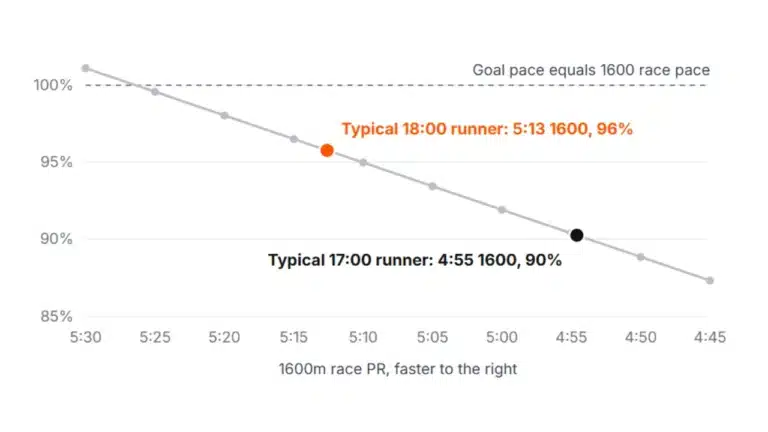
Answer 2: The aerobic system is the limiting factor for almost all high school distance runners. For 95% of kids, their ceiling is determined by aerobic capacity, not speed. Your 18:00 5K runner isn’t running 18:00 because they lack speed—they probably can hammer an 800 at 4:30 pace. Their aerobic engine can’t sustain faster pace for 3.1 miles.
Build a bigger engine (Zone 2 work), and speed takes care of itself.
The Four-Year Blueprint
| Year | Low Intensity | Hard Intensity | Primary Goal | Success Metric |
|---|---|---|---|---|
| Freshman | 85% | 15% | Build aerobic base, establish consistency | Handle 25-30 mi/week |
| Sophomore | 80% | 20% | Continue base; introduce structured workouts | Handle 30-35 mi/week; consistent improvement |
| Junior | 75% | 25% | Peak performance; develop mental toughness | Consistent PRs; competitive at championship |
| Senior | 70% | 30% | Deliver career performances; leave legacy | Running with joy; no regrets |
Common Mistakes Coaches Make
Mistake 1: Treating every workout like a race. If every practice is a puke fest, when do athletes actually get better? Adaptation happens during recovery.
Mistake 2: Comparing athletes to peers instead of potential. Jon handling 60 miles/week as a freshman doesn’t mean Henry should. Individual progression matters.
Mistake 3: Sacrificing sophomore year for freshman glory. A kid who runs 17:30 as a freshman and 17:45 as a senior represents coaching failure, not athlete failure.
Mistake 4: Ignoring psychological toll. Burnout research shows: negative affect, worry, illness, and injury more likely in overtraining athletes.
Mistake 5: Not communicating the plan. Athletes and parents need to understand WHY they’re running slow. Otherwise they think you don’t know what you’re doing.
The Metabolic Health Angle
Zone 2 has profound effects beyond running performance:
- Enhances metabolic flexibility; increases fat burning
- Improves insulin sensitivity
- Reduces diabetes and cardiovascular disease risk
- Supports cellular resilience and long-term health
- Can be performed daily with easy recovery
Zone 2 doesn’t just make better runners. It makes healthier humans—for life.
When you prioritize Zone 2 with freshmen and sophomores, you’re not just building runners. You’re teaching 14-year-olds that slow, consistent work builds real fitness. That you don’t need to destroy yourself every workout. That sustainable effort beats sporadic heroics.
These lessons apply to everything: academics, relationships, career, health.
Bottom Line
The most important thing you can give a high school athlete isn’t a fast 5K time. It’s a healthy relationship with the sport that lasts beyond high school.
Zone 2 training does both. It builds physiological foundation for long-term performance. And it creates sustainable training habits that don’t leave kids broken and burned out.
That kid still running in college? Still running at 30? Still running at 50? That kid learned to value slow, boring aerobic work. They learned sustainable beats spectacular. They learned to build an engine that lasts.
And that’s the real longevity we should be coaching toward.
See Also
- Jack Daniels VDOT Training
- Zone 2 vs Daniels Method
- The Lydiard Effect
- Mileage Manifesto
Related Blog Post
Read the full post: Zone 2 Training for High School Runners: Solving the 4-Year Burnout Crisis →