
Cam Myers Training: The Complete 1500m Blueprint (2026)
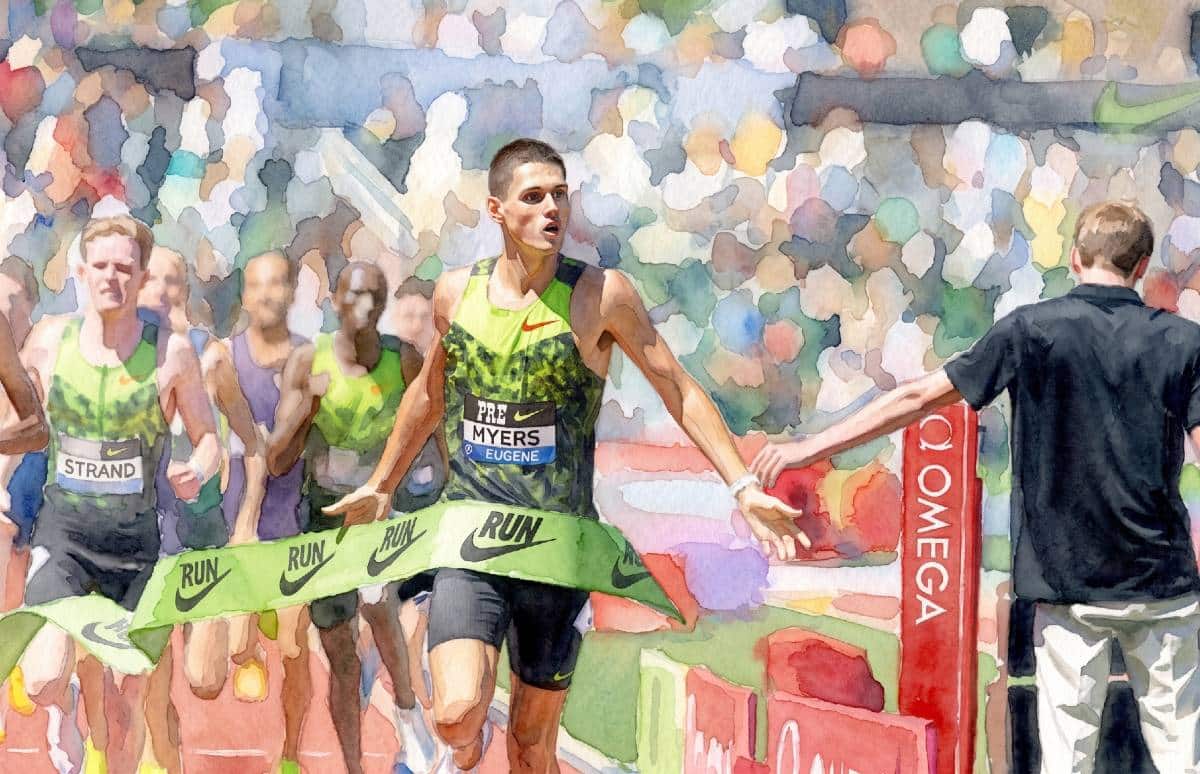
How Cam Myers, a Canberra Teenager Ran 3:28 on an Aerobic-First System, Why He Posts Every Workout on Strava, and What His Patient Rise Teaches Coaches Developing Young Talent
On June 28, 2026, at the Meeting de Paris, Cam Myers ran 3:28.00 for 1500 meters. He was 20 years old, having had his birthday nineteen days earlier.
The number that gives it meaning: 3:29.41. That was the Australian record, held by Commonwealth champion Ollie Hoare, and Myers erased it by more than a second while winning the race outright, running away from the field over the last lap. It was the 12th-fastest 1500m ever run by anyone. Only one man in history had ever run faster before his 21st birthday.
That man is Jakob Ingebrigtsen. And Myers has spent his whole career being measured against him, because at 16 he broke Ingebrigtsen’s age-group world records in the mile, the 1500m, and the 3000m. Here is how Myers was built.
Who Is Cam Myers?
Born June 9, 2006, in Canberra, Australia, Cameron Myers is a professional middle-distance runner for Nike, the Oceanian record holder in the 1500m, the mile, and the indoor 3000m, and the world under-20 record holder in the indoor mile. In February 2023, at 16 years and 259 days, he became the second-youngest person in history to break four minutes for the mile, running 3:55.44. He won world U20 1500m silver in 2024, won the Wanamaker Mile at the 2026 Millrose Games over a field of Olympians, and in June 2026 ran 3:28.00 to move to 12th on the world all-time list.
And, lucky for all of us, he posts nearly every training session, splits included, on a public Strava account.
Career at a Glance
| Year | Milestone | Mark |
|---|---|---|
| 2023 | Age-16 mile world best, Melbourne (2nd-youngest sub-4 ever) | 3:55.44 |
| 2023 | Fastest 1500m ever run by an U18 athlete, Silesia | 3:33.26 |
| 2024 | World U20 Championships 1500m silver, Lima | 3:40.60 |
| 2024 | Bowerman Mile PB, Prefontaine Classic | 3:50.15 |
| 2025 | World indoor U20 mile record, Millrose (5th-fastest indoor miler ever) | 3:47.48 |
| 2025 | 1500m Oceania U20 record, Ostrava | 3:29.80 |
| 2026 | Indoor 3000m Oceania record, Boston (10th all-time) | 7:27.57 |
| 2026 | Wanamaker Mile win, Millrose (beat Nuguse) | 3:47.57 |
| 2026 | 1500m Australian & Oceanian record, Paris (world lead) | 3:28.00 |
| 2026 | Bowerman Mile champion, Prefontaine Classic (Australian record) | 3:46.06 |
The Foundation: A Sports Scientist, a Grassroots Coach, and No Rush
Myers did not come out of a specialized academy. From age 10 he was coached by Lee Bobbin, a local Canberra coach, and at 14 Bobbin brought him into the training group run by Dick Telford. That detail is significant, because Telford is not a typical age-group coach.
Dick Telford was the first sport scientist ever appointed to the Australian Institute of Sport (AIS), back in 1980, and he built the AIS sports-science philosophy from the ground up. He is a physiologist first and a distance coach second. You can listen to a great podcast featuring Telford here.
Bobbin did not disappear when Telford came in. The two co-coach Myers to this day, with Bobbin close to the athlete day to day and Telford setting the physiological direction. Myers also races for the Bankstown Track Club in Sydney and trains alongside Olympian Jye Edwards. Before running took over Cam was a competitive soccer player, a striker for Canberra Croatia and Gungahlin United, and he is still a devoted Chelsea supporter. The multi-sport athleticism came first; the specialization came later.
What that group decided early is the thing every coach of a talented young runner should study. When Myers broke the age-16 mile record, the obvious move would have been to chase the next headline. Instead the training stayed patient and aerobic, and Myers himself waved off the hype at the time: “It’s only an age world record. It’s cool to have, but it’s not the be-all and end-all.” That is a 16-year-old who had been coached to understand that the age-group record was not a final destination.
Actionable Tip, Coaches
The most dangerous moment in a young runner’s career is the season right after a breakthrough, when everyone around them wants more, faster. Telford and Bobbin answered a world age-group record by keeping the plan boring: build the aerobic base, protect the timeline, let the times come. If you coach a kid who just ran something special, your job the following season is restraint, not acceleration. See how this same principle shaped Keely Hodgkinson’s protected development.
Cam Myers Training Volume & Mileage Progression
Here is the number that surprises people. Myers runs roughly 75 to 85 miles per week. For an elite 1500m runner that is not high; plenty of American collegiate milers run more. What makes it work is not the weekly figure but the multi-year progression underneath it.
Because his training is public, the arc is visible in a way it almost never is for an elite. His yearly running volume climbed steadily as he matured:
| Year | Age | Approx. yearly volume |
|---|---|---|
| 2022 | 16 | ~2,570 miles |
| 2023 | 17 | ~3,020 miles |
| 2024 | 18 | ~3,320 miles |
| 2025 | 19 | ~3,840 miles |
That is the shape of intelligent development: a gradual, almost patient climb, with room still left to grow into his early twenties. He did not arrive at 85-mile weeks. He was walked there over four years, and his 1500m PB fell from 3:46 to 3:28 along the way. The volume and the fitness rose together, neither one rushed.
Just as important is what he does inside that volume. His easy days are genuinely easy, often 6:50 to 7:20 per mile, which for a runner of his caliber is very light. He doubles most days to accumulate the mileage without any single run being long or punishing, and his long run is only 12 to 13 miles, short by the standards of the American system. The point is that every hard session gets fully absorbed because the surrounding running is kept soft.
Actionable Tip, Coaches
Myers’s easy pace barely changed from age 16 to 19, even as his race times plummeted. That is deliberate. As an athlete gets faster, keeping the easy runs at the same relaxed pace means they become even easier relative to race pace, which lets you stack more aerobic volume without stealing from the hard days. If your athletes are turning easy runs into gray-zone grinds, they are paying for it in workout quality.
Threshold Training, Double Workouts, and Lactate Testing
Telford is a physiologist, and it shows in how the hard work is prescribed. Myers describes the priority simply: “Keep the main thing the main thing,” and the main thing is a strong aerobic base. In his own words the week has “a good amount of threshold, a good amount of easy running, and a fair amount of VO2 max work.”
The signature feature is the double-threshold day, run most weeks. On these days Myers does two separate threshold sessions, morning and evening, at controlled intensity rather than one exhausting session. This is the same logic that underpins the Norwegian middle-distance method, and the reason it works is restraint: two moderate doses accumulate a large amount of quality aerobic stimulus while keeping lactate low enough that the athlete recovers and repeats it days later.
And lactate is not a metaphor here. It is measured. Myers regularly reports blood-lactate readings from his sessions, often holding threshold reps at around 1.5 to 2.5 mmol/L, using the numbers to keep himself honest rather than running by feel alone or by hitting arbitrary splits. A typical morning threshold set might be three by 10 minutes at controlled effort testing under 2.0 mmol; the evening a set of 8 x 1000m with short recovery. The paces matter less than the principle: the effort is capped by physiology, not ego.
One more Telford fingerprint is the float. Myers runs a lot of over/under work, where he pushes above threshold and then, instead of stopping, floats down to threshold or just below and holds it. “He really likes the idea of going above threshold, then coming down to threshold or just below and maintaining that,” Myers says of Telford. It is aerobic development and race rehearsal at once, because in a real 1500m you are already tired when you have to respond to a move.
Sample Cam Myers Training Week (Base Phase)
| Day | Session | Purpose |
|---|---|---|
| Mon | Easy double, ~10–12 mi total + strides | Aerobic volume, neuromuscular touch |
| Tue | Track: 8 x 1000m or Deeks Quarters (400 hard / 200 float) | VO2 / lactate buffering |
| Wed | Easy double + short hill sprints (40–80m) | Recovery with speed maintenance |
| Thu | Double threshold: AM 3 x 10 min, PM 8 x 1k short rest | Aerobic power, lactate-controlled |
| Fri | Easy double | Active recovery |
| Sat | Long run, 12–13 mi at ~6:40–7:00 | Aerobic durability |
| Sun | Easy + speed development / weights | Force, fast-twitch, structure |
Approximate total: 75 to 85 miles across mostly double days. Note how much of the week is easy running wrapped around three hard sessions, and how the “speed” is preserved with short hill sprints and strides rather than long grinding intervals. Myers does dedicated speed development, often 40 to 80 meter sprints and sometimes uphill, most weeks of the year. He has run 150s in the mid-16-second range off a running start, and hinted at an 800m this season on the strength of it. The top-end gear is maintained deliberately, exactly as it is in the anaerobic speed reserve model, not left to hope.
Actionable Tip, Coaches
You do not need a lactate meter to coach the lesson here. The idea behind Myers’s double-threshold days is that quality aerobic work should leave the athlete able to train again soon, not wrecked for three days. Dose your threshold work so it can be repeated. That is how consistency, the real driver of endurance, actually gets built.
Analyzing Heart Rate and Lactate Context
There is a detail in Myers’s data that should reassure any coach who has ever panicked at a heart-rate monitor. Myers runs at a strikingly high heart rate for his paces. His max is north of 200, and he can be over 170 bpm at 6:30 mile pace, which on paper looks like he is working far too hard on an easy run.
Except lab testing tells the real story. At a heart rate of 190 during threshold work, his measured lactate is only around 2.5 mmol/L, comfortably aerobic. His heart simply runs hot. Because he has the lab data, he does not chase a heart-rate number that would force him to jog absurdly slowly; he trains by lactate and effort and treats heart rate as one input among several.
Actionable Tip, Coaches
Heart rate is individual, and for some athletes it is close to useless as an absolute gauge. If you have a kid whose heart rate looks alarmingly high on easy runs but who recovers well, sleeps fine, and hits their workouts, do not force them into a slower zone to satisfy a chart.
The Racing Education: From Rabbit to Contender
Myers’s competitive résumé reads like a deliberate curriculum. As a 17-year-old he paced Ingebrigtsen to a European mile record, learning front-running rhythm at world-record pace from inside the race. He collected age-group records almost as a byproduct of racing up against grown professionals rather than dominating juniors.
The honest part of the story is that it has not been a straight line. At the 2025 World Championships in Tokyo he went out in the heat, worn down by a long European season. He was clearly past his best by the time Worlds arrived. That is not a footnote to skip; it is the lesson. A young athlete racing a full senior circuit will have flat days at the wrong moments, and the response is not to panic but to periodize better.
In 2026, with no outdoor global championship forcing a September peak, Myers and his coaches were free to point the whole season at midsummer. At the Prefontaine Classic on July 4, 2026, Myers won the Bowerman Mile in 3:46.06, another Australian record, holding off Yared Nuguse, a fast-closing Ethan Strand, Hobbs Kessler, Timothy Cheruiyot, and Olympic champion Cole Hocker in a race where nine men broke 3:49.
It was a defining win. Myers had run fast times and taken indoor titles, but a Bowerman Mile victory over that field, on that stage, is a different kind of result. It is the young talent no longer merely hanging with the best milers alive but beating them, from the front, when it counted.
Bowerman Mile Results (Prefontaine Classic, July 4, 2026)
| Place | Athlete | Country | Time | Notes |
|---|---|---|---|---|
| 1 | Cam Myers | AUS | 3:46.06 | Australian record, WL |
| 2 | Yared Nuguse | USA | 3:46.61 | SB |
| 3 | Ethan Strand | USA | 3:46.97 | PB |
| 4 | Hobbs Kessler | USA | 3:47.38 | |
| 5 | Timothy Cheruiyot | KEN | 3:47.39 | |
| 6 | Cole Hocker | USA | 3:47.57 | |
| 7 | Robert Farken | GER | 3:47.76 | |
| 8 | Vincent Ciattei | USA | 3:48.34 |
Actionable Tip, Coaches
Myers’s flat run at 2025 Worlds is a reminder that even elite systems misjudge the calendar. For your athletes, be ruthless about identifying the one or two races that actually matter each season and building toward those, rather than trying to be sharp for every meet on the schedule.
Four Coaching Lessons from the Myers Blueprint
1. Progress the volume over years, not months
The teenage years were for building the engine gradually, not maxing it out. Resist the urge to jump a young runner’s mileage to prove they can handle it.
2. Keep the easy running genuinely easy
His easy pace barely moved as his race times dropped by seconds. That gap between easy and race pace is the space where aerobic volume gets absorbed. Gray-zone easy days are the most common self-inflicted wound in distance training. This connects directly to avoiding the four-year burnout.
3. Dose hard work so it can be repeated
The double-threshold day exists because two controlled sessions beat one heroic one. Consistency, week over week, is the real engine of improvement. Learn to tell productive fatigue from the edge of overtraining.
4. Use data to stay honest, not to obey
Myers logs lactate and heart rate, but he reads them in context, cutting a rep or adding recovery when he feels off. The number serves the athlete, not the other way around.
Who coaches Cam Myers?
Cameron Myers is coached by Dick Telford, a physiologist and the first sport scientist appointed to the Australian Institute of Sport, together with Lee Bobbin, who has coached Myers since he was 10 and works closely with him day to day. He trains in Canberra and races for the Bankstown Track Club in Sydney.
What is Cam Myers’s training like?
It is aerobic-first. He runs roughly 75 to 85 miles a week, mostly as easy doubles, with three hard sessions: threshold work (often as a double-threshold day, two moderate sessions in one day), VO2 max intervals, and dedicated short speed work. Sessions are guided by blood-lactate testing rather than by hitting arbitrary splits.
How fast is Cam Myers?
As of July 2026 his personal bests include 3:28.00 for 1500m (Australian and Oceanian record), 3:46.06 for the mile (Australian record, run to win the Bowerman Mile at the Prefontaine Classic), 7:27.57 for the indoor 3000m (Oceanian record), and 1:44.05 for 800m.
How many miles a week does Cam Myers run?
Around 75 to 85 miles per week, accumulated mostly through double runs, with a relatively short long run of 12 to 13 miles. His yearly volume has climbed steadily from about 2,570 miles at age 16 to about 3,840 at age 19.
What is a double-threshold day?
Two separate threshold sessions in the same day, morning and evening, each run at controlled sub-threshold intensity. The approach accumulates a large volume of quality aerobic work while keeping lactate low enough to recover quickly and repeat the pattern through the week.
Key Takeaways for Coaches
- Patience beats acceleration with a prodigy.
- Build volume gradually and keep easy easy.
- Let physiology, not ego, cap the hard days.
- Read your data, don’t obey it.
Related Coaching Guides
- Keely Hodgkinson training: the complete 800m blueprint, another masterclass in protecting a young talent’s timeline
- Cooper Lutkenhaus: the 30-mile 800m blueprint
- Hobbs Kessler training: the complete blueprint
- The Sam Ruthe method: inside the training of a 16-year-old phenom
- Anaerobic speed reserve for distance runners