

Plan Your Spring Track Season: From Winter to Track on the P-Scale
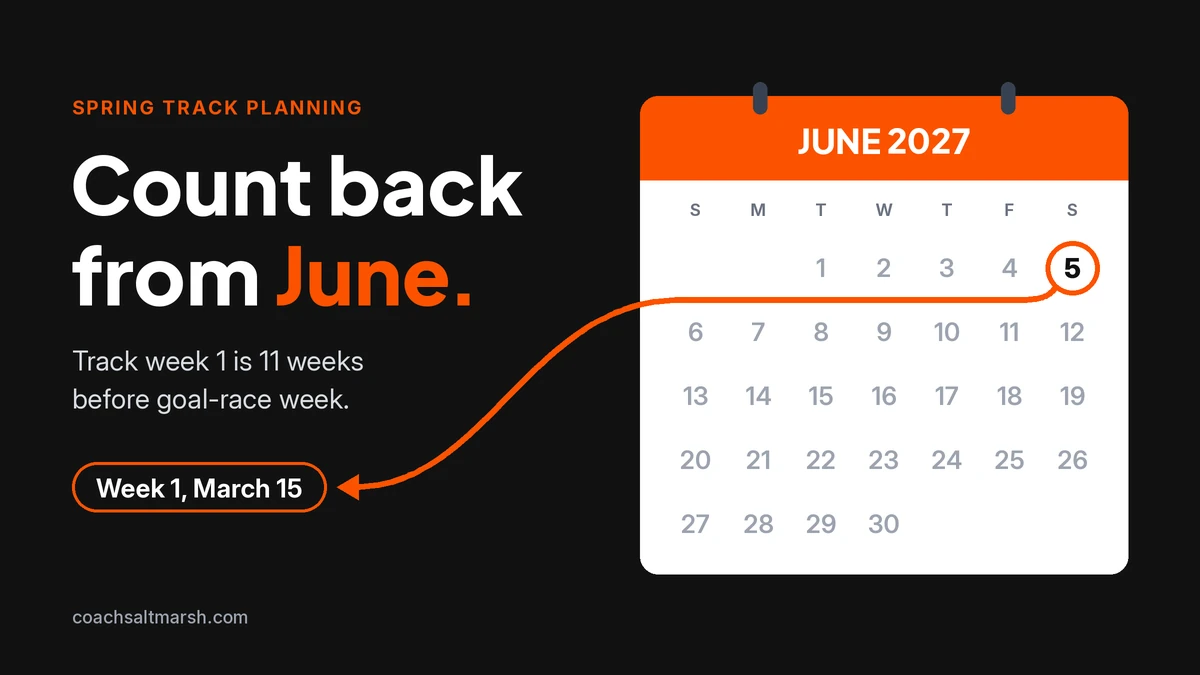
The spring schedule comes out in January. Once your goal race has a date, the rest of the season falls into place.
This is how I plan the spring for a high school distance group. Start with that date. Find where each runner’s winter ends. Then set four things for every runner: the event, the level, the March paces and the first week’s checks. Every pace is on the P-Scale, the same pace language my cross country and track plans use.
Two of my boys raced at New Balance Nationals Indoor: a freshman in the 1000m and a senior in the 400m. Our outdoor season started the very next week. They didn’t start with it. They took ten days off, then began their spring training.
Rest and recovery get protected, no matter how ready an athlete tells you he is. Every runner on a team reaches the spring from a different place. Some finish winter early. Some, like those two, finish it the week before track starts. The plan has to meet each one where they are.
The short answer. Count back 11 weeks from the Monday of your goal-race week. That Monday is track week 1. Line it up with each runner’s winter plan. Where the two overlap, track week 1 takes over. Where there is a gap, hold the last winter week. Then give each runner one event, a level set by their winter miles, and March paces from a race, never a goal.
Cross Country to Track Goal Calculator
Enter a championship 5K and how fast the course ran. Get the floor, target and stretch for the spring 1600 and 3200, for one runner or a whole roster.
Set spring goalsWhat is in this guide
Start with the goal race
Every P-Scale track plan runs 12 weeks, and week 12 is goal-race week. So the date that matters most is the race you are building toward. Count back from it.
Week 1 is the Monday 11 weeks before goal-race week. Enter that Monday in the plan’s calculator and it dates every day of the season.
| Goal race (Saturday) | Week 12, goal-race week | Track week 1 |
|---|---|---|
| May 29, 2027 | May 24 to 30 | Mon, Mar 8 |
| June 5, 2027 | May 31 to June 6 | Mon, Mar 15 |
| June 12, 2027 | June 7 to 13 | Mon, Mar 22 |
| June 19, 2027 | June 14 to 20 | Mon, Mar 29 |
Count back from your biggest race, not the last meet on the schedule. If your goal is the state meet, week 12 is state meet week.
Your first outdoor practice may come before track week 1. Those weeks still belong to winter. The next section shows what to do with them.
Find where winter ends
Winter starts on a different Monday for each runner. In the Winter Training Block, week 1 is the Monday after each runner’s own last cross country race. So week 20 lands on a different Monday too.
| Last cross country race | Winter week 1 | Winter week 20 |
|---|---|---|
| Sat, Oct 31 | Nov 2 | Mar 15 to 21 |
| Sat, Nov 7 | Nov 9 | Mar 22 to 28 |
| Sat, Nov 14 | Nov 16 | Mar 29 to Apr 4 |
| Sat, Nov 21 | Nov 23 | Apr 5 to 11 |
Now put each runner’s week 20 next to track week 1. You will find one of three cases.
Overlap: track week 1 takes over
This is the most common case, and the easiest. Stop winter when track week 1 arrives. With no indoor season (Path B), the weeks you lose are 19 and 20. Those weeks move the hard running off the hills and onto the flat, and track weeks 1 to 3 do the same job. With an indoor season (Path A), week 20 is the first outdoor build week, and track week 1 replaces it.
More than two weeks of overlap? Cut from the middle of winter instead, in the order laid out in How to Fit a Winter Training Plan to Your Indoor Track Calendar.
Fit: run both as printed
Winter week 20 ends on the Sunday before track week 1. Nothing changes.
Gap: add a hold, never a step
Winter ends before track week 1. Hold the week 20 mileage, with Steady runs and hill sprints, until track week 1. Save the hard track work for the track plan. An extra week of the same work is free. An extra jump in load is not.
The same rule covers a spring whose first practice comes before track week 1. Those early weeks are holds.
One team, three winters
Here is one team with no indoor season and one goal race on Saturday, June 5, 2027. Track week 1 is Monday, March 15, for all three runners. Each one reaches it from a different winter week.
| Runner | Last cross country race | Winter week on March 15 | What happens |
|---|---|---|---|
| A, season ended at the conference meet | Sat, Oct 31 | Week 20 | Runs winter weeks 1 to 19. Track week 1 replaces week 20. |
| B, raced the state meet | Sat, Nov 7 | Week 19 | Runs winter weeks 1 to 18. Track week 1 replaces weeks 19 and 20. |
| C, raced Nike Cross Regionals | Sat, Nov 21 | Week 17 | Runs a 16-week winter, cut from the middle, then track week 1. |
Three winters, one track week 1
Goal race Saturday, June 5, 2027. Track week 1 is Monday, March 15, for every runner.
Winter week 1 is the Monday after each runner’s last race, so each winter ends on a different week. Track week 1 replaces whatever winter has left.
Runner C’s 16-week winter comes straight from the indoor calendar guide: plan weeks 1 to 10, 12 to 14 and 16 to 18.
Now move the goal race to June 19. Track week 1 becomes March 29, and all three cases show up on one team.
- Runner A has a gap. Winter week 20 ends March 21, one week early. A holds the week 20 mileage with Steady runs and hill sprints, then starts track week 1.
- Runner B fits. Winter week 20 ends March 28. Both plans run as printed.
- Runner C overlaps. March 29 is winter week 19. C runs plan weeks 1 to 18 and skips 19 and 20.
Pick each runner’s event
Each runner gets one plan, for one main event. If your team raced indoors, the indoor event already told you most of what you need.
| Indoor event | Spring plan | What carries over |
|---|---|---|
| 3000m | 3200m, sometimes 1600m | Aerobic depth and pace discipline. They need speed work in April, not more miles. |
| 1500m | 1600m | Nearly the same race. The easiest handoff of the three. |
| 1000m | 800m, sometimes 1600m | Speed. They need aerobic volume rebuilt before May. |
No indoor season? Start a cross country runner on the 3200m, with the 1600m as a second race. Start a freshman on the 1600m. Start a speed-type runner, the one who came from soccer or the 400m, on the 800m, with the 1600m second.
The open 400 settles close calls. Compare it with goal pace per lap. If the gap is under five seconds, the runner needs speed, and the shorter event fits. If it is over ten seconds, they have speed they are not using, and the longer event fits. Anaerobic speed reserve explains why.
A second event is a race, not a second plan. Races count against each plan’s session limits: a 1600m race is 1600m at P100. Planning a 1600m and 3200m double? Read the double guide before you enter anyone.
The three plans: P-Scale 800m Plan, P-Scale 1600m Plan and P-Scale 3200m Plan.
Place each runner in a level
Winter levels came from the fall peak week. Track levels come from experience and the miles a runner handled this winter. The names do not line up, so don’t carry them over.
Start with winter miles. Each plan has its own bands, and they rise with the event.
| Track level | 800m | 1600m | 3200m |
|---|---|---|---|
| Beginner | First season, under about 12 miles a week this winter, or a sprinter moving up | First season, or under about 15 | First season, or under about 18 |
| Returner | Second season, or 6+ weeks of steady running at 15+ | Second season, or 6+ weeks of steady running | Second season, or 6+ weeks of steady running at 20+ |
| Veteran | Third or fourth year, winter base of about 18 to 25 | Winter base of about 22 to 30 | Winter base of about 25 to 33 |
| Experienced | Has already handled 30+ | 35+ | 40+ |
| Peak week by level | 20, 24, 28, 34 | 24, 28, 34, 40 | 27, 32, 38, 45 |
Miles a week. From the P-Scale 800m, 1600m and 3200m Coach’s Guides.
Coming off the Winter Training Block, that works out like this:
| Winter level | Winter peak, Path A / B | 800m, week 1 | 1600m, week 1 | 3200m, week 1 |
|---|---|---|---|---|
| No Fall Season | 19 / 21 | Beginner, 15.5 | Beginner, 17 | Beginner, 19.5 |
| Rookie | 30 / 34 | Veteran, 23 | Veteran, 25 | Veteran, 27.5 |
| Returner | 40 / 45 | Experienced, 27.5 | Experienced, 29 | Experienced, 32.5 |
| Veteran | 49 / 56 | Experienced, 27.5 | Experienced, 29 | Experienced, 32.5 |
Miles a week.
Then let experience move a runner down, never up. A first-year runner is a Beginner or a Returner, whatever the miles. A runner hurt this winter goes one level lower. A runner with a past stress fracture, or one who may not be eating enough, starts at Beginner. Between two levels, pick the lower one. Moving up after the week 3 time trial is easy. Moving down after an injury is not.
Four levels for each event
The P-Scale Track Bundle has the 800m, 1600m and 3200m plans, each with a Coach’s Guide, Day-by-Day Schedules and a calculator that writes every runner’s splits.
See the Track BundleYes, spring mileage starts lower
Look at the week 1 numbers. Most runners start spring below where winter ended. A Returner who finished a winter without indoor racing at 36 miles starts the 3200m plan at 32.5. A Veteran who finished at 44 starts it at 32.5, and the 800m plan at 27.5.
That is the plan working, not a mistake. Spring adds two key sessions a week, from P80 up to P115, and races from week 3. Volume eases in through week 3, peaks in weeks 8 and 9, and drops about a third by race week. Intensity stays. Volume is what comes down.
Less running does not mean lost fitness. In one well-known study, runners cut their weekly volume by about 70 percent for three weeks, and their performance held (Houmard, 1990). Mileage is a ceiling, not a target. Don’t add miles to get back to the winter number.
Carry the paces across
The P-Scale is one pace language for the whole year. The Winter Training Block uses five named gears instead, because nobody should hold a stopwatch in the cold. Here is where each gear sits on the scale.
| Winter gear | Talk test | P-Scale | In the track plans |
|---|---|---|---|
| Chat | Full sentences, easily | Easy | Easy runs, warm-ups and cool-downs |
| Steady | Full sentences, with rhythm | P70 to 75 | Not in the track plans |
| Strong | Three or four words | P80 | Threshold work on Mondays |
| Race | A word or two | P90 and up | Race pace: about P93 for the 3200m, P100 for the 1600m, about P106 for the 800m |
| Zoom | Too short to talk | Hills and strides | Hill sprints on Tuesdays, strides building to P100 to 105 |
What changes in March is the anchor. In winter the talk test is the whole system. In spring every pace is a percent of one number, P100, the runner’s current 1600m race pace, and every rep gets a split.
When the split and the talk test disagree, the talk test wins. Coaches who used Daniels’ VDOT can see how the two systems line up in VDOT vs P-Scale.
Set March paces from a race, not a goal
P100 has to come from a race the runner actually ran. Goal times don’t count. Every P-Scale Coach’s Guide says so, and March is when it matters most.
- Raced indoors? Use a 1500m, mile or 3000m from the last few weeks. A 1600m is best for every plan, and an 800m works for the 800m plan. The calculator converts it.
- No race since November? Use the November 5K. Enter it in the free Cross Country Training Pace Calculator. Its P100 line is the starting mile pace: 5K race pace divided by 1.10.
- Week 3. The time trial resets P100 for everyone. After that, only a race or a PR changes it, never a workout.
Take a boy who ran 17:15 in November. His 5K pace was 5:33 a mile, so P100 starts at 5:03 a mile and P80 at 6:03. Those are honest numbers for his first two weeks back on the track. The free 800m, 1600m and 3200m pace calculators turn one race into every zone and rep split.
Where the spring goal comes in
Goals set G, the goal race pace. They don’t set P100. After the week 3 time trial, runner and coach set G, and it drives the goal-pace sessions and the week 11 readiness check.
The goal calculator gives a floor, target and stretch from the fall 5K. From a slow championship course, our 17:15 boy reads a 4:45 floor and a 4:40 target. That is where G starts the conversation in week 3. What a Cross Country 5K Tells You About Spring Track explains the ranges.
Week 1: three checks before the first workout
Don’t open the spring with a race or a time trial. Open it with three checks.
- A threshold effort, to see where fitness really sits.
- A set of strides, watched, to see who lost their mechanics.
- A private question to every runner about whether anything hurts.
The March Check-In sheet in the Winter Kit has room for all three. Every runner also needs a current sports physical. Screen for low energy availability and past bone injuries before week 1. Those runners start at Beginner.
The timing matters. In a seven-year study of college distance runners, bone stress injuries were most common in competitive phases, and tibial and femoral shaft injuries peaked early in each one (Wolff, 2025). Those were college runners. The lesson still holds: don’t stack a jump in miles on the first weeks of racing. Starting spring at or below winter’s volume does that for you. More in Why Winter Mileage Jumps Break Tibias.
Then build the season on the runner in front of you, not the one who raced in October.
The runners who don’t fit
- Winter-sport athletes. A basketball player or swimmer whose season ends in late February. If they arrive four or more weeks before track week 1, start them at week 2 of the Winter Block’s No Fall Season column and fit its first six weeks into four. If they arrive later, start them at Beginner in the current track week, with paces from their first race. Their heart is ready before their bones are.
- Runners hurt this winter. One level lower than their miles say. Pain in one spot they can point to, pain that gets sharper as the run goes on, or pain that hasn’t settled in two weeks means a doctor first.
- Indoor runners after a February championship. Take the whole reset: ten to fourteen days of easy running and strides. Then winter week 20, then track week 1. If the reset runs into track week 1, the reset still comes first.
- A spring shorter than 12 weeks. Cut from the middle. For 11 weeks, drop week 5. For 10, drop weeks 4 and 5. Keep weeks 1 to 3 and 9 to 12 whole. With fewer than 10 weeks, start each runner one level down.
- Middle schoolers. They need a different plan. The Middle School Track Plan counts running minutes, not miles.
Your January to June checklist
Here is the whole spring for runner B, who finished at the state meet on November 7, with a June 5 goal race. Swap in your own dates.
| When | Dates | Do this |
|---|---|---|
| January | By Jan 31 | Write down the goal race and track week 1. Write each runner’s winter week 20 and mark overlap, fit or gap. Set up the calculator roster with March 15 as week 1. |
| Winter week 12 | Jan 25 to 31 | Open 400 time trial, in the down week. |
| Winter week 13 | Feb 1 to 7 | Indoor runners commit to one event. |
| Late February | Feb 22 to 28 | Plan the spring parent meeting. Print the plans for each event and level. |
| Track week 1 | Mar 15 to 21 | The three checks. Enter a race or the November 5K. Print the week sheets. |
| Track week 3 | Mar 29 to Apr 4 | Time trial resets P100. Set G. Move levels up if earned. |
| Track week 11 | May 24 to 30 | Readiness check at G: 600m, 1000m or 2000m. |
| Track week 12 | May 31 to June 6 | Goal race, Saturday, June 5. |
The spring track library
Everything on the site for the spring season, in one place.
Plans and calculators
- P-Scale Track Bundle. The 800m, 1600m and 3200m plans in one purchase.
- P-Scale 800m Plan. Twelve weeks, four levels, speed every week.
- P-Scale 1600m Plan. Twelve weeks, four levels, rolling 200s and the week 11 1000m.
- P-Scale 3200m Plan. Twelve weeks, four levels, built on a Lydiard base.
- Cross Country to Track Goal Calculator. Spring 1600 and 3200 goals from a fall 5K.
- The P-Scale. The pace scale behind every plan.
Workouts and training
- 1600m Workouts for High School. Seven sessions that build a miler.
- Rolling 200s. 200m at goal pace, 200m jog, over and over.
- Middle-distance training. Training for the 800m and 1600m.
- VDOT vs P-Scale. Two ways to turn one race into training paces.
Racing
- How to race the 3200m. Race tactics for high school runners.
- The 1600m and 3200m double. A guide for coaches deciding whether to double a runner.
- The 4x800m and 4x400m relays. Strategy, order and the coaching calls that win championships.
From winter to spring
- Winter training for high school distance runners. The 20 weeks before this page.
- Fit a winter plan to your indoor calendar. What to cut when the calendar is short.
- 1000m, 1500m or 3000m: choosing indoor events. The event that points to the spring plan.
- What a cross country 5K tells you about spring track. Floor, target and stretch from 1,608 runners.
- The indoor to outdoor track transition. Why the two weeks between seasons matter.
- The first 4 weeks of spring track. Running the whole program: staff, groups and the first month.
Common questions
When should I start planning the spring track season?
In January, once you know the goal race date. Week 12 of a P-Scale plan is goal-race week, so week 1 starts 11 weeks before that Monday. Then check where each runner’s winter ends against it.
What if the winter plan and the track plan overlap?
Track week 1 takes over. With no indoor season, drop winter weeks 19 and 20 first. Track weeks 1 to 3 do the same job: they move the hard running onto the flat.
What if there is a gap between winter and track?
Add a hold, never a step. Hold the last winter week’s mileage with Steady runs and hill sprints, and save the hard track work for track week 1.
Which track plan should each runner use?
The plan for their main event. The indoor event points the way: the 3000m to the 3200m, the 1500m to the 1600m, the 1000m to the 800m. A second event is a race, not a second plan.
What paces should runners use in March if they didn’t race indoors?
Their November 5K sets P100 for weeks 1 and 2: 5K race pace divided by 1.10, the P100 line in the free Cross Country Training Pace Calculator. The week 3 time trial resets it for everyone. Never set P100 from a goal time or a workout.
Why does spring mileage start lower than winter?
Spring adds two key sessions a week and races from week 3. Volume eases in through week 3 and peaks in weeks 8 and 9. Runners who cut volume but keep quality hold their fitness, so don’t add miles to match the winter number.
Can I use the track plans if my team didn’t run the Winter Training Block?
Yes. Place each runner by experience and winter miles, enter a recent race from 800m to 3200m, and run the week 3 time trial.
What if my spring season is shorter than 12 weeks?
Cut from the middle. For 11 weeks, drop week 5. For 10, drop weeks 4 and 5. With fewer than 10 weeks, start each runner one level down.
Twelve weeks to the goal race. Every split written.
The P-Scale Track Bundle is the 800m, 1600m and 3200m plans in one purchase. Each has four levels, a Coach’s Guide, Day-by-Day Schedules and the full pace calculator.
Enter one race per runner and the Monday of week 1, and every rep gets its split.
Get the Track Bundle · $99 Whole year: HS Distance Bundle · $179One purchase covers your whole staff and team. 30-day money-back guarantee. Each plan alone is $39.
Sources
- Houmard JA et al. Reduced training maintains performance in distance runners. International Journal of Sports Medicine, 1990;11(1):46-52.
- Wolff A, Kurina LM, Sainani KL, Tenforde AS, Nattiv A, Fredericson M. A descriptive analysis of the seasonal patterns of bone stress injury incidence in Division I collegiate distance runners. The American Journal of Sports Medicine, 2025;53(3):708-716.
- Coach Saltmarsh. P-Scale 800m, 1600m and 3200m Coach’s Guides, and the Winter Training Block Coach’s Guide, Calendars and Event Guide, 2026 editions.
Dates are for the 2026-27 season. Mileage is a ceiling, not a target. This is coaching guidance, not medical advice. Any runner with pain in one spot, pain that sharpens during a run, or pain that has not settled in two weeks should see a doctor before training continues.